
LCAC: Eradicating Rumors Through Cross-Platform Strategy in Multiplex Networks
Least Cost Rumor Influence Minimization in Multiplex Social Networks
This paper introduces the Least Cost Anti-rumor Campaign (LCAC) problem specifically designed for multiplex online social networks (OSNs). It proposes a strategy to select a minimal seed set of users to launch an anti-rumor campaign that leverages overlapping users—those with accounts across multiple platforms—to maximize awareness and contain rumor spread across diverse network layers.
TL;DR
In the era of digital interconnectedness, a rumor on Twitter rarely stays on Twitter. This paper tackles the Least Cost Anti-rumor Campaign (LCAC) problem, focusing on Multiplex Social Networks. By identifying "bridge users" who exist across multiple platforms, the researchers propose a greedy algorithm that efficiently deploys anti-rumor information to maximize secondary awareness, achieving a 63% optimization guarantee.
Contextual Positioning
Most rumor containment research treats Facebook, Twitter, and Weibo as isolated islands. The authors pivot this perspective by modeling them as a Multiplex Structure. They move beyond "node blocking" (which harms user experience) toward a "truth-campaign" model that proactively educates users.
Problem & Motivation: The "Jump" Effect
Existing RIM (Rumor Influence Minimization) models ignore overlapping users. If a rumor is blocked on platform A but the user sees it on platform B, the defense fails. The central insight is that overlapping users act as "bridges." While bridges facilitate rumor contagion, they can also be the most efficient conduits for anti-rumors.
Methodology: The Core Mechanism
1. The Multiplex Model
The network is defined as a set of layers . Inter-layer edges connect the same individual across different platforms.
2. Heterogeneous Propagation
Unlike simplified models, the authors use a balanced probability approach:
- Sending Probability: Decreases over time as interest in the rumor wanes ().
- Acceptance Probability: Incorporates the "Celebrity Effect", where high-degree nodes are harder to influence but exert more authority over others ().
3. The LCAC Solution
The goal is to select seed nodes to minimize the total influence of the rumor by maximizing the number of overlapping nodes reached by the anti-rumor first.
 Fig 1: Illustrating how a rumor spreads across layers via overlapping users.
Experiments & Deep Insights
The Power of Overlapping Users
The experiments show a counter-intuitive but logical result: as the number of overlapping users increases, the impact of the rumor is actually reduced more effectively by the LCAC strategy. This is because the anti-rumor campaign can "hijack" these bridges faster than the rumor itself when optimized.
Topology Matters: SF vs. SW
- Small-World (SW) Networks: Rumors spread fast because the networks are dense. However, the anti-rumor also travels fast, leading to quick containment.
- Scale-Free (SF) Networks: These are dominated by "hubs." If a rumor hits a hub early, it is significantly harder to contain because the anti-rumor campaign must compete with the massive authority of the infected hub.
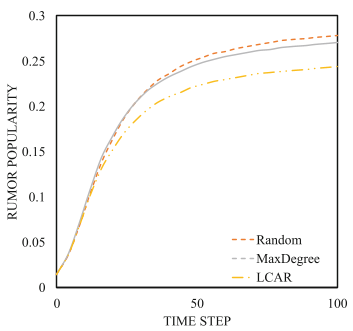 Fig 2: The LCAC Greedy Algorithm vs. Max Degree and Random baselines on real-world data (Twitter/Facebook/YouTube).
Critical Analysis & Conclusion
Takeaway: This work proves that in a multiplex world, "who you know" is less important than "where you are." A node with a medium degree that exists on three platforms is a more valuable anti-rumor seed than a high-degree celebrity on only one platform.
Limitations:
- The model assumes the rumor and anti-rumor share the same propagation characteristics. In reality, rumors (often sensationalist) may have higher "virality" than dry, factual anti-rumors.
- The computational cost of the greedy algorithm, while optimal, may still be high for web-scale networks with millions of nodes.
Future Outlook: This research lays the groundwork for "Cross-Platform Intervention" systems where social media companies might coordinate to suppress disinformation via strategic user education rather than blunt censorship.