
Algorithms as Political Entities: A Left Realist Critique of Machine Learning in Justice
A Left Realist Critique of the Political Value of Adopting Machine Learning Systems in Criminal Justice
2020-01-01
Summary
Problem
Method
Results
Takeaways
Abstract
This paper presents a theoretical critique of adopting supervised machine learning (ML) in criminal justice, viewed through the lens of Left Realism. Rather than focusing on algorithmic fairness (the outcomes), it evaluates the political implications of the decision to use ML, identifying a functional alignment with "law and order" ideologies.
## TL;DR
While the AI community obsesses over "Fairness" metrics (how to make a model unbiased), this paper argues we are missing the bigger picture: **The very decision to use supervised learning in criminal justice is a political choice.** Through the lens of *Left Realism*, the author reveals that standard ML models—which prioritize prediction over cause—implicitly endorse a "law and order" political stance and "military policing" tactics.
## The Illusion of Technical Neutrality
In the current academic climate, "Fairness" is often treated as an optimization problem—a constraint added to a loss function. However, the author, Fabio Massimo Zennaro, argues that technology is never neutral. By framing criminal justice as a functional mapping of $y = f(x)$, we are making a profound political assumption: that crime is a technical problem to be predicted and managed, rather than a social symptom to be understood and prevented.
## The Left Realist Lens
To ground this critique, the paper revives **Left Realism**, a 1980s criminological theory that critiques both:
1. **Left Idealism**: Which views criminals only as victims of the system.
2. **Law and Order**: Which views criminals as deviant individuals to be suppressed by state force.
Left Realism argues that while crime is "real," it must be fought through community consensus and by addressing root causes (marginalization, discontent) rather than just reacting to effects.
## Why Supervised Learning is Politically "Right-Leaning"
The paper identifies several core features of supervised learning that align it with conservative "Law and Order" approaches:
### 1. Correlations vs. Causes
Supervised learning is notoriously **causal-agnostic**. A model might predict recidivism based on features that are merely correlated with crime (like zip codes) without understanding the *why*.
* **Political Meaning**: This focuses on the *effects* of social factors (the crime) while disregarding the *causes* (the socio-economic drivers), a classic hallmark of "law and order" politics.
### 2. The "Fire-Brigade" Mentality (The CCTV Analogy)
The author draws a brilliant parallel to the adoption of CCTV in the 1980s. CCTV allowed police to monitor communities from afar and intervene only when a "fire" broke out. Supervised ML does the same: it processes data remotely, leading to **Military Policing**.
* **The Rift**: This removes the police from the community, relying on "big data" labels rather than consensus-based information gathering.
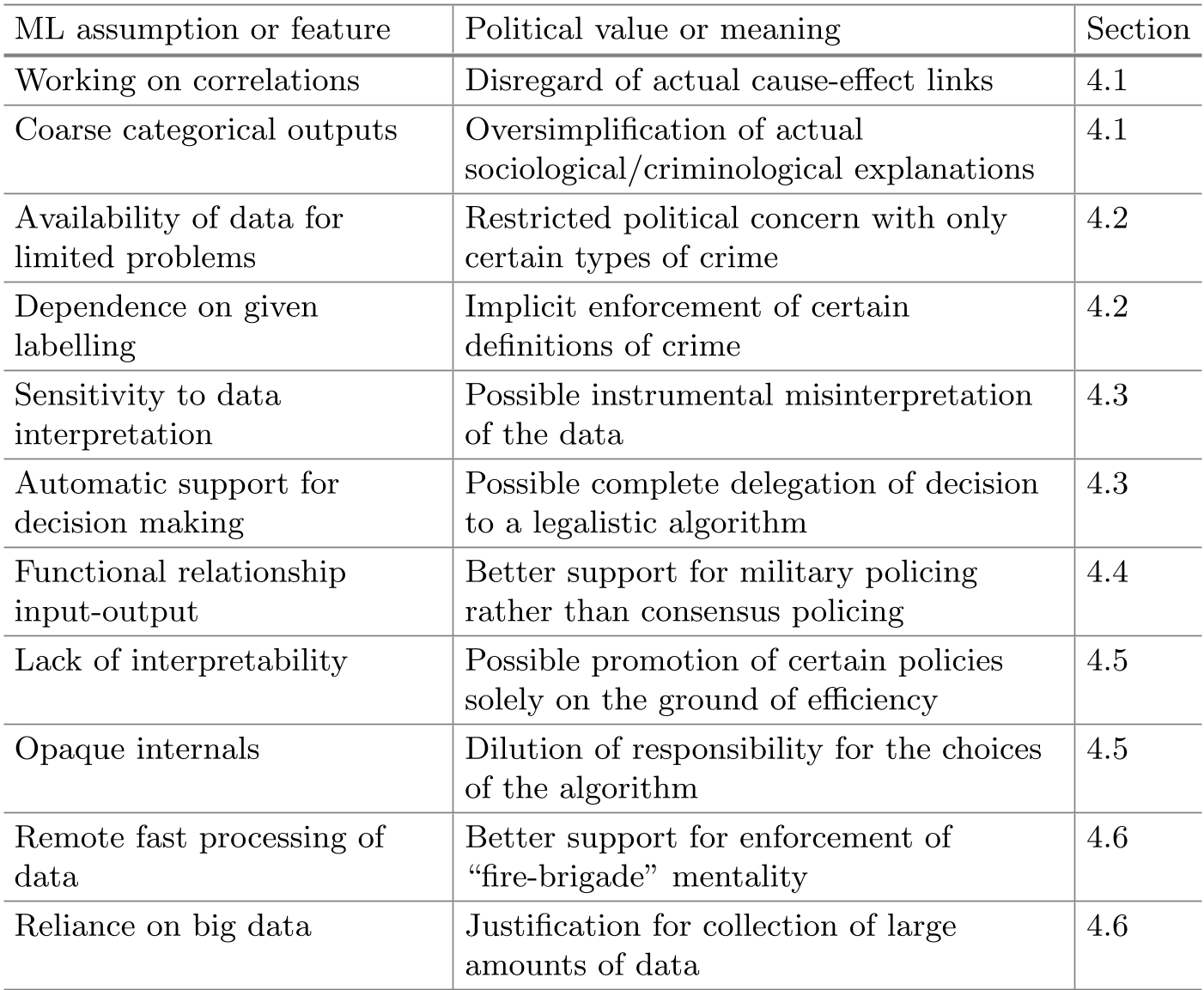
*Table 1: How technical ML assumptions translate into political values.*
### 3. Opacity and the Dilution of Accountability
Modern neural networks are "Black Boxes." When a judge uses an opaque risk score to deny parole, the responsibility shifts from the human decider to the "accurate" algorithm.
* **The Result**: If we cannot explain *why* a decision was made, we cannot have democratic oversight. Trust is built on technical efficiency rather than social consensus.
## Methodology: The Functional Trap
The author defines the standard supervised learning paradigm as:
$$\min \mathcal {L} \left(f (\mathbf {x} _ {i}) - y _ {i}\right)$$
By minimizing this loss, we are essentially training the state to automate its past biases. Because historical data contains the definitions of "crime" provided by existing power structures, the algorithm acts as an **oracle of the status quo**, making it harder to challenge what actually constitutes a crime (e.g., focusing on street crime while ignoring white-collar crime).

## Critical Analysis: Is there a "Left" Machine Learning?
Zennaro does not suggest we abandon ML entirely. Instead, he points toward more "politically aware" technical paths:
* **Causal Machine Learning**: To move beyond correlations and actually inform policy interventions.
* **Interpretable ML**: To restore democratic accountability.
* **Bayesian Approaches**: To better handle the inherent uncertainty in sociological data.
## Conclusion: Beyond Accuracy
The paper serves as a vital warning for AI researchers and policymakers. Efficient algorithms are not always "just" algorithms. When we adopt ML in criminal justice, we aren't just buying a tool; we are buying into a specific political philosophy of how society should be policed. We must stop asking "is this model accurate?" and start asking "does the adoption of this model support the kind of society we want to live in?"
**The Takeaway**: High accuracy is often just a high-tech way of saying "we are very good at repeating the past."