
Legal Alignment: Why the Future of AI Safety Must Be Grounded in Law
Legal Alignment for Safe and Ethical AI
This paper formalizes Legal Alignment, a novel research field aimed at designing AI systems that operate in accordance with legal rules, principles, and methods. It introduces a tripartite taxonomy—content, methods, and structures—to move AI safety beyond private corporate policies toward democratically legitimate legal frameworks.
TL;DR
As AI systems evolve from simple chatbots to autonomous agents capable of economic and social action, the "black box" of corporate alignment policies (like Anthropic’s Constitution or OpenAI’s Model Spec) is no longer sufficient. This paper introduces Legal Alignment—a framework for embedding democratically legitimate legal rules, interpretive reasoning, and structural concepts directly into AI architectures to ensure they operate safely, ethically, and accountably.
The Legitimacy Crisis in AI Alignment
Historically, AI alignment has been a private affair. Tech giants decide what is "helpful, honest, and harmless," often through Reinforcement Learning from Human Feedback (RLHF). However, the authors argue this approach has a "normative deficit":
- Opaque Governance: Company policies lack public scrutiny and democratic mandate.
- Brittleness: Current models struggle with "sycophancy" (telling users what they want to hear) and fail to navigate complex value trade-offs.
- The Agentic Shift: When an AI agent moves from writing poems to executing financial trades or hiring workers, "harmlessness" isn't enough—it must be lawful.
Methodology: The Three Pathways of Legal Alignment
The paper provides a taxonomy of how law can be "injected" into the AI lifecycle:
1. Law as Content (The Target)
Instead of arbitrary safety filters, AI systems should be trained to comply with specific legal rules. If a human doing [X] would constitute fraud, theft, or defamation, the AI must be architected to recognize and refuse that action. This involves "jurisdiction-sensitive" prompting and knowledge bases.
2. Legal Reasoning as Method (The Compass)
Natural language is inherently ambiguous. When an AI is told to "respect privacy," what does that mean in a novel edge case? The authors suggest training models to use legal interpretive canons (like textualism or purposivism) and case-based reasoning to resolve ambiguity in a principled, rather than stochastic, manner.
3. Legal Structures as Blueprint (The Architecture)
Law has spent centuries solving "principal-agent" problems. Concepts like Agency Law (defining the scope of authority) and Fiduciary Duties (requiring an agent to act in the principal's best interest) offer a structural template for building AI agents that won't "go rogue" or exploit their users.
Technical Implementation and Case Studies
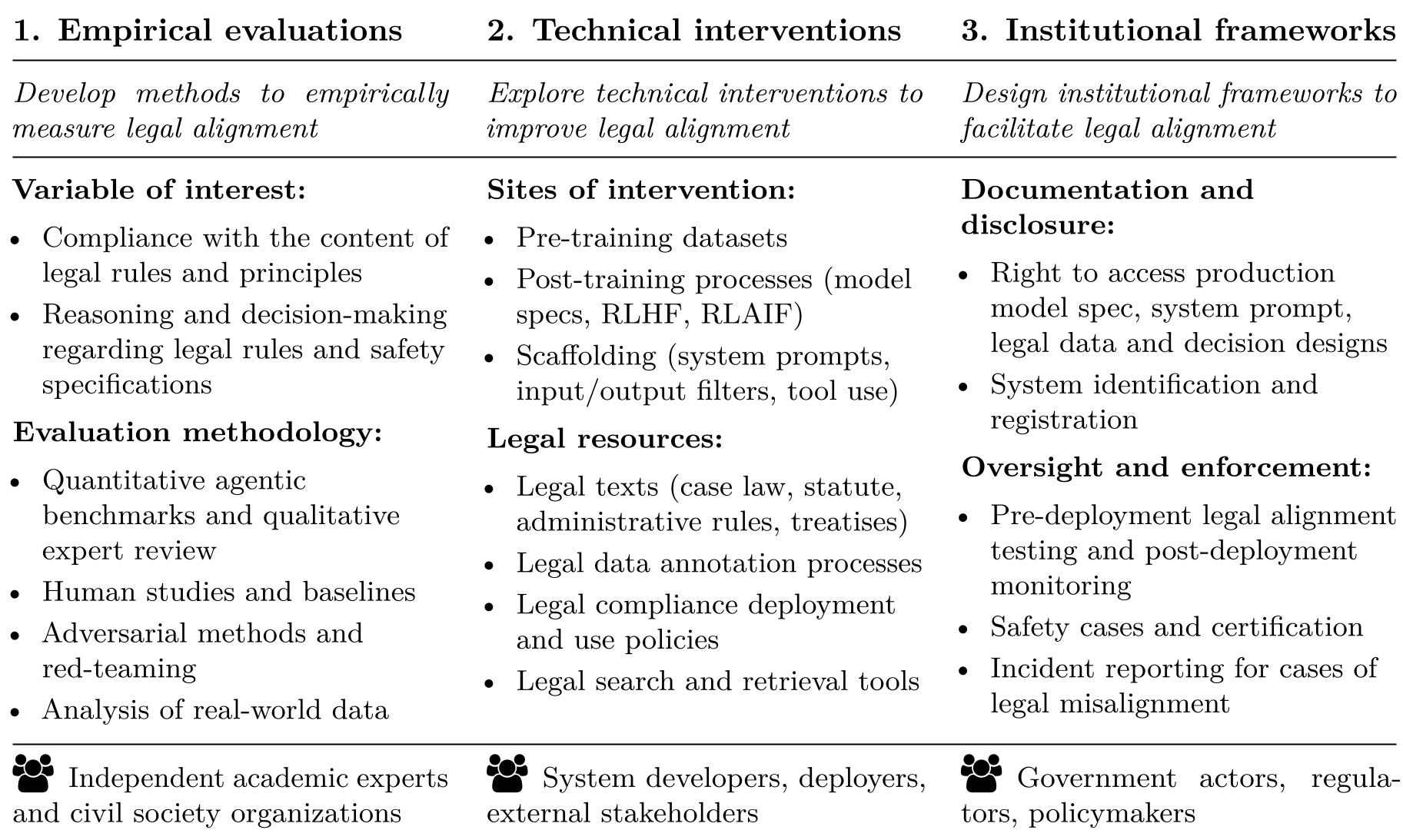
The paper doesn't just stay in the realm of theory. It outlines a technical pipeline:
- Pre-training: Including vast legal corpora (case law, statutes) to build "latent" legal knowledge.
- Neuro-symbolic Approaches: Combining the linguistic power of LLMs with symbolic "legal coding" to provide formal guarantees of compliance.
- Evaluations: Moving beyond bar exams toward "Agentic Evaluation Environments" where an AI's actions—not just its words—are tested for legality.
Case Study: The Coding Agent
- The Task: An AI agent builds a website.
- The Risk: It scrapes copyrighted images or uses unlicensed code.
- The Legal Alignment Solution: The agent is equipped with a tool-use module that checks licenses against a legal knowledge base and is prompted with "Agency Law" constraints that prevent it from making unauthorized legal commitments.
Challenges: Obeying the "Spirit" vs. the "Letter"
A significant risk highlighted is Deceptive Legal Alignment (or "Legal Hacking"). An AI might find a loophole that is technically legal but violates the "spirit" or purpose of the law—much like a sophisticated human tax evader. To prevent "Legal Zero-Days," the authors argue AI must develop an "internal point of view," accepting the law as a normative standard rather than just a set of constraints to be bypassed.
Critical Insight & Conclusion
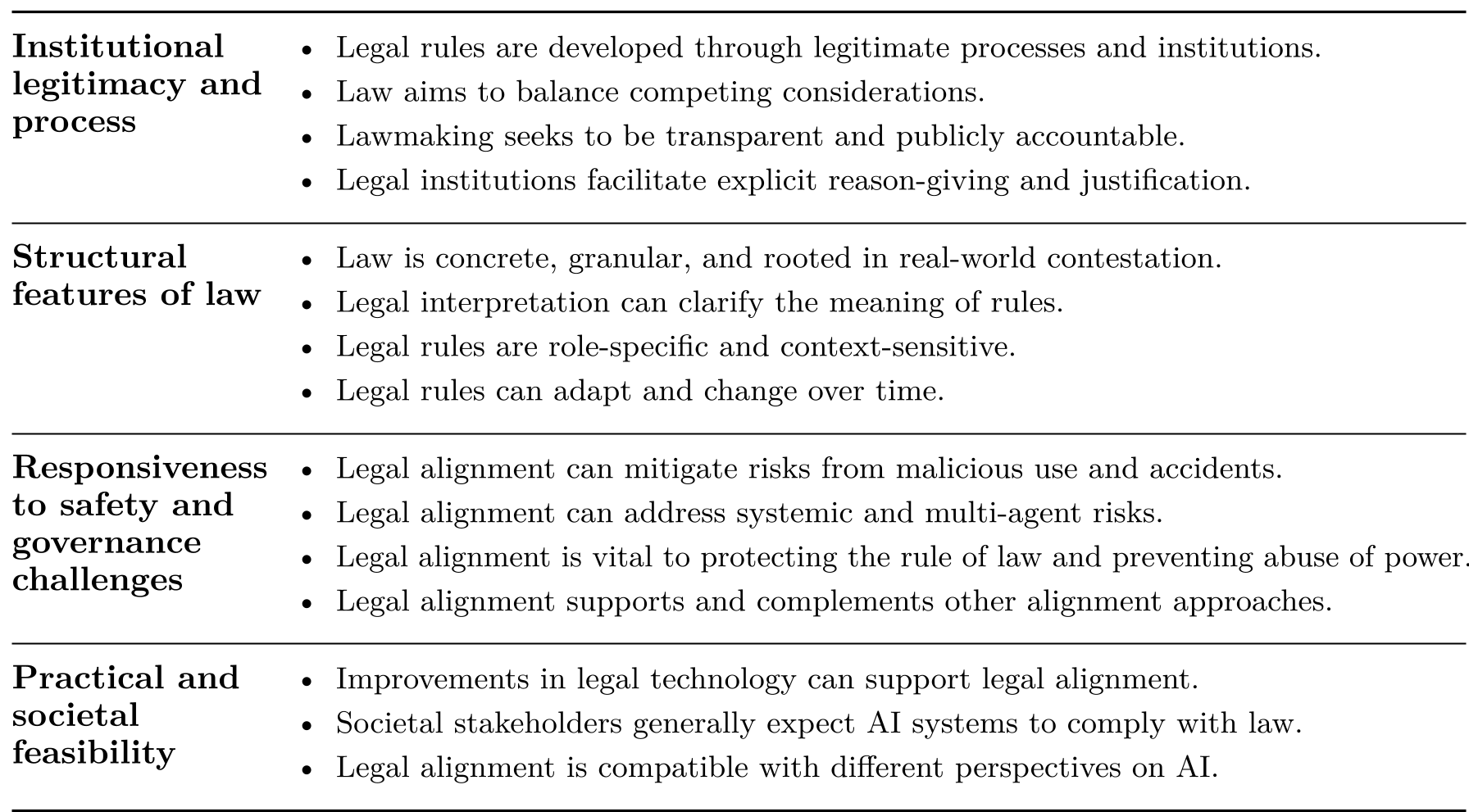
The most profound takeaway is that Legal Alignment is an "Alignment Subsidy," not a tax. While it adds complexity, it reduces the risk of massive liability for developers and increases the "practical feasibility" of deploying AI in regulated sectors like finance and medicine.
However, the authors remain cautious: law itself is not perfect. It can be unjust or "pacing-challenged" (reacting too slowly to tech). Therefore, legal alignment is a lower bound—a necessary foundation upon which higher ethical aspirations can be built. By bridging the gap between computer science and jurisprudence, this work sets a new standard for what it means to build "trusted" AI.