
Legal Intelligence for E-commerce: Fusing Behavior and Law via Multi-task Learning
Legal Intelligence for E-commerce: Multi-task Learning by Leveraging Multiview Dispute Representation
This paper introduces a novel Legal Dispute Judgment (LDJ) prediction task for e-commerce by bridging e-commerce data mining with legal intelligence. It proposes a multi-task learning framework that leverages multiview representations (transaction, buyer, seller, and legal knowledge) to achieve SOTA performance on lawsuit judgment results.
TL;DR
Predicting the outcome of an e-commerce lawsuit is notoriously difficult due to the sparsity of trial data and the complexity of legal reasoning. This paper presents an end-to-end framework, LDJ (Legal Dispute Judgment), which uses millions of "noisy" online dispute records to help a model learn how to predict the final verdict of a "clean" lawsuit. By looking at a case through a "multiview" lens—buyer history, seller credibility, transaction facts, and legal ontologies—the model achieves a new SOTA in automated judicial prediction.
Problem & Motivation: The "Isolated Domains" Gap
Traditional Legal Intelligence (LI) often treats a case as an isolated text document. However, in the e-commerce ecosystem:
- Context Matters: A dispute over a "broken phone" looks different if the seller has a history of fraud or if the buyer is a "professional extortioner."
- The Sparsity Trap: While there are millions of Online Dispute Resolutions (ODR) on platforms like Taobao, only a tiny fraction (thousands) escalate to actual courtrooms. This makes it impossible for standard deep learning models to learn the "trial logic" from scratch.
The authors' insight was to treat ODR data not as a separate entity, but as a precursor to legal judgment, creating a logical bridge between e-commerce behavior and judicial outcome.
Methodology: The Multiview and Multi-task Architecture
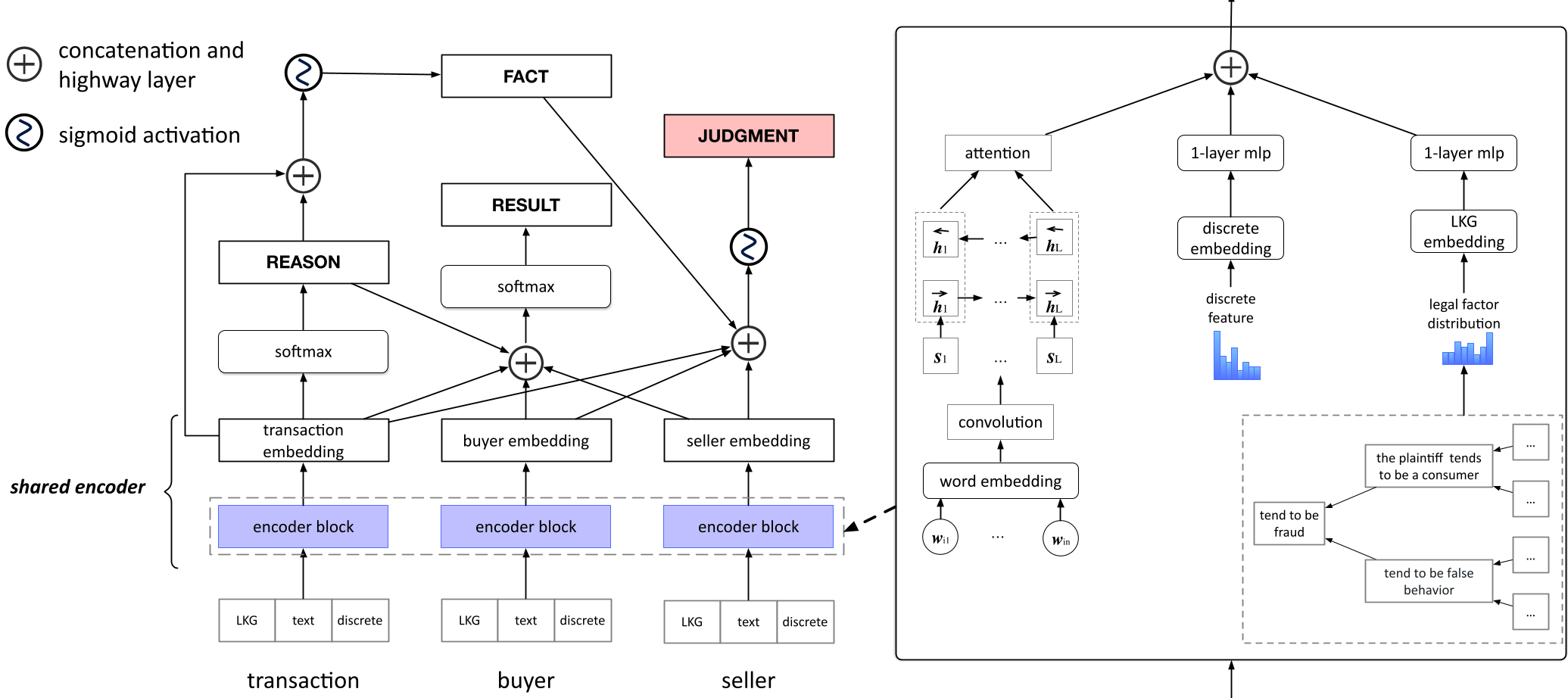
1. Multiview Representation
The model doesn't just "read" the complaint. It represents a case through three pillars:
- E-commerce View: Metadata (price, category) and behavioral history (credit scores, past disputes).
- Textual View: A hierarchical encoder (CNN for words, Bi-GRU + Attention for sentences) to capture the semantic nuance of complaints.
- Legal View: A Legal Knowledge Graph (LKG). The model projects the case text onto a graph of legal concepts (e.g., "False Promotion" "Fraudulent Case") and propagates energy across the graph to extract expert legal features.
2. Multi-task Cascade
Instead of jumping straight to the verdict, the model follows a sequence that mimics human logic:
- Task 1 & 2 (ODR Level): Predict the Dispute Reason and the platform's initial Dispute Result.
- Task 3 & 4 (Lawsuit Level): Predict the Legal Fact (identified by a judge) and the final Judgment (e.g., Triple Compensation).
This cascading structure allows the "Main Task" (Lawsuit Judgment) to utilize the label embeddings of the easier, data-rich subtasks.
Experiments & Results: The Power of Joint Learning
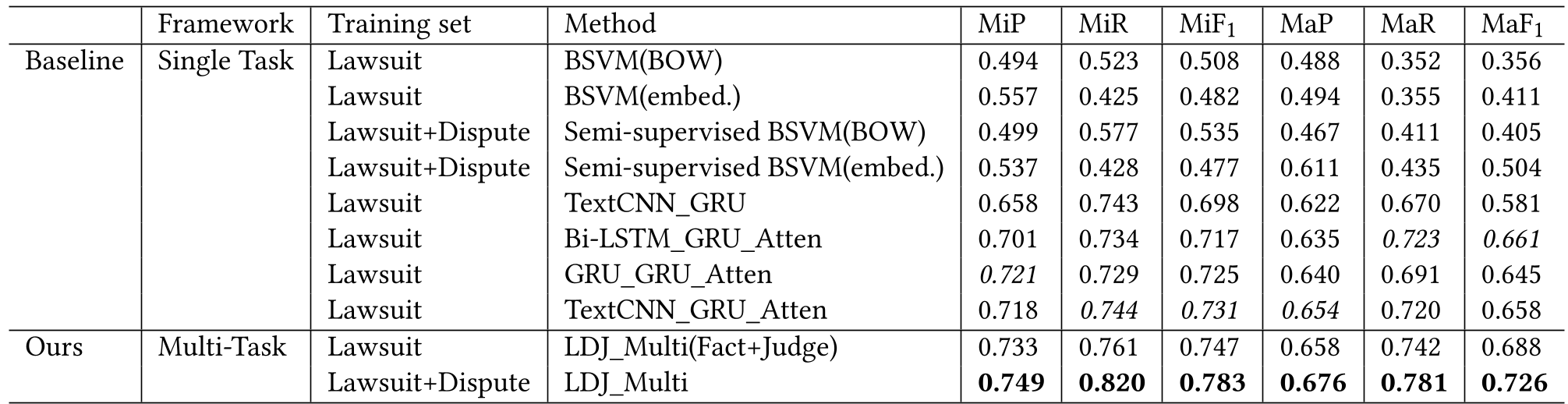
The team evaluated the model on a unique dataset: 400,000 ODR records and 6,858 Supreme Court cases.
- SOTA Achievement: The LDJ model reached a Micro-F1 of 0.783, significantly outperforming traditional SVMs and single-task Deep Learning models like TextCNN and HAN.
- Data Plugin Effect: As shown in Fig. 3, increasing the ODR dispute data steadily improved the performance of the lawsuit prediction, proving that behavior data acts as a powerful regularizer for legal reasoning.
Key Insights from Ablation Study
- Behavioral Features: Removing "Buyer" and "Seller" history caused the highest error spike, proving that in e-commerce law, the identity of the actors is as important as the facts of the transaction.
- Knowledge Graphs: The LKG was particularly vital in the multi-task setting, providing the necessary "legal logic" that raw text alone couldn't provide.
Critical Analysis & Conclusion
This paper is a pioneer in E-commerce Legal Intelligence. Its strength lies in its ability to quantify "litigant reputation" and map it to judicial outcomes.
Limitations:
- The model's reliance on a manually curated LKG might make it hard to scale as laws evolve.
- 70.8% of errors still stem from "Fact Prediction," suggesting that disentangling similar legal concepts (like "fake goods" vs. "infringement") remains an open challenge.
Future Outlook: This research opens the door for "Legal Assistants" in e-commerce apps that can tell a user before they sue: "Based on your history and the seller's past cases, you have an 80% chance of winning a triple compensation claim."