
Bridging Code and Practice: Building a Legal Ontology for E-Commerce
Legal Ontology of Sales Law Application to eCommerce
This paper presents a knowledge-based system that transitions a legal expert system into a structured legal ontology using the Web Ontology Language (OWL) and the Jess inference engine. It specifically targets Article II of the Uniform Commercial Code (UCC) to facilitate automated reasoning in e-commerce transactions.
TL;DR
This research tackles the "open-texture" problem of law by transforming the Uniform Commercial Code (UCC) into a dynamic knowledge-based system. Using OWL and the Jess inference engine, the authors created a prototype that doesn't just read rules—it reasons through e-commerce disputes (like software licensing) by balancing formal statutes with real-world practitioner expertise.
Context: Why Law is a "Hard" Domain for AI
Unlike scientific domains governed by empirical constants, the law is inherently "open-textured." A rule that seems clear on paper often requires the "rich experience of practitioner expertise" to apply in court.
The authors argue that many AI legal systems fail because they focus solely on the formal code. They propose that the UCC (Article II) is the perfect entry point for AI because it is a "composite"—a codification of centuries of actual merchant practice rather than just theoretical legislation.
Methodology: From Expert Systems to Semantic Ontologies
The transition involves moving from 1980s-era deterministic expert systems to a modern Semantic Web approach.
1. The Knowledge Stack
The system is built on a three-tier knowledge hierarchy:
- Formal Statutory Framework: The literal text of the UCC.
- Case Law Interpretations: Adding authoritative detail through precedents.
- Practitioner Heuristics: Capturing the "rules of thumb" used by seasoned lawyers and logistics experts.
2. Implementation with OWL and Jess
The authors used Protégé to build the ontology in OWL (Web Ontology Language). To move from static classification to active reasoning, they integrated Jess, a Java-based rule engine.
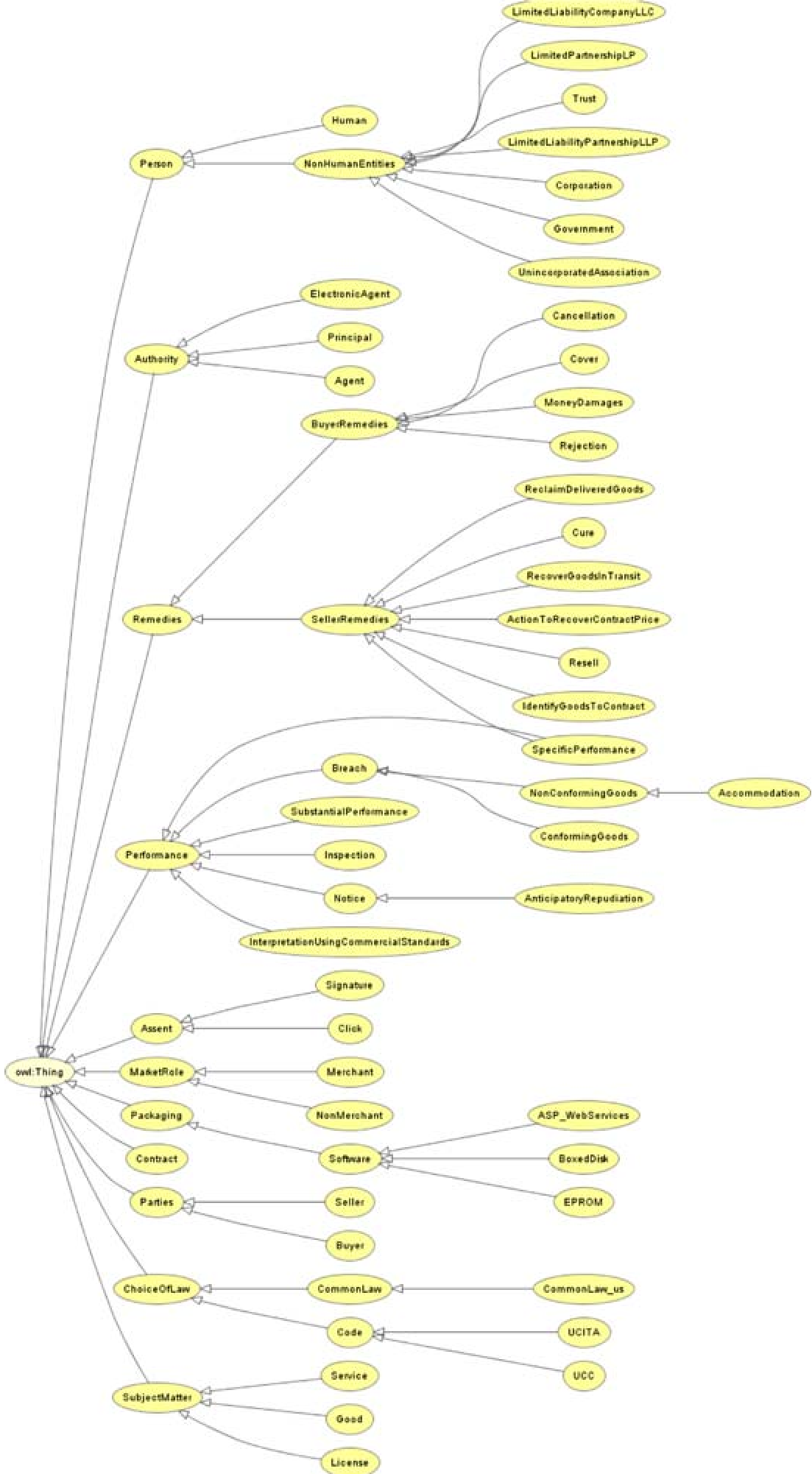 The figure above illustrates the hierarchical structure of the UCC ontology, mapping relationships between contracts, parties (Merchants), and subject matter.
Real-World Simulation: The Netscape Case
To test the system, the authors ran a "real case enhanced hypothetical" based on Netscape v. Specht. The core legal issue was whether "SmartDownload" users were bound by arbitration terms.
The Reasoning Logic:
- Input: Software delivered via "EPROM".
- Inference Rule: If packaging is EPROM, then Subject Matter is "Good".
- Outcome: If Subject Matter is "Good", the Choice of Law is "UCC".
If the system encounters ambiguity (e.g., software that could be a service or a license), it doesn't just fail—it informs the user of the possible legal paths and the implications of each.
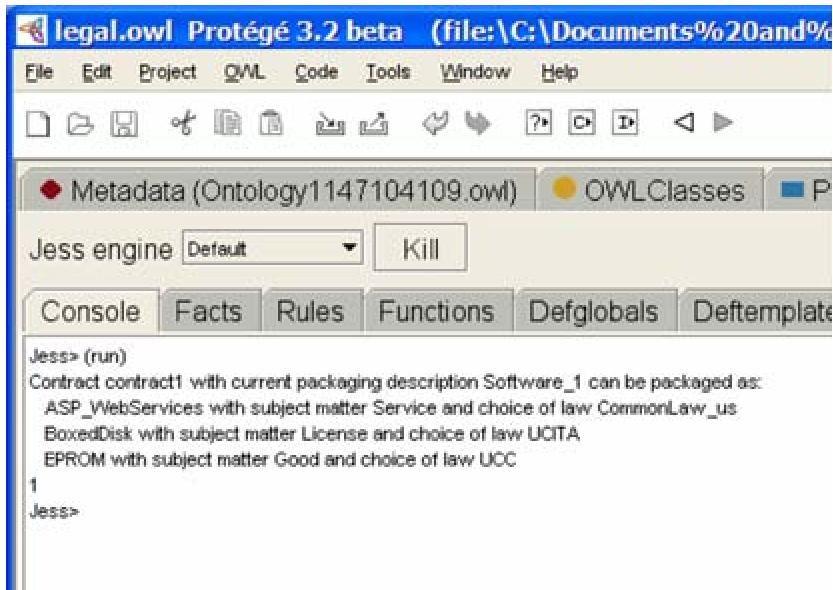 In cases of ambiguity, the Jess engine provides the user with options and highlights the impact of different legal classifications.
Critical Insight: The "Modular" Statute
The most profound takeaway is the authors' defense of the UCC as a "modular" system. Most laws are a "hodgepodge" of political compromise, but the UCC’s organization mimics Object-Oriented Design. This modularity makes it uniquely susceptible to AI modeling, providing a blueprint for how future laws might be drafted to be "machine-readable" from the start.
Conclusion & Future Outlook
This work marks a shift from simple search-and-retrieval to context-sensitive legal advice. While the prototype is focused on US domestic law, the methodology is a precursor to global semantic web applications in international trade (CISG).
Limitations: The authors acknowledge that AI cannot yet fully substitute for a human practitioner, primarily due to the liability risks of "legal malpractice" by an algorithm and the complex social visions (as noted by Judge Posner) that influence high-stakes litigation.
The Future: Integration with "Intelligent Software Agents" that can act as legal persons, negotiating and executing contracts automatically within these ontological boundaries.