
Theory Construction: The Evolution of Value-Based Legal Reasoning
A model of legal reasoning with cases incorporating theories and values
This paper presents a formal model of legal case-based reasoning (CBR) that treats the process as competitive theory construction. It introduces a framework where cases are described by factors, which are linked to social values, and demonstrates how current SOTA CBR approaches (like HYPO and CATO) can be unified under this value-based meta-theory.
TL;DR
In the landmark paper “Reasoning with Cases Incorporating Theories and Values,” Trevor Bench-Capon and Giovanni Sartor redefine legal Case-Based Reasoning (CBR). Instead of seeing law as a static set of rules, they model it as a dynamic process of Theory Construction. By anchoring legal rules in social values (like Economic Productivity or Property Rights), they provide a formal logic to explain why certain precedents "trump" others.
Problem & Motivation: Beyond Simple Rules
The classical view of law is often represented as (Rules times Facts equals Decision). However, this is a mirage. Facts are subject to interpretation, and rules derived from precedents are inherently defeasible—they can be overturned or "distinguished."
Prior systems like HYPO allowed lawyers to find cases with similar factors, but they couldn't explain why a certain difference mattered. The authors argue that the "missing link" is Teleology: the purpose behind the law. Every rule exists to promote a social value. When rules conflict, we aren't just comparing cases; we are comparing the values those cases represent.
Methodology: The Three Levels of Theory
The authors propose a model structured in three hierarchical layers:
- Factors: Raw descriptors of a case (e.g., "Plaintiff was on his own land").
- Rules: Defeasible links between factors and outcomes.
- Values: The social goals promoted by the rules (e.g., Protecting Property).
The Formal Model
The theory is defined as a five-tuple: .
- Rule Preferences () are not arbitrary; they must be justified by Value Preferences ().
- If a court decides for a plaintiff despite a pro-defendant factor, it effectively "abduces" that the value promoted by the plaintiff's factor is currently more important than the defendant's.
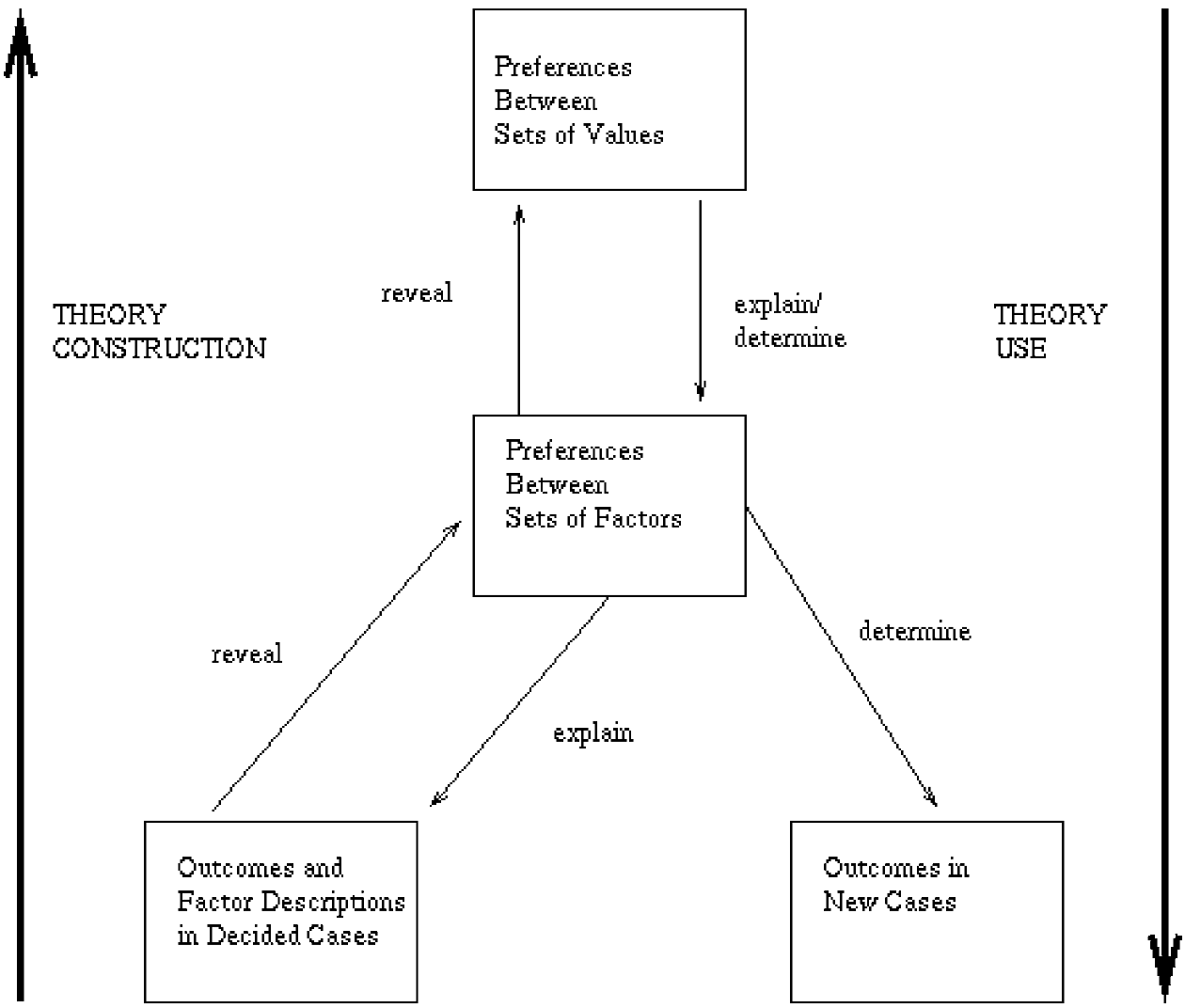 The Figure above illustrates the flow from decided precedents to the abduction of value preferences.
Experiments & Results: The Wild Animal Cases
The authors apply their model to the famous "Wild Animal" cases (Pierson, Keeble, and Young).
- In Pierson, the defendant won because the plaintiff hadn't caught the fox (Value: Less Litigation via clear possession rules).
- In Keeble, the plaintiff won despite lack of possession because he was pursuing a livelihood (Value: Economic Productivity).
By mapping these to a value hierarchy, the model explains Young v. Hitchens (a dispute between commercial fishermen). The defendant wins here because both parties represent Productivity, effectively canceling that value out and reverting to the "clear possession" rule from Pierson.
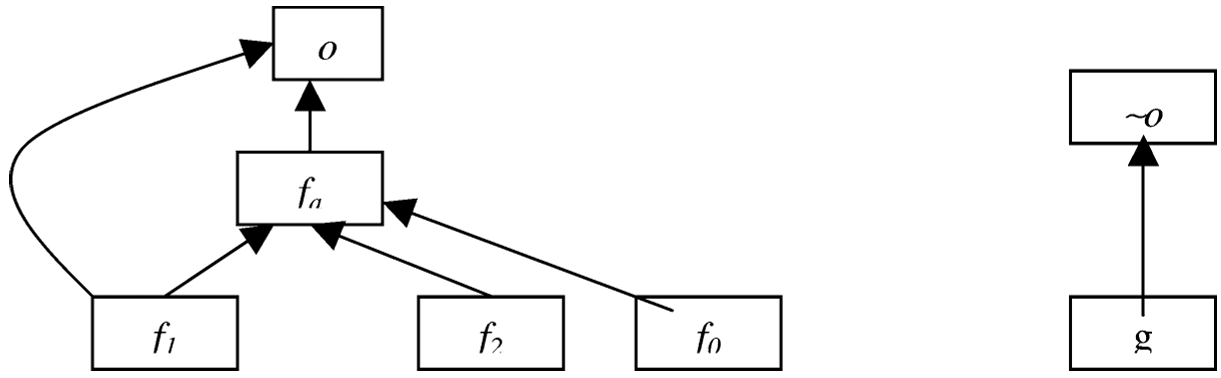 This hierarchy shows how abstract factors allow players to "downplay" distinctions by moving up the tree to common values.
Critical Insight: Safety vs. Simplicity
A key contribution is the evaluation of what makes a "good" legal theory:
- Explanatory Power: Does the theory explain more precedents than the opponent’s?
- Consistency: Is the value hierarchy stable?
- Simplicity vs. Safety: Should a lawyer use a simple rule (fewer factors) or a "safe" rule (incorporating every possible detail to preempt distinctions)?
Conclusion & Future Outlook
This paper transitioned AI and Law from symbolic logic to Evaluative Argumentation. It proved that legal "truth" is not discovered but constructed through the most coherent theory.
Limitations: The model assumes a fixed set of values. In reality, societal values shift over time (e.g., the shift from "Productivity" in hunting to "Ecological Preservation"). Future work involves creating dynamic "quantifiable coherence" metrics to allow AI to judge which theory a human court is most likely to accept based on current social trends.