
Lensing in the Blue: How SuperBIT is Rewriting Cluster Cosmology from the Stratosphere
This paper presents the weak gravitational lensing shape catalogs for 30 merging galaxy clusters imaged by the Super-pressure Balloon-borne Imaging Telescope (SuperBIT) during its 2023 flight. By operating in the stratosphere, SuperBIT achieved near-space quality, diffraction-limited imaging, utilizing a novel gridded metacalibration technique to reconstruct unbiased weak-lensing signals.
TL;DR
The SuperBIT collaboration has released a definitive weak-lensing shape catalog for 30 merging galaxy clusters. By flying a 0.5m telescope at 33km altitude—above 98% of the Earth's atmosphere—SuperBIT captured near-space quality images in the UV and blue bands. Their novel gridded metacalibration approach reduced shear bias to just 1.1%, proving that balloon-borne platforms can match space-based precision at a fraction of the cost.
Background: The High-Altitude Advantage
Weak gravitational lensing is the "gold standard" for weighing the universe's most massive structures: galaxy clusters. However, measuring the tiny, percent-level distortions (shear) in galaxy shapes is notoriously difficult. Ground-based telescopes are hindered by atmospheric turbulence (seeing), which blurs galaxies, while space missions like Hubble are expensive and oversubscribed.
SuperBIT (Super-pressure Balloon-borne Imaging Telescope) occupies a unique niche. By operating in the stratosphere, it avoids atmospheric blurring and benefits from a much darker sky in the blue and near-UV wavelengths. This "Lensing in the Blue" strategy allows for higher resolution and deeper imaging of faint background galaxies.
The Technical Challenge: Modeling the PSF
In weak lensing, the shape we see is a convolution of the true galaxy shape and the telescope's Point Spread Function (PSF). If your PSF model is slightly off, your mass estimate for the cluster will be wrong.
The authors used a multi-stage PSF pipeline:
- PSFEx: To model spatial variations across the wide 0.1 deg² field of view.
- ngmix: To represent these PSFs as a mixture of Gaussians for forward-modeling galaxy shapes.
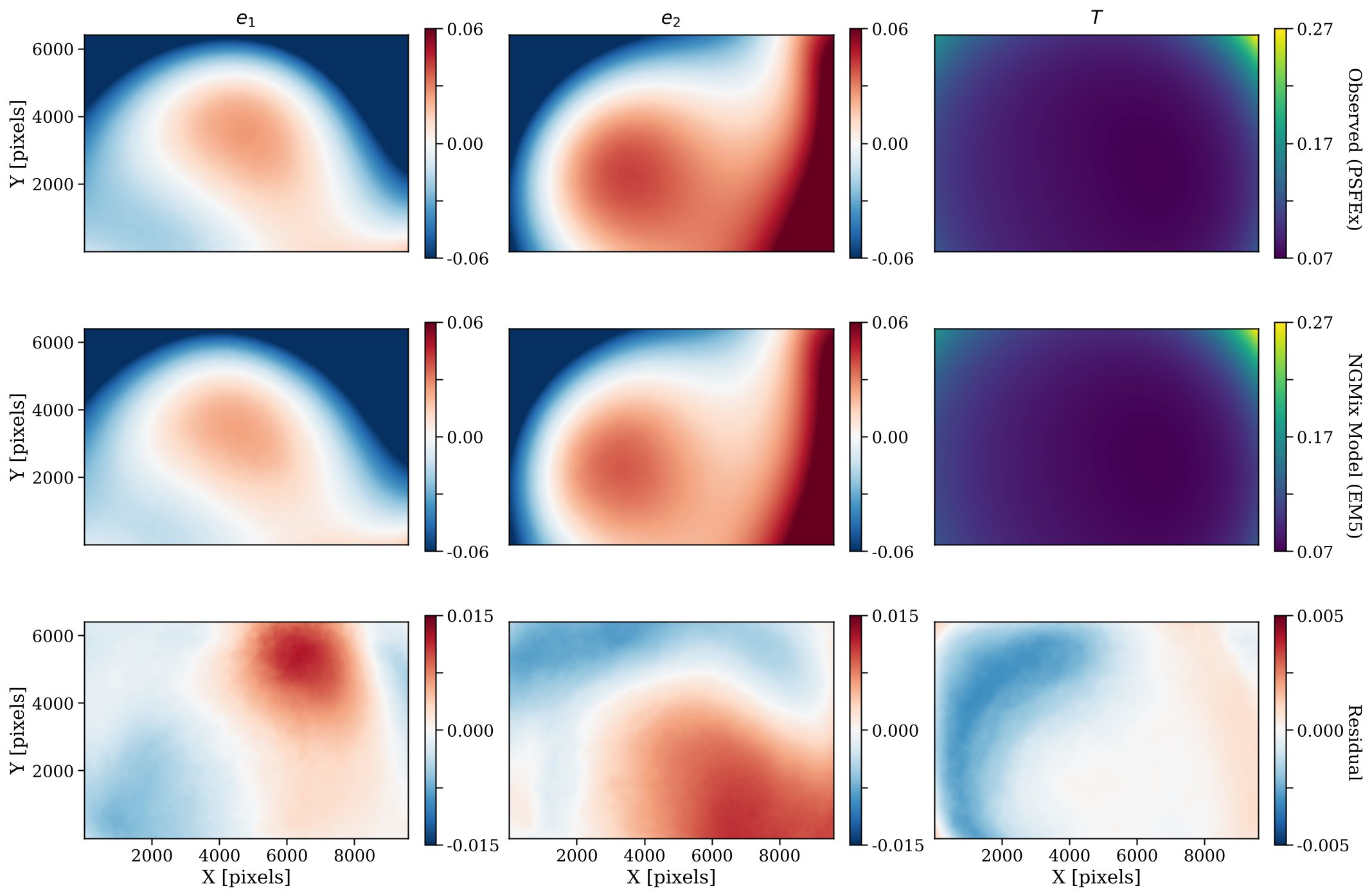 Figure: The pipeline transition from raw stellar images to the high-fidelity PSFEx model and the ngmix Gaussian-mixture representation used for deconvolution.
Despite the high-frequency structure in the stratospheric PSF (unfiltered by the atmosphere), the authors demonstrated via -statistics that their residuals were well within the "safe zone" for cosmological analysis.
Methodology: From Global to Gridded Metacalibration
The core of the shape measurement uses Metacalibration. Instead of relying on simulations to understand how a shape measurement responds to shear, Metacalibration shears the actual data mathematically to measure the "Response" ().
The breakthrough in this paper (Paper III) is the move to a Gridded Response Calibration.
- The Problem: Global averages of the response matrix often hide biases caused by source blending and varying SNR.
- The Solution: The team binned galaxies in a 2D space of SNR and Size Ratio (). This granular approach allowed them to calibrate shapes based on their specific measurement quality.
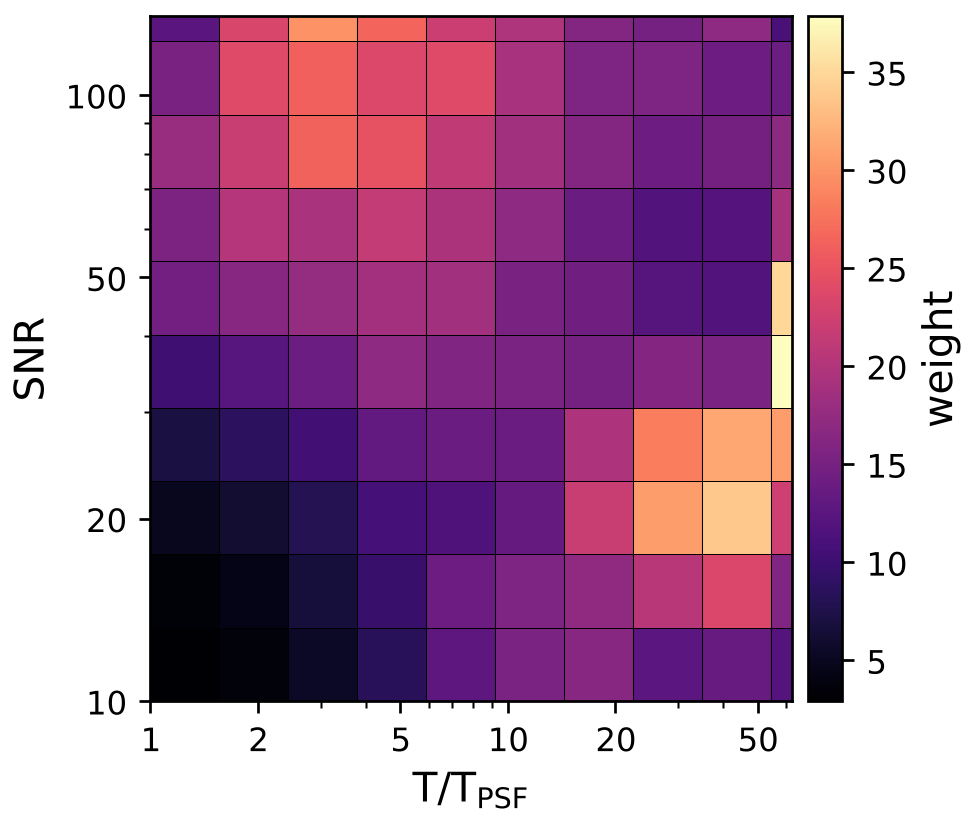 Figure: The 2D parameter space (SNR vs Size Ratio) used to assign weights and calculate the gridded shear response.
Experimental Validation: Simulations vs. Reality
To prove the pipeline works, the team created Fiducial Simulations using real COSMOS galaxy populations and actual SuperBIT flight PSFs.
The results were striking:
- Conventional Calibration: Left a significant bias in the shear signal.
- Gridded Calibration (New): Reduced the bias to a negligible .
This confirms that the gridded approach successfully accounts for the "noise bias" and "selection bias" that typically plague weak lensing surveys.
Insights & Future Outlook
This shape catalog is more than just a list of ellipticities; it is a proof of concept for a new era of "near-space" astronomy.
Key Takeaways:
- Cost-Efficiency: SuperBIT achieved sub-arcsecond stability ( focal-plane stability) comparable to space missions but at a balloon-borne price point.
- Blue Spectrum Utility: Blue/UV lensing provides a higher density of background sources, crucial for mapping dark matter in cluster mergers like the famous Bullet Cluster.
- Next Steps: The team is now moving toward Paper IV, which will release the high-resolution "Convergence Maps"—visualizing the dark matter distribution itself—and investigating dark matter self-interaction ().
Conclusion
The SuperBIT Lensing in the Blue series demonstrates that by combining clever mechanical stabilization with advanced statistical calibration (like gridded metacalibration), we can probe the dark side of the universe with unprecedented clarity. The release of these shape catalogs for 30 merging clusters marks a significant milestone for both balloon-borne instrumentation and gravitational lensing science.