
From the Wild West to Curated Wisdom: Why ML Data Needs Archival Rigor
Lessons from Archives: Strategies for Collecting Sociocultural Data in Machine Learning
The paper "Lessons from Archives" identifies critical flaws in machine learning data collection and proposes a new subfield focused on data methodologies. It draws direct parallels between sociocultural ML data and the centuries-old practices of archival science to address fairness, accountability, and transparency.
TL;DR
Data collection is the "forgotten" stage of the Machine Learning pipeline, yet it is where most ethical failures begin. This paper argues that ML should stop reinventing the wheel and instead adopt the rigorous, interventionist strategies of Archival Science. By shifting from a "Laissez-Faire" web-scraping culture to a curated, professionalized approach, the ML community can better address issues of consent, power, and representation.
The "Laissez-Faire" Crisis
Most modern ML datasets are built on the "Wild West" model: scrape as much as possible, as fast as possible. This approach assumes that volume equals neutrality. However, the authors point out two insidious forms of bias that scale cannot fix:
- Historical Bias: Structural inequities in society (e.g., a lack of women in historical leadership roles) being baked into the data.
- Representational Bias: The gap between the real world and the digital world (e.g., certain cultures being stigmatized against sharing photos online).
When we use "natural" datasets like Reddit or Flickr, we aren't getting a mirror of humanity; we are getting a mirror of a specific, internet-active demographic.
Methodology: The Interventionist Shift
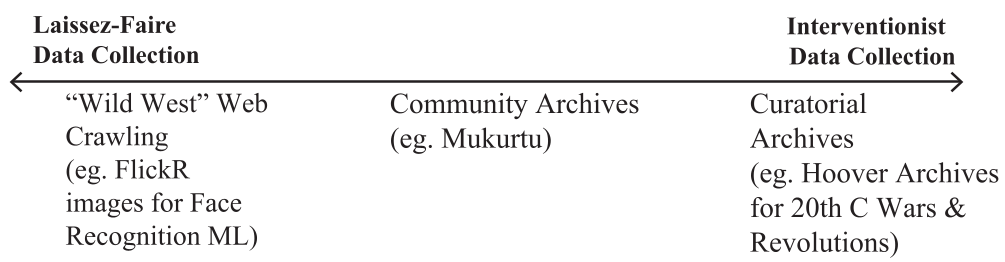
The core proposal is to move toward Interventionist Data Collection. Unlike the passive crawling of the web, this method requires intent and oversight at every step.
The Archival Spectrum
The paper places data collection on a spectrum of supervision:
5 Pillars of Ethical Data
- Inclusivity through Mission Statements: Instead of collecting data based on "what is available," researchers should start with a public commitment to what should be represented.
- Consent via Community Archives: Moving from extractive crowdsourcing to participatory models like Mukurtu, where communities own and label their own cultural data.
- Power via Data Consortia: Establishing library-style networks to share the high cost of ethical data management, preventing large tech firms from monopolizing "clean" data.
- Transparency through Appraisal: Keeping "process records" of why certain data was kept or discarded.
- Ethics via Professionalization: Treating data collection not as a chore for an intern, but as a full-time career with a professional code of conduct and license.
Case Study: Re-evaluating GPT-2's WebText
The authors apply their framework to OpenAI's GPT-2. While GPT-2's creators were transparent about some biases, the training data (WebText) was largely "Laissez-Faire," relying on Reddit upvotes as a proxy for quality.
By applying an archival lens, the authors reveal that WebText inherently excludes generations that don't use Reddit, rural populations with low internet access, and non-Western linguistic structures. They propose that a "Mission Statement" for such a dataset would force researchers to acknowledge these gaps upfront, rather than discovering them after the model is deployed.
Experimental Insights: Multi-Layer Supervision
One of the most radical suggestions is the adoption of committee-based data collection. In archives, appraisal isn't done by one person; it goes through a hierarchy:
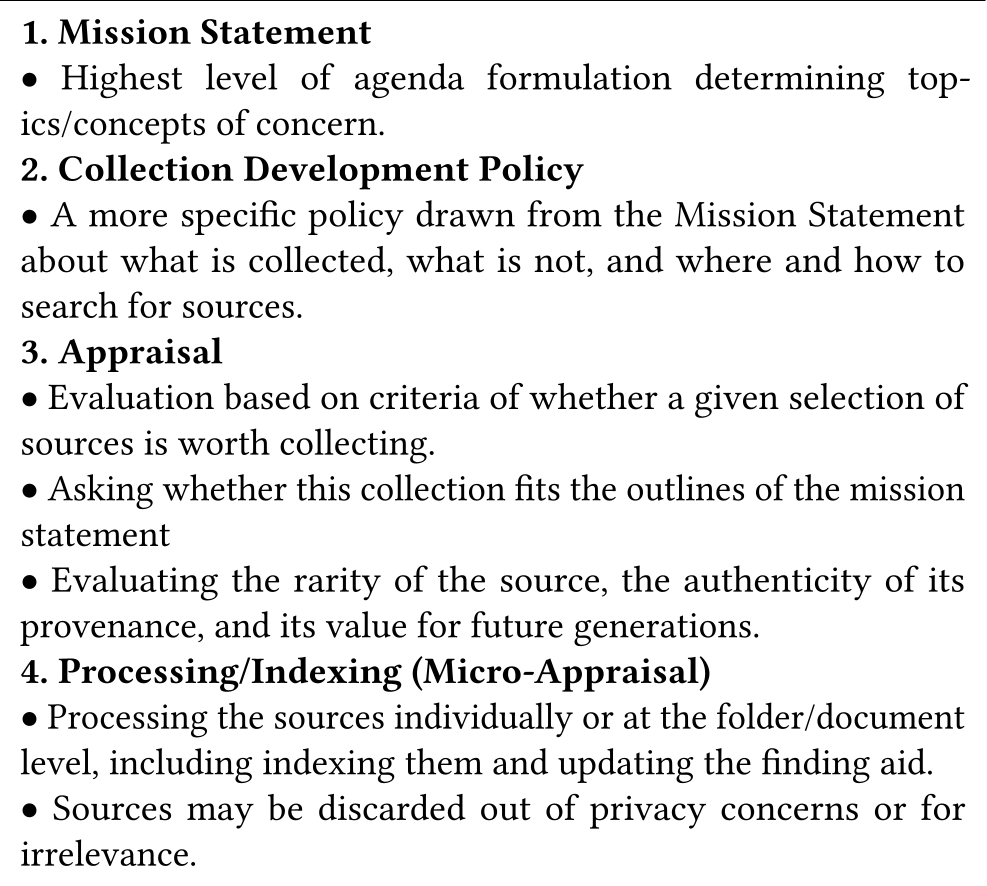
This structure ensures that the "value" of data is weighed against privacy and ethics by multiple experts before it ever reaches a training script.
Critical Analysis & Conclusion
Takeaway
The ML community currently views data as a raw commodity to be mined. This paper demands a paradigm shift: Data is a sociocultural record. By adopting the institutional frameworks of archives, we can transition from unintentional bias to intentional representation.
Limitations
The primary hurdle is cost. Archival methods are slow and expensive, which runs counter to the "move fast and break things" ethos of AI development. However, as the authors argue, the "cost" of biased, harmful AI—resulting in lawsuits, broken trust, and societal harm—is far higher.
Future Outlook
We expect to see the rise of "Data Curators" as a standard role in AI labs, and perhaps the birth of national AI Data Archives that function with the same public-trust mandate as the Library of Congress.