
Lessons from Scranton: Using 'The Office' to Solve the Workplace Communication Disconnect
Lessons from Scranton: Using Scenes from the Television Series The Office to Teach Topics in Professional Communication
This paper explores "Pedagogy in Professional Communication," introducing a method that utilizes scenes from the TV series The Office to bridge the gap between academic learning and workplace application. By integrating comedic clips with structured exercises, the authors address critical topics such as negative messages and intercultural communication, achieving high student satisfaction and conceptual retention.
Executive Summary
TL;DR: This paper tackles the age-old problem of why "A" students in English often struggle in the boardroom. By using specific, bumbling scenes from the US version of The Office, the authors transform the classroom into a laboratory for analyzing "communication gone wrong," providing students with a memorable framework for negative messaging and intercultural awareness.
Positioning: This is a Pedagogical Case Study that moves beyond traditional lecturing. It situates itself as a bridge between cognitive theory (Dual-Coding) and practical instructional design, proving that humor is a serious tool for professional development.
The "Digital Native" Paradox: Problem & Motivation
Despite being "digital natives" who communicate constantly, new employees are frequently criticized by employers for poor written communication. The root cause is a contextual disconnect. In school, communication is a grade; at work, it’s a tool for managing relationships and policy. Students often find textbooks dry and "irrelevant" to the chaotic, personality-driven reality of a real office.
The authors' insight was simple: use a "mockumentary" that highlights these chaotic realities to trigger Dual-Coding Engagement—where the brain processes the visual humor and the verbal lessons simultaneously, leading to superior retention.
Methodology: The Scranton Method
The authors didn't just "watch TV" in class. They integrated clips into a rigorous 3-step pedagogical cycle:
- Observation: Watching a specific failure (e.g., Michael Scott delegating "bad news" about health care to an incompetent subordinate).
- Analysis: Using professional heuristics (like Locker & Kienzler’s audience analysis) to dismantle why the characters failed.
- Application: Asking students to write the "Before" memo (as it appeared in the show) and a "Corrected" version based on their analysis.
Key Instructional Framework
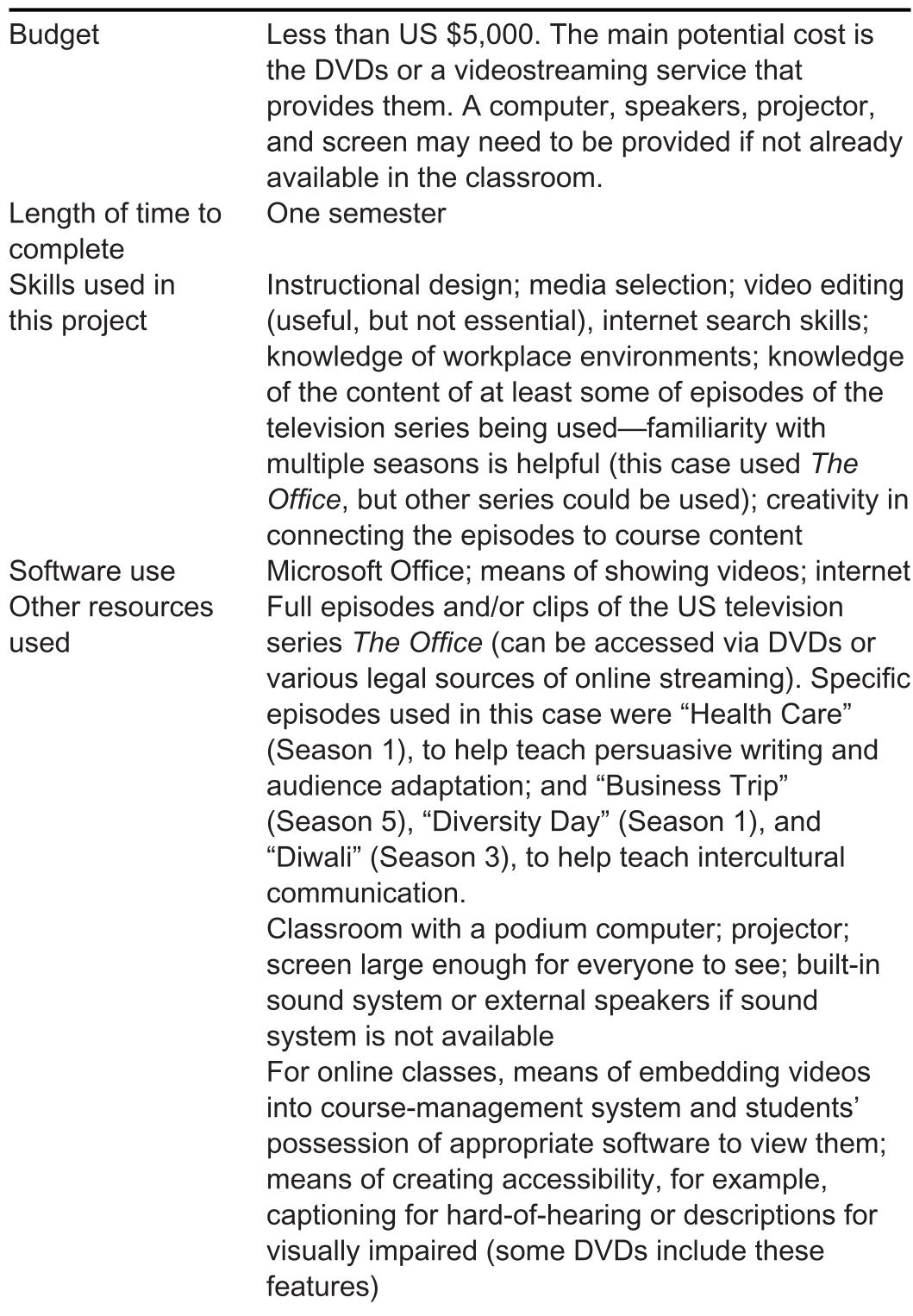 The budget and resources required are minimal, yet the instructional impact relies heavily on the "Creative Connection" made by the instructor.
The study utilized episodes like "Diversity Day" and "Diwali" to tackle intercultural issues. Instead of lecturing on stereotypes, students watched Michael Scott commit every possible cultural blunder, providing a safe, comedic space to discuss sensitive workplace topics without the students feeling attacked or defensive.
Experiments & Results: Does It Work?
The results were remarkably consistent across different units. Students didn't just enjoy the clips; they found them functionally useful for learning.
Student Reception Metrics
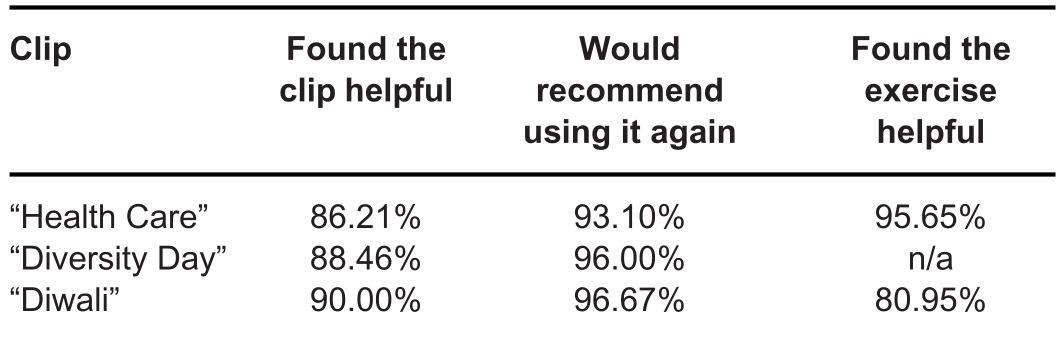 Approval ratings for the "Health Care" and "Diversity Day" modules hovered between 86% and 96%, indicating that students recognized the pedagogical value, not just the entertainment value.
Ablation Study of Interest: When asked why it worked, three themes emerged:
- Relatability: It made "textbook concepts" feel like "real-life issues."
- Physical Intuition: Seeing the reaction of the employees in the show helped students understand the "human cost" of a poorly written memo.
- Mnemonic Strength: Students reported they could "see the scene" when trying to remember how to structure a buffer for a negative message.
Critical Analysis & Conclusion
Takeaway
The paper confirms that Visual Evidence of failure is often more instructive than a list of "Best Practices." By using The Office, educators can leverage a shared cultural vocabulary to teach the high-stakes "Inductive Bias" that experienced professionals use to navigate office politics.
Limitations
The study relies on self-reporting. While students felt they learned more, the study did not objectively measure if their final writing quality was superior to a control group. Furthermore, humor is subjective; a small minority of students found certain clips "insulting" or "confusing," highlighting the need for careful instructor framing.
Future Outlook
As the workplace moves toward remote/hybrid models, how do these "Scranton lessons" translate? Future research should look at using series like Silicon Valley or Severance to teach professional communication in the tech era, or even using "VR Roleplay" to let students enter the Scranton office and fix the memos themselves.