
CSCER: Optimizing Crowdsourced Joins via Hybrid Attribute-Based Pruning
Leveraging Attributes and Crowdsourcing for Join
The paper introduces CSCER (Category-Sorting-Clustering Entity Resolution), a hybrid framework designed to optimize crowdsourced join operations. By integrating category filtering, sliding-window sorting, and distance-based clustering, the method significantly reduces the number of candidate pairs requiring human verification while maintaining high recall.
TL;DR
Joining datasets is easy for machines but accurate entity matching is hard. Crowdsourcing solves the accuracy problem but creates a cost nightmare due to the pair comparison problem. This paper presents CSCER, a framework that uses Category, Sorting, and Clustering techniques to slash the number of pairs sent to human workers by over 99% while maintaining 98%+ accuracy.
Context & Motivation
In the world of data cleaning, the "Join" operation is the "Final Boss." When records like "iPhone 13 Black" and "Apple iPh 13 (Midnight)" exist in different databases, machines often fail to realize they are the same entity.
Crowdsourcing platforms (like CrowdFlower) provide the human intelligence needed to bridge this gap. However, if you have 10,000 records, a naive pairwise comparison generates 50 million pairs. At even a penny per task, the cost is astronomical. The challenge is: How can we filter out the "definitely not a match" pairs automatically so we only pay humans to look at the "maybe" ones?
The Hybrid Insight: How CSCER Works
The authors argue that standing on one leg isn't enough. Categorization alone leaves too many records in one bucket; Sorting alone (using a sliding window) misses matches if the sorting key is slightly off.
CSCER combines three layers of filtration:
- Category Step: Records are partitioned into buckets based on "hard" attributes (e.g., Device Brand).
- Sorting Step: Inside each bucket, records are sorted (e.g., by price or model number), and a sliding window () generates candidate pairs.
- Clustering Step: A distance threshold () is applied. If the distance between adjacent sorted records exceeds the threshold, the window is broken, preventing nonsensical comparisons.
Adaptive Attribute Selection
One of the smartest parts of the paper is the Adaptive Strategy. Not all attributes are created equal. Some are good for sorting (numeric values), others for categorizing (enums). CSCER uses an algorithm to decide which attribute performs which role based on the entropy and distribution of the data, ensuring the most efficient pruning path.
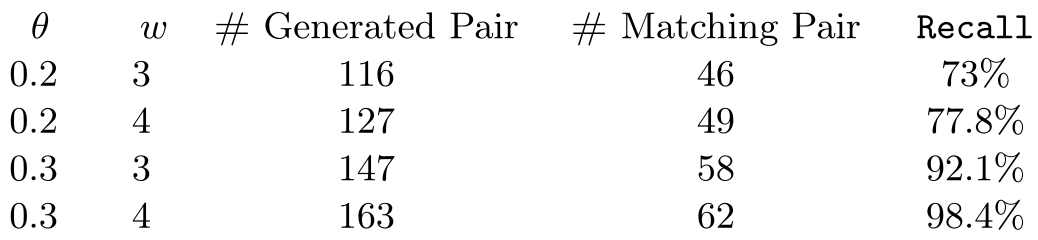 Table showing how varying the distance threshold () and window size () affects pair generation and recall.
Experimental Breakdown
Using an electronic product dataset with 338 records, the results were stark:
- Naive Approach: 56,953 pairs (Too expensive).
- Category-based: 1,219 pairs (High recall, but still too many).
- Sorting-based: ~1,000 pairs (Very low recall, ~28%).
- CSCER (Optimal): 163 pairs (98.4% Recall).
By utilizing Weighted Majority Voting (Weighted MV) to aggregate worker answers, the authors achieved near-perfect accuracy on the final join, proving that a smaller, high-quality set of pairs leads to better results than a massive, noisy one.
 Comparison of baseline methods vs CSCER's efficiency.
Critical Insight & Conclusion
The true value of CSCER lies in its cascading filter architecture. By moving from coarse-grained (Category) to fine-grained (Clustering) filters, it manages the trade-offs between precision and recall effectively.
Limitations: The method relies heavily on pre-defined distance measures and attribute types. In a modern context, integrating LLMs (Large Language Models) to handle the "attribute distance" calculation might further increase the robustness of the clustering phase, especially for messy, unstructured text.
Final Takeaway: Don't just throw data at the crowd. Smart pre-processing isn't just an optimization; it's a financial necessity for scalable human-in-the-loop systems.