
Fine-Grained Privacy: Balancing Sensitive Content and User Trust in Social Image Sharing
Leveraging Content Sensitiveness and User Trustworthiness to Recommend Fine-Grained Privacy Settings for Social Image Sharing
This paper introduces a holistic framework for recommending fine-grained privacy settings in social image sharing by simultaneously analyzing image content sensitiveness and user trustworthiness. The authors employ deep multiple instance learning (MIL) to detect 280 privacy-sensitive objects/events and utilize spectral clustering for user trustworthiness, ultimately integrating these via a tree classifier.
TL;DR
The explosion of social image sharing necessitates smarter privacy tools. This paper moves beyond binary "Public/Private" toggles by proposing a system that analyzes what is in the image (280 sensitive object classes) and who is requesting access (user trustworthiness). By combining deep learning with hierarchical tree classifiers, the authors provide a transparent, fine-grained recommendation engine that outperforms generic visual models.
Problem & Motivation: The Gap Between Content and Context
Current social platforms often burden users with tedious manual privacy configurations. Existing automated systems suffer from two main flaws:
- Contextual Blindness: They look at the image content (e.g., "it's a beach photo") but ignore the recipient (is it my mother or a stranger?).
- Semantic Gap: Generic deep features (like those from AlexNet trained on ImageNet) are great at recognizing "dogs" or "cars," but they don't inherently understand "privacy sensitiveness," such as a prescription bottle in the background or a specific facial expression.
The authors argue that privacy is a function of both the sensitiveness of the visual data and the reliability of the observer.
Methodology: The Dual-Track Approach
1. Representing Image Sensitiveness
The authors propose two ways to "see" privacy:
- Feature-based: A customized CNN (scaling down AlexNet's fully connected layers to 1024-D) fine-tuned on privacy-labeled data.
- Object-based: This is the core innovation. Using Deep Multiple Instance Learning (MIL), the model identifies 268 sensitive object classes and 12 event types. This allows the system to explain why an image is sensitive (e.g., "Contains identifiable personal tags").
 Fig 1: The overall framework integrating content analysis and user grouping.
2. Characterizing User Trustworthiness
Trust isn't just a "friend" label. The system analyzes:
- Interaction intensity and relationship closeness.
- Topic matching (similarity between user interests and image content).
- Reputation and stability of social behavior. Users are clustered into representative groups (e.g., "altruistic," "cynical") to create a trustworthiness dictionary.
3. The Tree Classifier: Making the Decision
Instead of a simple flat classification, the authors use a Tree Classifier. At each branch, the system determines whether the "Content" or the "User" is the more discriminative factor for that specific case. This allows for fine-grained outputs: {completely-share, not-share, partially-share, share-with-blurring}.
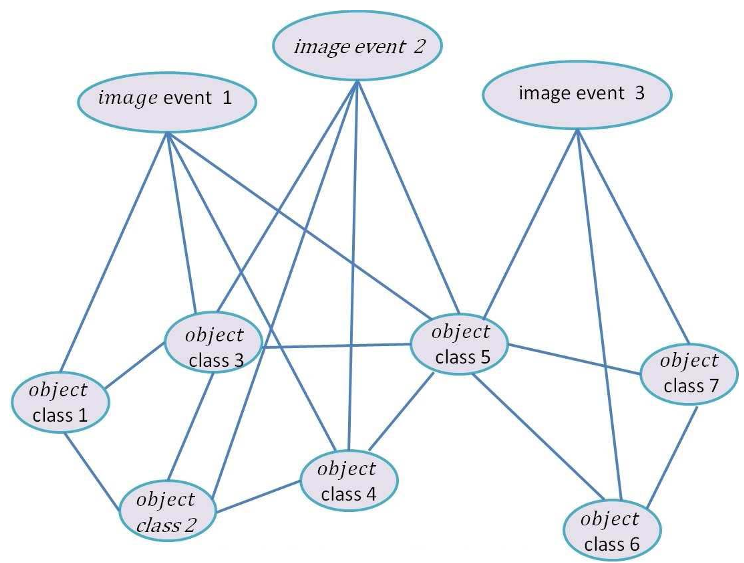 Fig 2: Two-layer CRF models used to infer privacy-sensitive events from object co-occurrences.
Experiments and Performance
The system was stress-tested against 90,000 test images. The results showed that:
- Deep features specifically tuned for privacy outperformed standard visual features (SIFT, GIST) and generic deep features.
- Interpretability: In user studies, the object-based approach was rated significantly higher because it could point to specific sensitive regions (e.g., a person's face or a location tag).
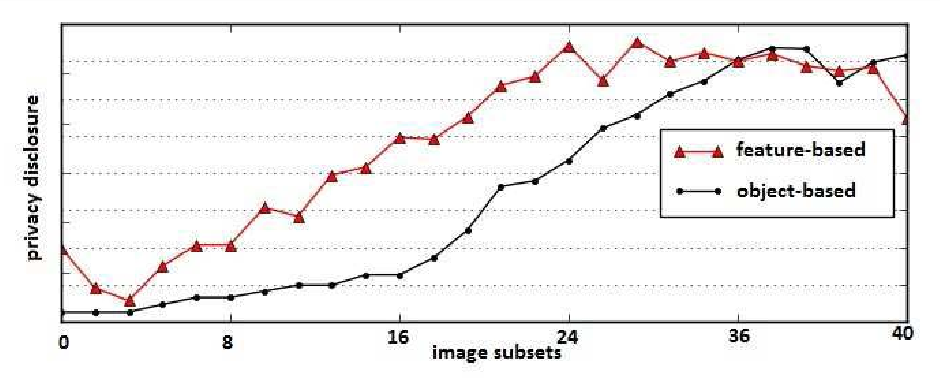 Fig 3: Performance on the Mirflickr set showing the object-based approach (red line) consistently resulting in lower privacy disclosure.
Critical Insight & Future Outlook
While the system is robust, the authors admit that privacy is inherently subjective. What one user finds sensitive, another might not.
Moving Forward: The paper suggests that future work should involve GANs to not just "blur" sensitive areas (which can be suspicious), but to replace them with "privacy-free" versions of the same scene—maintaining the aesthetic of the photo while protecting the user's data. This work sets a strong foundation for "Privacy-by-Design" in social AI.
Takeaway
By moving from "what is this object" to "is this object sensitive for this specific viewer," this research provides a more human-aligned approach to AI safety in social media.