
DALC: Synchronizing Deep Learning and Targeted Crowdsourcing for Intelligent Personal Assistants
Leveraging Crowdsourcing Data For Deep Active Learning - An Application: Learning Intents in Alexa
The paper introduces DALC (Deep Active Learning from targeted Crowds), a Bayesian framework designed to train deep learning models using noisy and sparse labels from specific user groups. It combines Bayesian deep learning with a low-rank annotator expertise model to achieve SOTA performance in intent classification for Amazon Alexa.
TL;DR
Researchers from Amazon and Delft University of Technology have developed DALC, a unified Bayesian framework that allows Deep Learning models to learn effectively from "targeted crowds" (like Alexa users). By modeling both the uncertainty of the AI and the expertise of the human annotators using a low-rank embedding approach, they reduced required training data by over 36% without sacrificing accuracy.
Context: The Hidden Cost of "Smart" Assistants
Behind every seamless interaction with Amazon Alexa or Google Home lies a massive dataset of human-annotated intents. Traditionally, this is a two-step silos process:
- Collect labels from anonymous workers (Crowdsourcing).
- Train the model (Deep Learning).
However, for subjective tasks like intent classification, "anonymous" labels are often noisy. The most valuable feedback comes from the users themselves (Targeted Crowdsourcing), but they rarely provide more than one or two labels. This leads to extreme data sparsity that traditional methods cannot handle.
Methodology: The Bayesian Bridge
The genius of DALC (Deep Active Learning from targeted Crowds) lies in its unified graphical model. Instead of treating the human and the machine as separate entities, it connects them via a Bayesian framework.
1. Bayesian Deep Learning (The Machine's Perspective)
Deep Learning models are usually "overconfident." DALC uses MC Dropout (Monte Carlo Dropout) to turn a deterministic network into a stochastic one. By running multiple forward passes with different dropout masks, the framework can measure the model's Uncertainty (Shannon Entropy). If the model is confused, it asks for a human label.
2. Low-Rank Annotator Expertise (The Human's Perspective)
Because users (annotators) labels are sparse, DALC maps each user into a low-dimensional embedding . This captures their latent expertise across different topics.
- Reliability Calculation: The probability of a label being correct is modeled as a sigmoid function of the interaction between the user's expertise and the data's latent features.
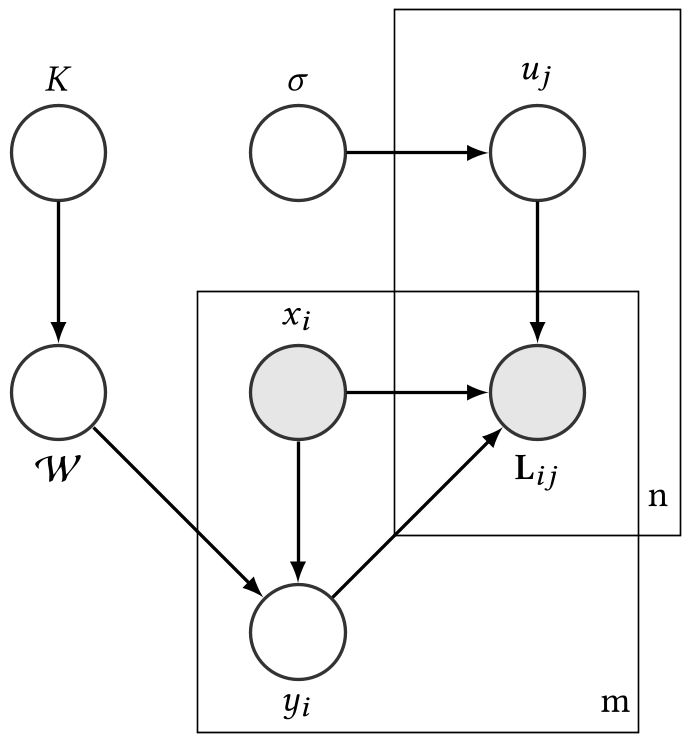 Figure 1: The DALC Graphical Model showing the convergence of the Deep Learning model (W) and the Learning-from-Crowds parameters (u, F).
Experimental Results: Alexa Intent Classification
The team tested DALC on a real-world Alexa dataset featuring over 32k queries and 10k users.
- Efficiency: DALC achieved the same performance as full-dataset training while using 36.53% fewer annotations.
- Label Recovery: Even when an individual user only contributed a single label (sparsity > 99%), DALC could infer the "true label" with over 99% accuracy by aggregating intelligence across the latent embedding space.
- SOTA Comparison: In terms of AUC (Area Under Curve), DALC (0.7235) significantly outperformed standard Majority Voting (0.6302) and previous SOTA methods like STAL.
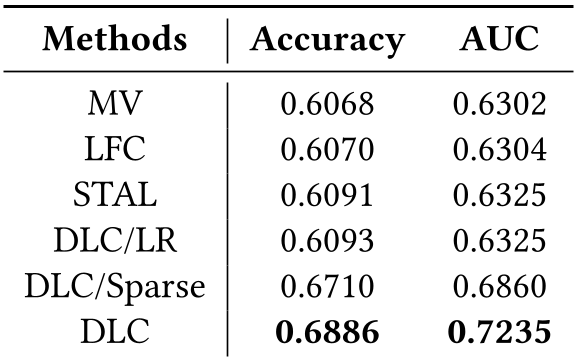 Table 1: Accuracy and AUC results showing DALC's superiority over traditional logistic regression and sparse DL baselines.
Deep Insight: Why Why Does the Low-Rank Structure Matter?
In the real world, an Alexa user who is an expert in "Music Intents" might be terrible at "Smart Home" confirmation. A standard model would treat this user's error as global noise. DALC's Low-Rank embedding allows the system to realize: "This user is usually right about Rock and Pop, let's trust them there, but ignore their feedback on Lighting intents." This granular trust is what allows the model to learn from messy, sparse real-world data.
Critical Analysis & Conclusion
DALC is a significant milestone in Human-in-the-loop systems. It moves us away from disposable, anonymous labels and toward a model where the AI understands the nuances of its teachers (the users).
Limitations:
- The current evaluation is offline. In a live system, "worker availability" (whether a user is willing to answer a confirmation question right now) remains a challenge.
- The computational cost of the EM algorithm and multiple MC Dropout passes may require optimization for real-time edge deployment.
Future Outlook: This framework isn't just for Alexa. It can be applied to medical imaging (expertise of different doctors) or autonomous driving (different driver behaviors), making it a cornerstone for future collaborative AI training.