
EmoCred: Why Emotions are the "Smoking Gun" in Fake News Detection
Leveraging Emotional Signals for Credibility Detection
The paper introduces EmoCred, an LSTM-based framework for fake news detection that integrates emotional signals extracted from text. By combining traditional word embeddings with specific emotional features, the model achieves better performance on PolitiFact datasets compared to text-only baselines.
TL;DR
Fake news isn't just about what is said; it's about how it makes you feel. EmoCred is a research framework that proves adding "emotional signals" to standard deep learning models (LSTMs) significantly boosts the accuracy of identifying misinformation. By analyzing fear, joy, disgust, and sadness within a claim, the model can separate fact from fiction more effectively than looking at words alone.
Background & Motivation: The Emotional Trap
We've all seen them: headlines designed to make our blood boil or fill us with sudden dread. These are not accidental. Fake news is intentionally engineered to trigger intense emotional responses to bypass our rational thinking and encourage social sharing.
While modern AI has become adept at identifying linguistic patterns (like excessive use of "I" or "swear words"), existing models often missed the psychological bait. The researchers behind this paper noticed a gap: If fake news relies on emotion to spread, why aren't our detection systems using emotion to catch them?
Methodology: How EmoCred "Feels" the Text
The core of the EmoCred architecture is a hybrid approach. It doesn't just read the words; it extracts an "Emotional Signal Vector" (ESV).
1. The Architecture
The system uses an LSTM to process the textual sequence of a claim. Simultaneously, it inputs emotional signals through three potential "lenses":
- Lexicon-based (emoLexi): Counting words that match specific emotional categories (e.g., "anger", "trust").
- Intensity-based (emoInt): Measuring the strength of the emotion expressed by specific words.
- Reaction-based (emoReact): A sophisticated Bi-LSTM with attention that predicts how a typical social media user would react (e.g., "Love", "Haha", "Angry").
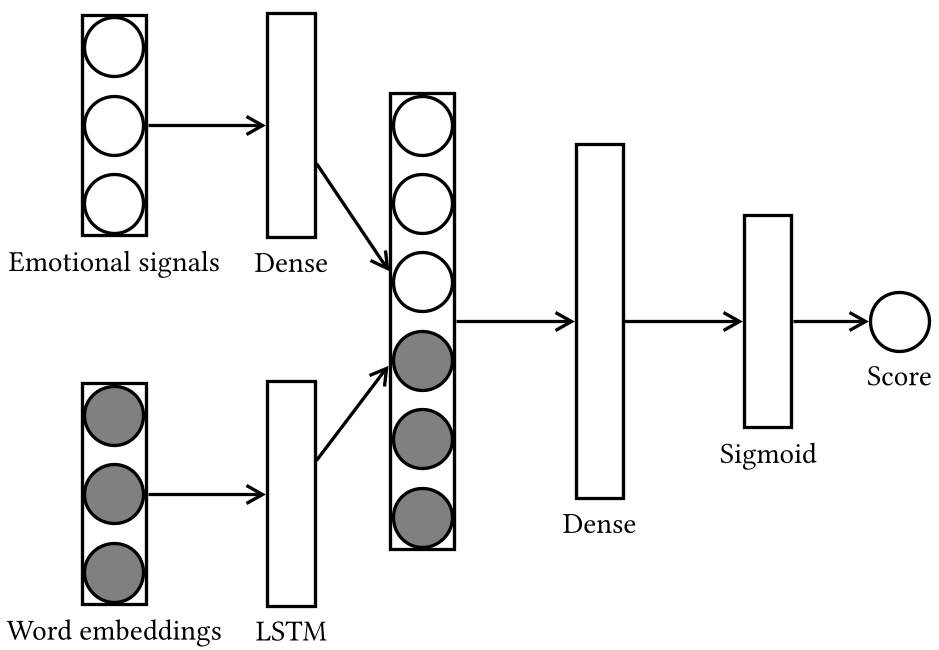
These emotional vectors are concatenated with the textual features, allowing the model to weigh the credibility of a claim based on both its content and its "emotional signature."
Experimental Battleground
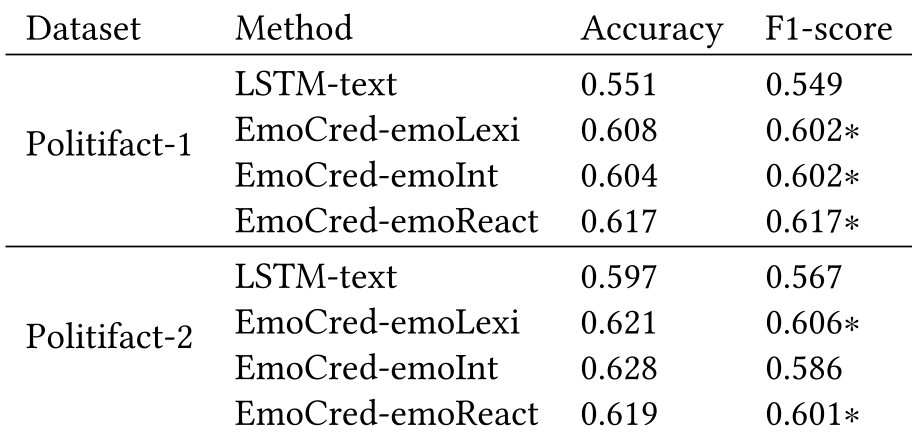
The researchers tested EmoCred against a standard LSTM baseline on two major real-world datasets from PolitiFact.
Key Findings:
- Significant Gains: On PolitiFact-1, the
emoReactmodel achieved a massive improvement, jumping from a baseline F1-score of 0.549 to 0.617. - Emotional Significance: The authors found that emotions associated with true news (joy, sadness, trust, anticipation) were actually stronger predictors for model performance than the "angry" emotions associated with fake news.
Deep Insight: The "Truth" in Positive Emotions
One of the most fascinating takeaways from the ablation study (Table 2 in the paper) is the analysis of emotion groups. While we often associate fake news with "fear and disgust" (Group 1), the model performed significantly better when focusing on "joy and trust" (Group 2).
This suggests an interesting Inductive Bias: True claims consistently exhibit a stable emotional profile of "trust" and "anticipation," and the absence of these is often a more reliable indicator of a fake claim than the presence of outrage.
Conclusion & Future Outlook
EmoCred demonstrates that the "emotionality" of a claim is not just noise—it is a feature. By incorporating the "how it feels" dimension, we can build more robust tools to safeguard our information ecosystems.
Limitations: The study relies on relatively short claims. In the future, applying this to full-length articles or incorporating the emotional stance of external evidence (how other news outlets feel about the claim) could be the next frontier in digital fact-checking.