
Leveraging Multisource Information: A New Frontier in Social Collaborative Filtering
Leveraging Multisource Information in Matrix Factorization for Social Collaborative Filtering
This paper introduces a social collaborative filtering algorithm that integrates user reliability and implicit interactions within a Matrix Factorization (MF) framework. By combining rating records with social network influence propagation, the proposed model achieves superior recommendation accuracy on FilmTrust and Epinions datasets.
TL;DR
Collaborative Filtering (CF) is the backbone of modern recommendation, but it often hits a wall when faced with "cold-start" users who haven't rated many items. This paper proposes a sophisticated Matrix Factorization model that goes beyond simple social links. By calculating User Reliability (how accurate a friend's advice actually is) and Implicit Interactions (influence propagation through the network), the model significantly boosts recommendation quality, especially for new or inactive users.
Academic Positioning: This work moves beyond binary trust models (like SoRec or TrustMF) by introducing a continuous reliability metric and a dual-latent space (Multi-affect/Multi-affected) to capture the bidirectional nature of social influence.
Problem & Motivation: The "Binary Trust" Fallacy
Most current social recommendation systems make a naive assumption: if you "follow" someone, you trust them completely (Value = 1); if not, there is no connection (Value = 0). In reality, social influence is nuanced:
- Trust is Graduated: Some friends consistently recommend movies you love, while others have tastes that rarely align with yours.
- Implicit Ties: Two users might be very similar because they are influenced by the same "tastemakers," even if they aren't directly connected in a social graph.
- The Cold-Start Trap: Traditional CF fails when rating data is sparse. Social data helps, but only if we can extract deep structural information from it.
Methodology: The Multi-Source Fusion
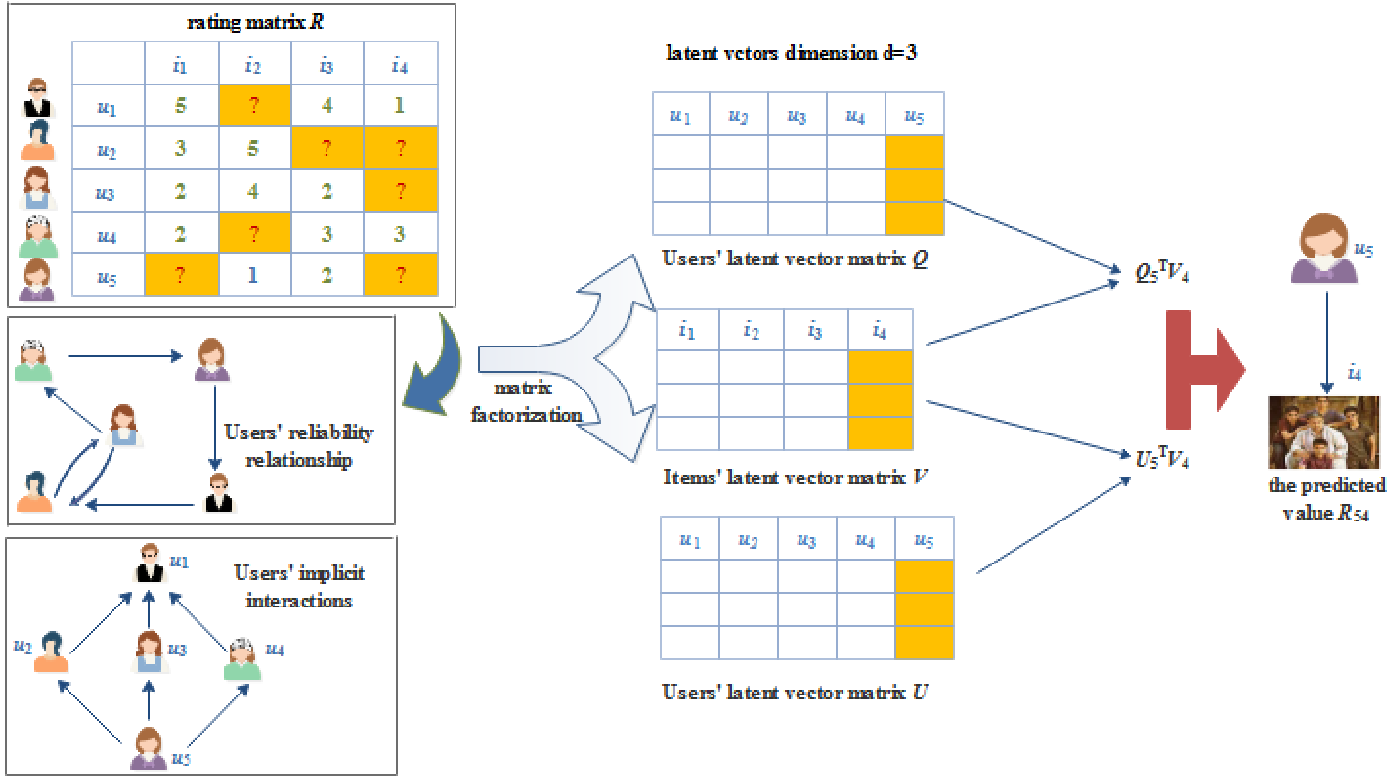
The researchers split the user's social identity into two distinct latent roles represented in the figure below:
1. Quantifying User Reliability
Instead of using a static trust score, the authors define User Reliability () based on the accuracy of past recommendations. If User 's ratings on common items predict User 's preferences well, approaches 1. This transforms the social graph from a simple adjacency matrix into a weighted reliability matrix.
2. Capturing Implicit Interactions
To find "hidden" similar users, the model uses an Influence Propagation view.
- Multi-affect Similarity: Users are similar if they influence the same set of people (out-links).
- Multi-affected Similarity: Users are similar if they are influenced by the same influencers (in-links).
3. The Dual Model Architecture
The recommendation engine is split into two specialized Matrix Factorization processes:
- Multi-affect Model ( vector): Focuses on how a user's role as an influencer reflects their preferences.
- Multi-affected Model ( vector): Focuses on how a user's role as a consumer of influence reflects their tastes.

The final prediction is a synthetic fusion of these two perspectives, ensuring that the model captures both the "leader" and "follower" dynamics of the user.
Experiments & Results: Beating the Baselines
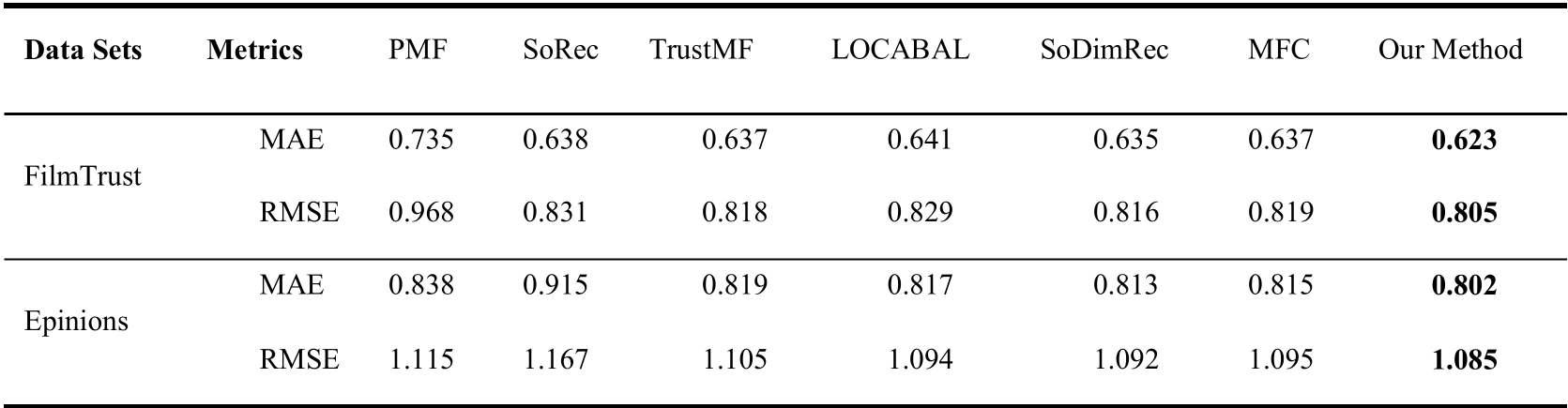
The model was tested against industry standards like SoRec, TrustMF, and LOCABAL on two real-world datasets: FilmTrust and Epinions.
Key Findings:
- Accuracy Boost: The method consistently achieved the lowest MAE and RMSE across both datasets. In FilmTrust, it outperformed the standard PMF by over 15% in error reduction.
- Cold-Start Champion: For users with ratings, the model maintained high accuracy by "borrowing" preference data from their implicit social neighbors.
- Social Degree Resilience: As shown in the performance charts, the model remains stable even for users with very low social connectivity (social degrees 1-5).
Critical Analysis & Conclusion
This paper provides a robust mathematical framework for treating social influence as a multi-dimensional, continuous variable rather than a binary link.
Takeaway: The success of the "Multi-affect/affected" approach suggests that our online personas are bifurcated; who we influence and who influences us provide different, but complementary, signals about our true preferences.
Limitations: While the influence propagation adds depth, calculating the reliability and influence matrices can be computationally expensive as the user base scales to millions. Future work could look into sparse approximations or graph-sampling techniques to maintain this accuracy at massive scales.