
Social Swarming: Boosting P2P Performance via the "Bridge Peer" Effect
Leveraging online social friendship to improve data swarming performance
This paper investigates the integration of Online Social Networks (OSN) with Peer-to-Peer (P2P) systems by proposing the "Public Social Swarming" scheme. By analyzing user behavior on Douban, researchers prove that social friends share high content interest similarity, allowing peers to bridge multiple swarms and significantly boost data availability.
TL;DR
Is your social network just for chatting, or could it speed up your downloads? This paper demonstrates that Online Social Networks (OSNs) can revolutionize P2P data swarming. By introducing the Public Social Swarming scheme, where "Bridge Peers" join multiple swarms based on friend recommendations, the authors achieve a 20%+ reduction in streaming failures and a massive increase in peer availability.
The "Isolation" Problem in Modern Swarming
In the current P2P landscape, identical content (like a popular movie or a Linux ISO) often exists in isolated silos. You might be in "Swarm A" while your best friend is in "Swarm B" downloading the exact same bytes. Because these swarms are managed by different trackers, the data stays localized, and if "Swarm A" has few uploaders, your performance suffers.
Previous attempts to fix this, such as private sharing between friends, failed because they didn't increase the overall visibility of data. The authors identified a missing link: Do social friends actually like the same stuff?
Empirical Proof: The Douban Case Study
Before building a solution, the researchers crawled Douban, a social platform centered around media reviews. Using Cosine Similarity and an intuitive Interest Distance metric, they analyzed nearly 200,000 users.
Key Finding: Over 95% of friend pairs showed a content similarity score above 0.8. This confirms the Homophily Principle—we are friends with people who share our tastes. This alignment provides a logical foundation for social-based P2P recommendations.
Methodology: The Public Social Swarming Scheme
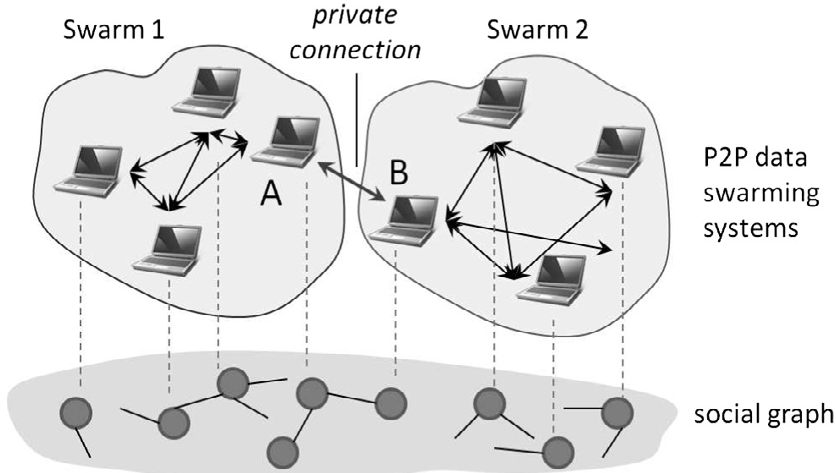
The core innovation is the Public Social Swarming scheme. Unlike "Private" schemes where you only send data to friends, "Public" swarming encourages a peer to become a Bridge Peer.
- Discovery: Peer A learns through an OSN middleware that Friend B is in a different swarm for the same movie.
- Joining: Peer A joins Friend B's swarm simultaneously with their original swarm.
- Bridging: Peer A now acts as a conduit, taking pieces from Swarm 2 and providing them to Swarm 1, and vice-versa.
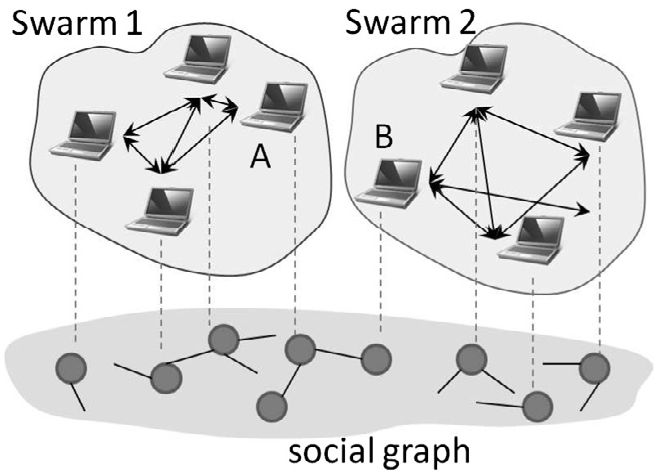 Caption: Comparison between Vanilla Swarming (Isolated) and the Social Swarming (Bridged) approach.
Impact of Network Topology
One of the paper's most sophisticated insights is that not all social circles are created equal. The authors tested the scheme across different graph types:
- Erdos–Renyi (Random Graphs)
- Barabasi-Albert (Scale-free Graphs)
- Empirical Graphs (Facebook/Douban)
Surprisingly, the scheme performs best on random graphs. In scale-free networks (like real social media), the "hubs" (popular people) create highly clustered communities, which actually makes it slightly harder for average users to bridge across diverse swarms compared to a purely random distribution of friends.
Experimental Results
The statistics are compelling. In P2P streaming simulations, the "Public" scheme consistently outperformed both vanilla swarming and "Private" social sharing.
 Caption: Chunk miss ratios across different streaming rates. The Social Swarming scheme (bottom lines) maintains near-zero failure rates even as bandwidth demands increase.
For file sharing, the File Download Completion Time was significantly reduced. Peers participating in four swarms simultaneously (as Bridge Peers) finished their downloads drastically faster than those restricted to a single swarm.
Critical Insight & Future Outlook
The beauty of this research lies in its simplicity and backward compatibility. You don't need to rewrite the BitTorrent protocol; you simply need a middleware that talks to your social API.
Limitations: The study assumes that content across swarms is identical (content aliasing). In reality, identifying that "Movie_Final_Ver.mp4" is the same as "Movie_HD.avi" requires robust hashing or manual tagging.
Future Directions: As we move toward decentralized Web3 structures, this "Social Bridge" concept could be the key to making decentralized storage as fast as centralized CDNs by leveraging the natural "communities of interest" we've already built online.