
Leveraging Pattern Recognition: Identifying the "Expert" in the Crowd
6763_Leveraging Pattern Recognition Consistency Estimation for Crowdsourcing Data Analysis.
This paper introduces a novel pattern-recognition-based method to estimate the consistency of human annotators in crowdsourcing projects like Galaxy Zoo. By training a supervised machine learning classifier on data labeled by a specific individual, the system uses the classifier's accuracy as a proxy for the annotator's reliability, achieving a 0.966 Pearson correlation with actual human performance.
TL;DR
In the world of Big Data, human eyes are often better than algorithms at spotting patterns (like galaxy types), but human volunteers are inconsistent. This paper presents a "meta-learning" approach: using a machine learning classifier to grade the humans. By measuring how well an AI can "learn" from a specific person's labels, the method accurately identifies high-quality annotators, allowing researchers to trust single experts over a noisy majority.
Background: The Crowdsourcing Bottleneck
Projects like Galaxy Zoo have revolutionized science by utilizing millions of volunteers. However, quality control is a nightmare. Traditionally, we use Majority Voting (MV)—if 10 people say it's a spiral galaxy, it probably is. But this is incredibly wasteful. What if one volunteer is as accurate as a NASA professional? Currently, their vote is drowned out by nine amateurs.
The Insight: Noise as a Metric
The authors' core intuition is elegant: A machine cannot learn from a chaotic teacher. If a volunteer labels images randomly or inconsistently (e.g., calling the same shape "spiral" today and "elliptical" tomorrow), a supervised classifier trained on their data will fail to find a pattern. Therefore, the accuracy of the AI becomes a direct proxy for the consistency of the human.
Methodology: Ranking the Volunteers
The system follows a straightforward but powerful pipeline:
- Data Sampling: Collect samples (e.g., 100) where a specific user provided a label.
- Feature Extraction: Use the Wndchrm utility to extract a massive set of image descriptors (texture, fractals, Chebyshev statistics).
- Training & Testing: Train a weighted nearest neighbor classifier on this user’s specific dataset.
- Consistency Scoring: The cross-validation accuracy () becomes the user's "Consistency Score."
 The distance-weighted formula used to determine class similarity based on user-provided labels.
Experimental Results
The authors analyzed 4,000 citizen scientists from Galaxy Zoo. The results were striking:
- Near-Perfect Correlation: The method's consistency score had a 0.966 Pearson correlation with manual expert audits.
- Outperforming the Majority: For certain high-scoring users (like User ID 55288), their individual classification was more accurate than the "Majority Vote" of the entire crowd.
- Small Sample Efficiency: Even with only 20 samples per class, the correlation remained high (0.928), meaning the system can identify good workers very quickly.
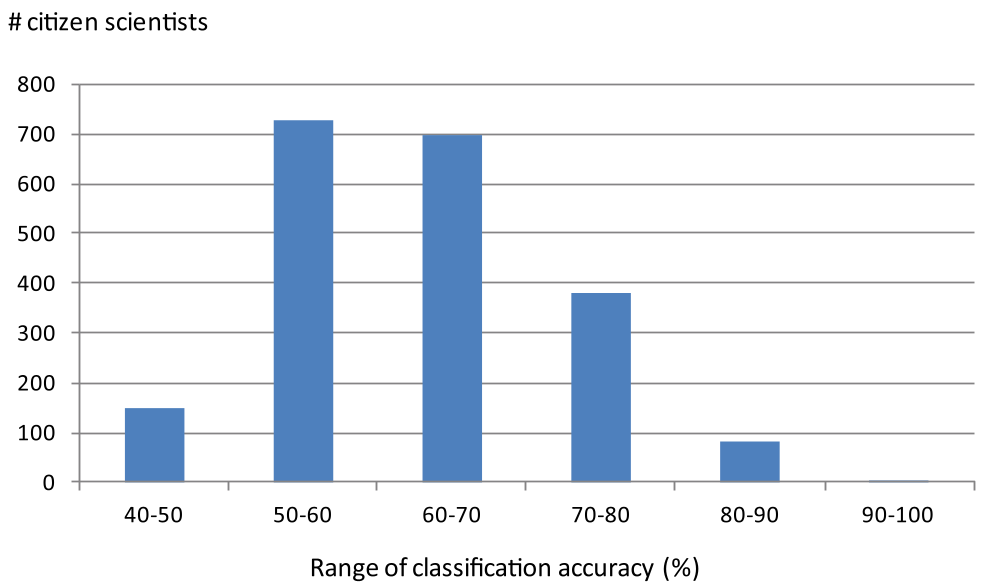 Distribution of classification accuracies across 4,000 volunteers, revealing a wide spectrum of reliability.
Why This Matters
This method changes the economics of crowdsourcing. Instead of asking 20 people to look at every image, we can:
- Identify Experts: Identify top-tier volunteers and trust their labels with minimal redundancy.
- Real-time Feedback: Give volunteers a "consistency rank" to encourage better performance.
- Weighted Consensus: Instead of , use to calculate the final truth, where is the consistency score.
Critical Analysis & Conclusion
While brilliant, the method has two main limitations:
- Computational Complexity: You must train a separate model for each user, which is heavy for millions of participants.
- Malicious Consistency: A user who is "consistently wrong" (maliciously labeling everything incorrectly) might still get a high score. However, as the authors note, such behavior is rare in scientific projects.
Takeaway: This paper proves that we don't need "Ground Truth" to find the truth; we only need to measure the internal logic of the observers. It signifies a shift toward Smarter Crowdsourcing, where human and machine intelligence form a recursive feedback loop for quality control.