
Beyond Incentives: Using Social Network Analysis to Predict Energy Efficiency Adopters
Leveraging Pisburgh's Energy Efficiency Social Network to Predict Next Adopters
This research presents a two-phase Social Network Analysis (SNA) framework to predict energy efficiency (EE) adoption among commercial building managers in Pittsburgh. By combining Mental Models and the Multiple Regression Quadratic Assignment Procedure (MR-QAP), the study identifies influential actors and key behavioral attributes that drive the diffusion of sustainable technologies.
TL;DR
Researchers at Carnegie Mellon University are moving beyond simple economic models to understand why some commercial building managers adopt energy-efficient (EE) technologies while others lag behind. By mapping the "social fabric" of Pittsburgh’s commercial sector, this study uses Social Network Analysis (SNA) and Multiple Regression Quadratic Assignment Procedure (MR-QAP) to identify the influencers and social attributes that predict the next wave of green building adopters.
Academic Positioning: This work bridges the gap between Economic Sociology and Energy Policy, moving technical EE research from the well-studied residential sector into the high-impact commercial building domain.
Problem & Motivation: The Social Gap in Energy Policy
Commercial buildings account for 20% of U.S. energy consumption, yet the diffusion of efficiency standards like LEED and Energy Star remains uneven. The authors argue that economic action is "embedded" in social relations. Previous research focused on residential "peer pressure" (like OPOWER's energy reports), but commercial building managers operate in a more complex web of contractors, experts, and stakeholders.
The core challenge is identifying why "late adopters" resist change despite clear economic benefits. The authors suggest the answer lies in Social Influence Theory: decisions are influenced by risk avoidance, social status, and trust in peer networks rather than just ROI calculations.
Methodology: Mapping the Manager's Mind and Network
The researchers proposed a two-phase methodology to test the hypothesis that social network influence is a primary correlate for energy efficiency status.
1. Phase One: The Mental Models Approach
Using semi-structured interviews with 20 EE experts and managers, the team constructed a list of "leading attributes." For example, "Trust"—specifically a manager's faith in their engineering staff—was identified as a critical qualitative variable that quantitative data alone often misses.
2. Phase Two: Meta-Network Assessment
The team utilized the CoStar database to survey 200 large building managers in Pittsburgh. They mapped "Two-Mode" network data—connecting managers to specific adoption categories or influencers.
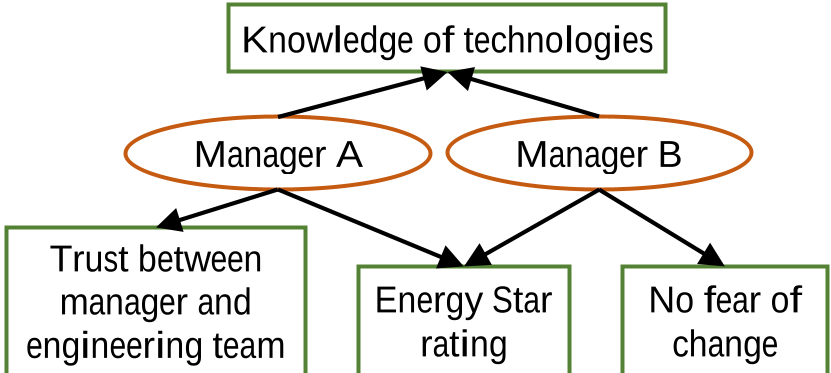 Figure 1: Illustration of how managers (nodes) are linked to shared attributes and influencers, creating a meta-network structure.
To calculate the significance of these social links, the study uses *ORA, a meta-network tool, and MR-QAP. QAP is essential here because traditional OLS regression assumes independent data points; however, in social networks, observations (links) are inherently dependent.
SOTA Insights and Anticipated Results
While residential studies found a 2% reduction in energy through peer-comparison letters, this commercial study looks at larger-scale structural impacts. By analyzing Degree Centrality (how many connections an actor has) and Eigenvector Centrality (how connected an actor is to other influential people), the researchers can pinpoint which "hubs" in the Pittsburgh 2030 District are most effective at spreading EE practices.
Early takeaways suggest that:
- Peer Density over peer size: The tightness of the network matters more than the number of connections.
- Attribute Discrepancy: Identifying the "gap" in trust or information access between LEED-certified managers and standard managers allows for tailored policy interventions.
Critical Analysis & Conclusion
Takeaway
The study concludes that "who you know" and "who you trust" are as predictive of energy efficiency adoption as the technology itself. By leveraging existing social networks, cities can enhance EE adoption without simply increasing subsidies.
Limitations
A primary limitation of this framework is its reliance on the Pittsburgh 2030 District—a relatively progressive and established network. The findings may vary significantly in cities without such strong "Green Building" alliances. Furthermore, the cross-sectional nature of the survey makes it difficult to establish a definitive causal link between network position and adoption over time (temporal lag).
Future Outlook
This research sets the stage for "Socially-Targeted Incentives." Instead of a city-wide rebate, future policies might identify the top 5% most "influential" managers in a network and provide them with early-access technology, knowing their adoption will naturally trigger a cascade across the remaining 95%.