
Safebook: Shielding Social Privacy Through Decentralized Matryoshkas
Leveraging Social Links for Trust and Privacy in Networks
This paper introduces Safebook, a decentralized peer-to-peer (P2P) architecture for online social networks (OSN). It utilizes a novel "Matryoshka" multi-hop routing structure to ensure data privacy and availability by leveraging real-life social trust relationships instead of centralized servers.
TL;DR
Safebook is a decentralized social network that replaces centralized servers (the "Big Brother" model) with a peer-to-peer overlay. By organizing a user's social circle into concentric shells called Matryoshkas, it leverages real-life trust to protect data privacy and ensure high availability without a central authority.
The "Big Brother" Problem in Social Media
Current Online Social Networks (OSNs) operate on a business model that treats user data as a commodity. Even with encryption, the Service Provider remains an omniscient entity with total visibility into user relationships and behaviors. Furthermore, centralized repositories are honeypots for automated identity theft and Sybil attacks.
The authors argue that true privacy is impossible under centralized control. However, moving to a standard Peer-to-Peer (P2P) model introduces a new problem: How do you trust a random peer with your private data?
Methodology: The Matryoshka Architecture
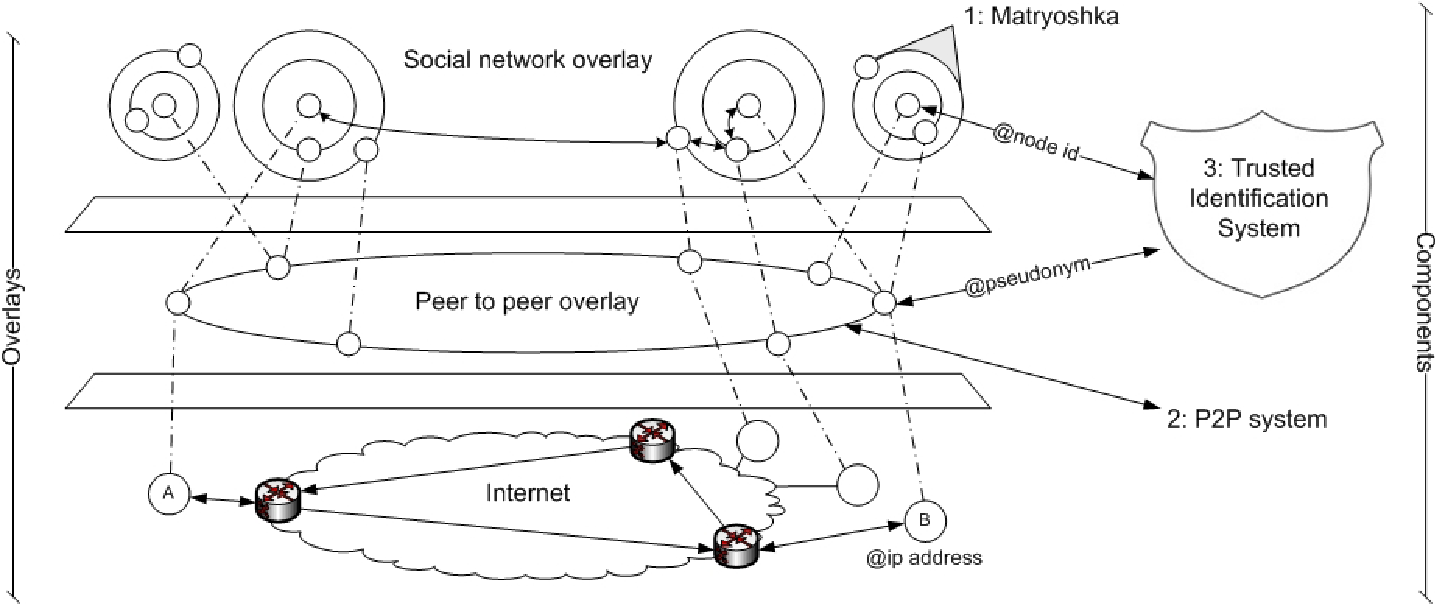
Safebook bridges the gap between P2P decentralization and social trust through a three-tier architecture:
- Trusted Identification Service (TIS): Provides unique pseudonyms to prevent identity spoofing.
- P2P Substrate (DHT): Uses Kademlia for decentralized data lookup.
- Matryoshkas: The core innovation.
The Matryoshka Logic
A user (the "Core") is surrounded by concentric shells of nodes.
- Inner Shell: Direct, trusted friends who cache the user's data.
- Outer Shells: Friends of friends who act as entry points and relay nodes.
When someone wants to view your profile, the request is routed through these shells. Because every hop represents a real-life friendship, there is a natural incentive for nodes to cooperate and a significantly lower risk of malicious interference.
Experiments & Feasibility
The researchers addressed two critical questions: Will my data stay online? and Will it be slow?
Data Availability
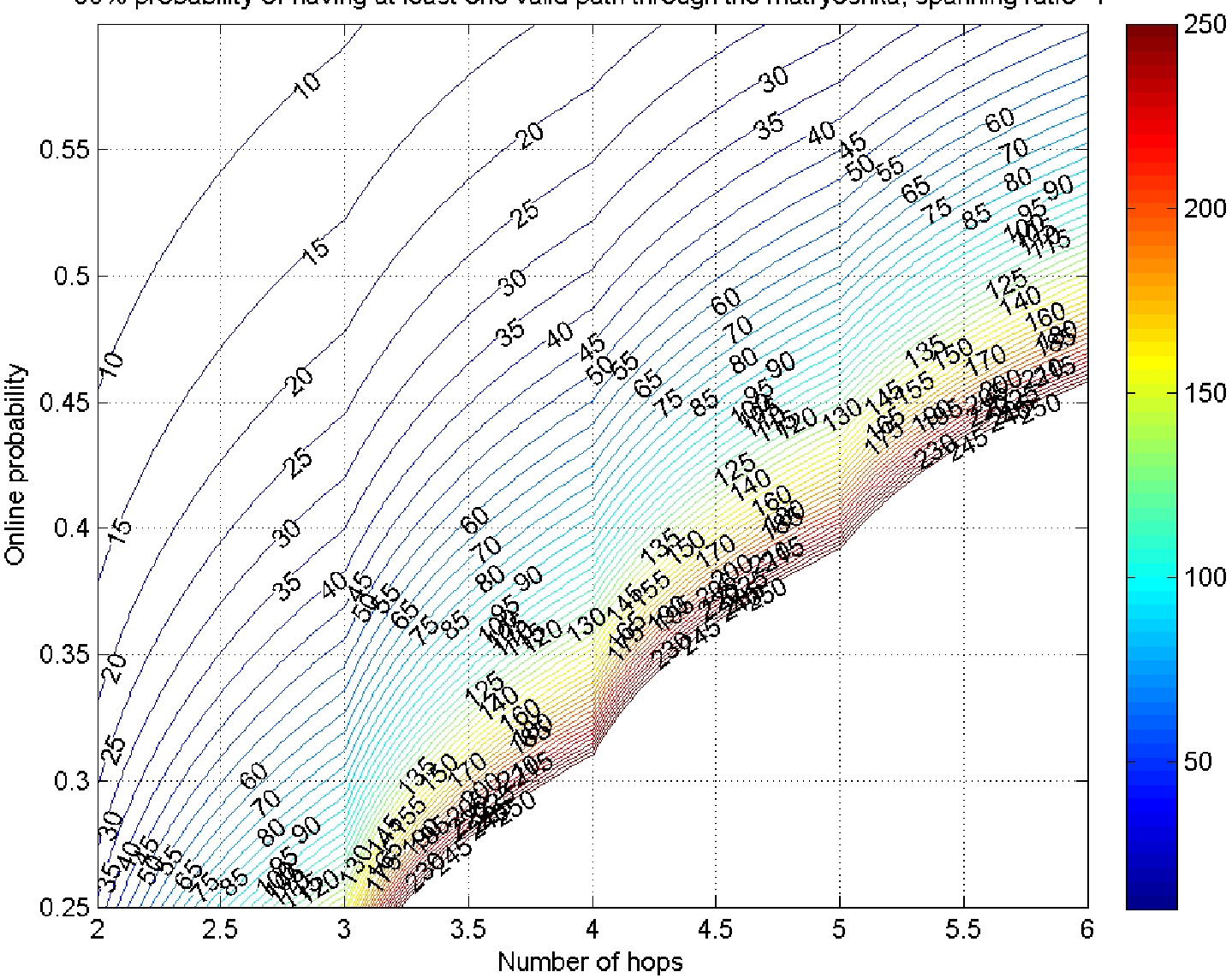
In a P2P network, nodes frequently go offline. Safebook uses a "spanning factor" (branching out the request tree).
- With a spanning factor of 2 and a social circle of ~20 friends, Safebook reaches 90% availability even if users are only online 30% of the time.
- This aligns with real-world social graph data (e.g., Xing), where the average user has roughly 24 contacts.
Latency
By optimizing the Kademlia DHT and utilizing the Matryoshka path, the total lookup time is kept around 5 seconds. While slower than a central server, it is significantly faster than other anonymous networks like GNUnet, making it practical for social browsing.
Critical Insight: Social Links as Security Primitives
The genius of Safebook lies in its realization that the Social Graph itself is a security asset. Instead of relying on complex cryptographic proofs of work, it relies on the cost of social capital. Malicious behavior in Safebook has real-world consequences (losing a friend's trust), which provides a stronger incentive for honesty than traditional P2P protocols.
Limitations & Future Work
- Global Adversaries: While Safebook protects against other users and the provider, it does not claim to hide communication patterns from a global network monitor (like an ISP).
- Scalability of Trust: The model assumes that trust is transitive enough to form shells, but "friend of a friend" trust can be weak in large, low-engagement networks.
Conclusion
Safebook is a pioneering attempt to reclaim the "Social" in Social Networks from corporate entities. By embedding privacy into the very structure of the network through Matryoshkas, it proves that decentralization can be both secure and efficient.