
Social BitTorrent: Turning Friendships into Bandwidth Robustness
Leveraging Social Networks for Increased BitTorrent Robustness
This paper introduces "Social BitTorrent," a P2P content delivery system that integrates social network links into the BitTorrent infrastructure. It proposes a Hybrid approach (HBT) combining traditional tracker-based peer discovery with trusted social connections to significantly enhance system robustness against freeriding.
TL;DR
P2P networks have long struggled with "freeriders"—users who download but never upload. While BitTorrent’s Tit-for-Tat (TFT) was designed to stop them, it often fails in practice. This paper proposes a "Social BitTorrent" (SBT) and a Hybrid BitTorrent (HBT) model that leverages real-world social trust to enforce cooperation. By prioritizing friends for bandwidth, the system remains performant even when 33% of the network consists of malicious freeriders.
Problem & Motivation: The Failure of Digital Altruism
The core philosophy of BitTorrent is reciprocity. However, research has shown that the standard TFT mechanism is easily gamed. Freeriders can exploit the "altruism" of seeders who upload to strangers to keep the swarm healthy.
The authors' insight is elegant: People are less likely to cheat their friends than they are to cheat strangers. If we embed the BitTorrent infrastructure within a social network (a "Darknet" or F2F system), we can use the external "human reputation system" to ensure cooperative behavior without complex cryptographic tokens or credit systems.
Methodology: High-Priority Friendships
The authors modified the BitTorrent architecture with one primary rule change: Friend Upload Priority.
- Identity: Peers authenticate via social links (e.g., Facebook API or XMPP).
- Strict Social (SBT): Data only flows between friends. This is highly secure but suffers when friends aren't interested in the same files (Sparse Swarms).
- Hybrid (HBT): Peers connect to friends and strangers from a tracker. Friends get absolute priority in upload slots, while strangers are dealt with via standard TFT.
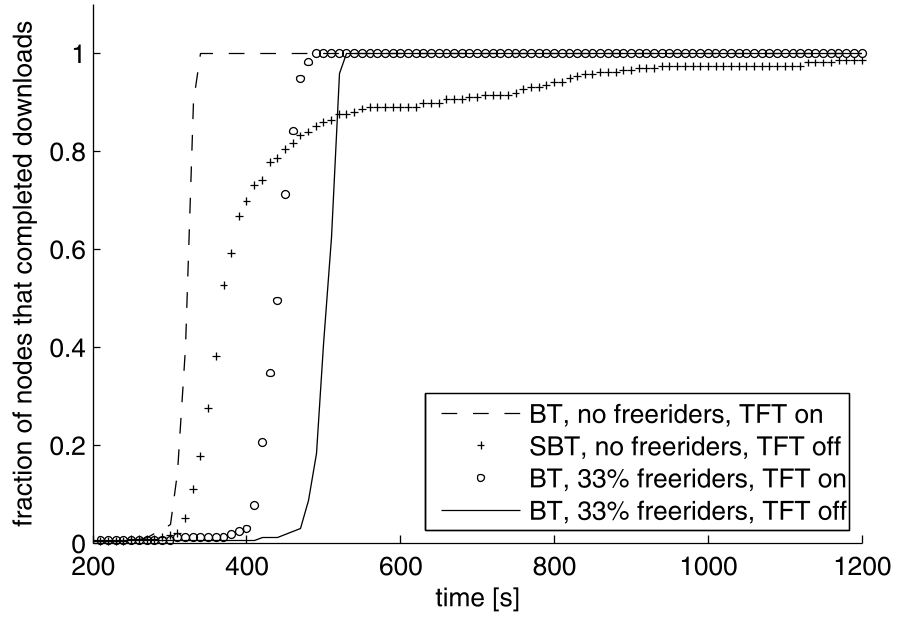 Fig 1: Completion times for BT vs SBT. Note how SBT handles freeriders significantly better than standard BT.
Experimental Insights: Scaling and Stability
The research utilized simulations based on actual large-scale social graphs. Key findings include:
- Robustness: In a standard BT swarm, 33% freeriders significantly delay the 90th percentile of users. In SBT, the delay is negligible because the "social backbone" continues to function regardless of freerider presence.
- The 2% Threshold: The hybrid system (HBT) is superior until the "swarm density" (fraction of friends interested in the same file) drops below 2%. At that point, the probability of finding a friend who has the data is too low, and the system reverts to the performance of standard BitTorrent.
- Bandwidth Balance: One of the most striking results is that HBT creates a more "vertical" CDF of bandwidth utilization, meaning the load is spread more evenly across the network compared to purely social or purely tracker-based systems.
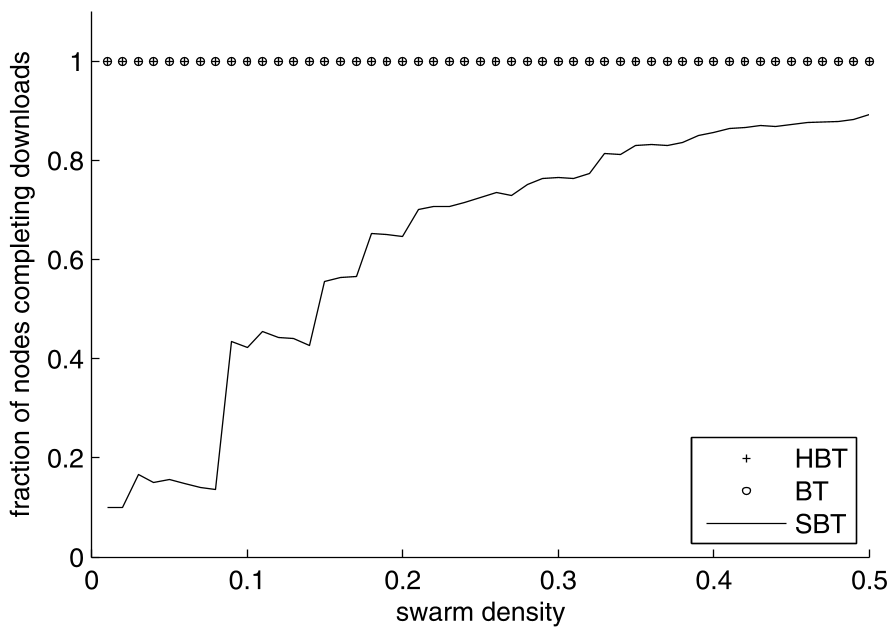 Fig 4: HBT (Hybrid) shows the most balanced upload bandwidth distribution among all models.
Critical Analysis & Conclusion
Takeaway
Social BitTorrent proves that the topology of social networks alone is an efficient and scalable medium for content distribution. By combining social trust with tracker-based discovery, we get the "best of both worlds": the capacity of a global network with the reliability of a private circle.
Limitations
- Power-Law Tails: Because social networks follow a power-law distribution, users with very few friends ("poorly connected" nodes) still struggle to finish downloads in a purely social system.
- Privacy vs. Discovery: While strict social links improve privacy, they hinder the "long tail" of content discovery.
Future Outlook
This work sets the stage for "Socially-Aware" decentralized systems. As we move toward Web3 and decentralized storage, integrating social graphs (like Lens Protocol or Farcaster) could provide the necessary incentive layer to prevent the "Tragedy of the Commons" in shared resource networks.