
KT Voting: Redefining Crowdsensing Recruitment through Social Influence
Leveraging Social Networks to Enhance Effective Coverage for Mobile Crowdsensing
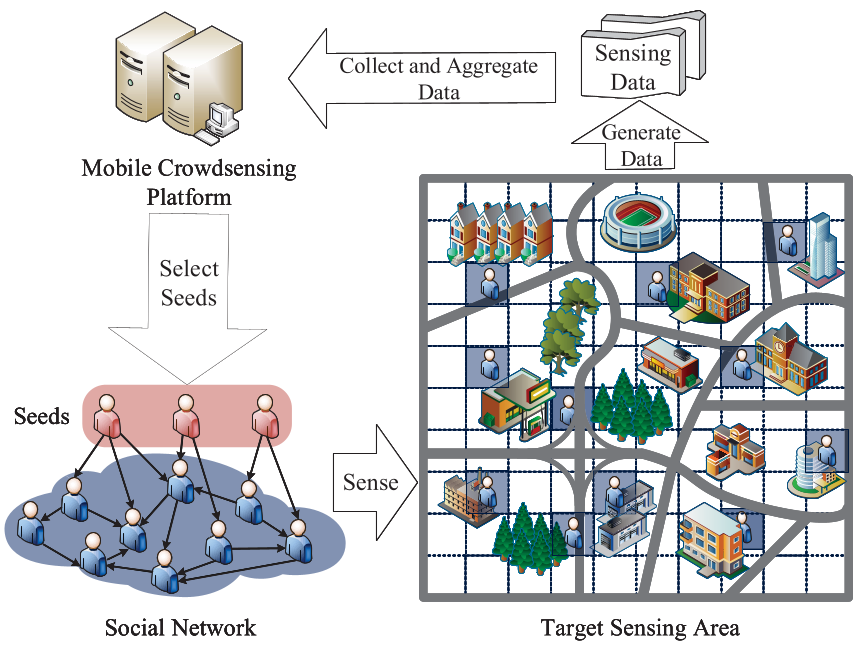
This paper introduces a novel framework for Mobile Crowdsensing (MCS) that recruits participants via social networks to overcome the limitations of platform-only worker pools. By formulating the Maximum Effective Sensing Coverage (MESC) problem and proposing the KT Voting algorithm, the authors leverage multi-step social influence and spatial relevance to optimize worker selection.
Executive Summary
TL;DR: This paper tackles the "small worker pool" problem in Mobile Crowdsensing (MCS) by using social networks to "go viral." Instead of just picking workers, the researchers pick seed workers who spread the task to their friends. Using the proposed KT Voting algorithm, they maximize "Effective Coverage" by considering both who is influential and where those people are located.
Positioning: This work bridges the gap between Influence Maximization (IM) in social networks and Task Allocation in MCS. It moves beyond simple greedy selection by introducing a voting-based heuristic that accounts for multi-hop influence.
Problem & Motivation: The "Closed Loop" Bottleneck
In traditional MCS, the platform is a walled garden; if you aren't registered, you don't see the task. This leads to poor coverage in sparsely populated or new regions. While reward mechanisms can boost participation, they cannot create workers out of thin air.
The authors' Insight is twofold:
- Social Terminal Synergy: Almost every smartphone user is a potential sensor and a social network user simultaneously.
- Accuracy Matters: It’s not enough to just reach people; we need to reach people who are near the sensing targets to ensure data authenticity.
Methodology: From Selection to Election
The authors formulate the MESC (Maximum Effective Sensing Coverage) problem, proving it is NP-hard. To solve it, they shift from a "selection" mindset to an "election" mindset via the KT Voting Algorithm.
1. Conceptual Framework
- Electoral Districts: The target area is divided into districts to ensure workers aren't all clustered in one spot.
- -step Voting: A user votes for a candidate if can reach within steps in the social graph.
- Weighted Votes: The strength of a vote depends on (a) the probability of influence and (b) the voter's ability to sense a specific district accurately (based on Euclidean distance).
2. The Influence Model
The paper utilizes the Independent Cascade (IC) model, where participation probability is calculated recursively:

3. Algorithm Architecture
The algorithm iterates through nodes to calculate their "influence district" and their "Total Vote." Seeds are selected by picking the top-voted candidates for each district.
Experiments & Results
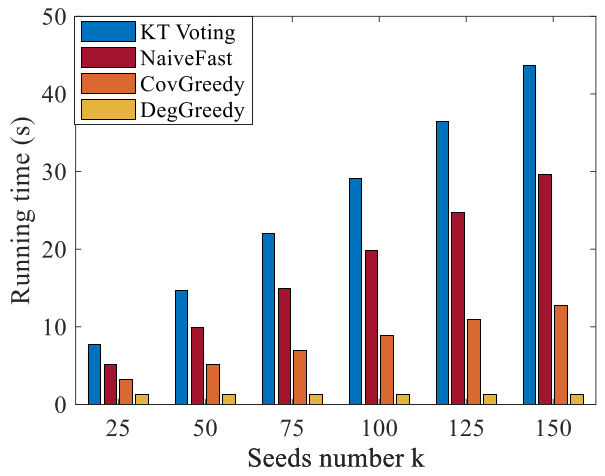
The researchers tested KT Voting against three baselines (DegGreedy, CovGreedy, and NaiveFast) using Gowalla and Brightkite datasets.
Key Findings:
- Superior Coverage: KT Voting achieved ~6.7% better effective coverage than the best baseline (NaiveFast).
- Scalability: While more "expensive" than simple degree-based greedy algorithms, KT Voting scales linearly with the number of seeds, making it practical for large-scale deployments.
- Diminishing Returns: As the number of seeds () increases, the growth of Effective Coverage slows down, confirming the "limited influential node" theory.
Critical Analysis & Conclusion
Takeaway
The KT Voting algorithm successfully internalizes "spatial awareness" into the social influence propagation model. By allowing users to "vote" for their influencers, the system naturally identifies nodes that are both central to the network and geographically relevant to the task.
Limitations
- Dynamic Networks: The model assumes a static social graph, but real-world social ties and user locations are highly dynamic.
- Incentive Costs: The study assumes users propagate tasks voluntarily or for a fixed budget. In reality, the "cost per hop" might change based on social distance.
Future Outlook
Future research should look into incentive-aware diffusion, where the platform pays seeds not just to participate, but to effectively recruit others, creating a "multi-level marketing" effect for urban sensing.