
Leveraging Social Capital: Can MySpace Save the Planet?
Leveraging Social Networks To Motivate Individuals to Reduce their Ecological Footprints
This paper proposes "Footprints," a social media integration framework designed to motivate individuals to reduce energy consumption and CO2 emissions. By embedding personalized ecological data and group-based motivational schemes into high-traffic platforms like MySpace and Yahoo! 360, the researchers aim to leverage frequent feedback and social influence to drive large-scale environmental action.
TL;DR
Researchers from Carnegie Mellon University proposed a system called "Footprints" that embeds ecological tracking directly into social networks like MySpace and Yahoo! 360. By shifting environmental feedback from isolated "green" sites to the places people visit every day, they aim to turn energy reduction into a social competition, potentially reducing residential energy consumption by over 10%.
The Visibility Gap: Why Information Isn't Enough
Despite the massive scale of human-induced climate change, most individuals fail to see the link between their morning commute and global CO2 levels. Traditional environmental websites suffer from "echo chamber" effects—only reaching those who are already activists.
The authors identify two critical barriers:
- Lack of Integration: People don't want to visit a separate, boring "CO2 calculator" every day.
- Invisible Impact: Energy use is abstract. Without frequent feedback and social context, there is no psychological incentive to change.
Methodology: The Footprints Framework
The core "insight" of this paper is that social networks offer mobilizing structures. Instead of building a new community from scratch, the researchers "piggyback" on existing ones.
1. Seamless Integration (Web 2.0)
The system uses "Badges" and RSS feeds to display a user's CO2 impact and money saved directly on their profile. This makes a person's ecological "face" part of their online identity.
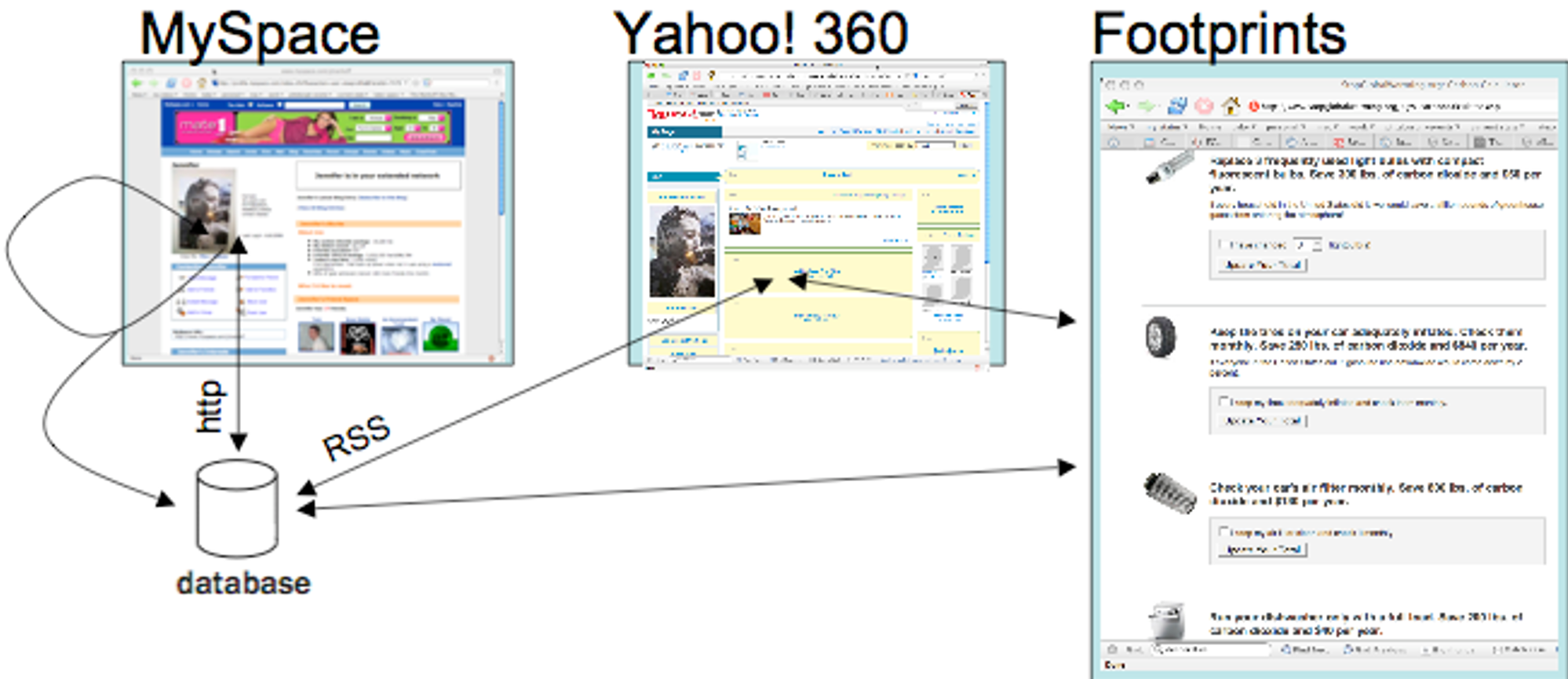 Figure 1: The architecture shows how Footprints syncs data between a central database and various social platforms.
2. Motivational Schemes
The authors propose a hierarchy of motivation, moving from simple information to intense competition:
- Personalization: Recommendations are tailored (e.g., suggesting a rideshare for someone with a long commute).
- Social Comparison: Users see how their friends are performing.
- Group Competition: Schools or clubs can compete to see who achieves the highest reduction, leveraging collective identity.
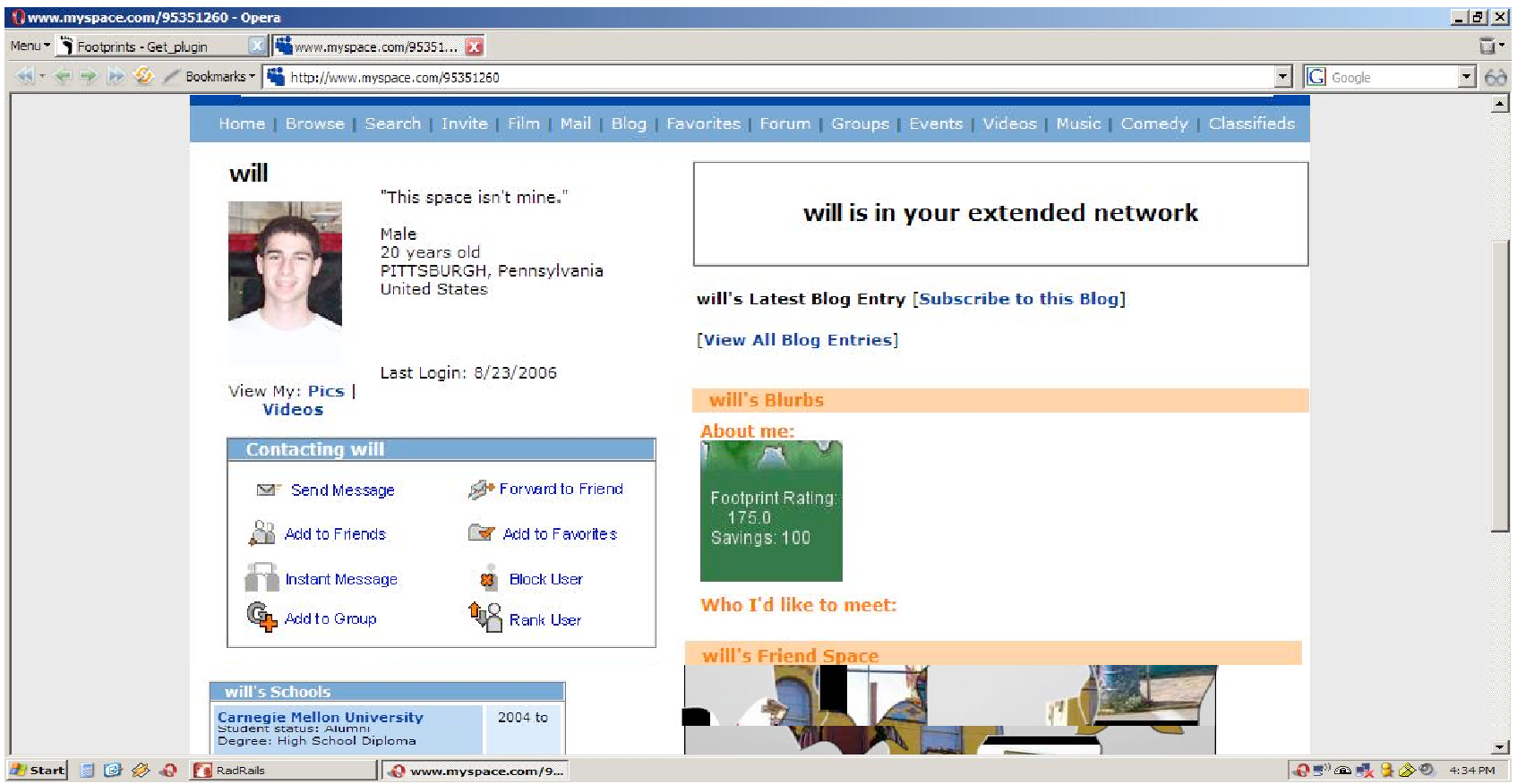 Figure 2: A mockup of a MySpace profile modified to show the owner's CO2 impact, making sustainability a point of social pride (or shame).
Measuring Success: Beyond the "Green" Crowd
The paper outlines an experimental deployment on a college campus to test four strategies:
- S1 (Baseline): Just showing information.
- S2 (Individual Goals): Personal targets.
- S3 (Group Goals): Shared targets for a club or dorm.
- S4 (Competition): Leaderboards and rewards for recruitment.
The hypothesis is clear: Competition (S4) will outperform all other methods. This is because participation in a social movement is most sustainable when it is integrated into a person's existing social capital and life goals.
Critical Insights & Future Outlook
The "Footprints" project was a visionary precursor to today's "gamified" environmental apps. Its brilliance lies in the realization that social capital is a currency—if we make "being green" a source of status within a user's primary social circle, behavioral change follows naturally.
Limitations:
- Self-Reporting Bias: The study relies heavily on users accurately reporting their actions.
- Privacy: Publicly displaying energy habits may be intrusive to some demographics.
Takeaway: Effective environmental tech shouldn't ask users to change where they go online; it should reach them where they already are. Future systems should focus on automating data collection (via IoT) while maintaining the "social pressure" mechanisms pioneered here.