
LewiSpace: Bridging Chemistry Education and Multimodal Affective Computing
LewiSpace: An Educational Puzzle Game Combined with a Multimodal Machine Learning Environment
The paper introduces LewiSpace, a 3D educational puzzle game designed to teach Lewis molecular diagrams. It utilizes a multimodal sensor suite (EEG, Eye Tracking, Facial Recognition) and a Logistic Regression model to predict learner performance, achieving a baseline for real-time adaptive gameplay.
TL;DR
Researchers at the Université de Montréal have developed LewiSpace, a 3D puzzle game that teaches college-level chemistry. By monitoring learners via EEG, eye-tracking, and webcams, they successfully trained a machine learning model to predict whether a student would succeed or fail a task, paving the way for AI "tutors" that react to your brainwaves in real-time.
The "Fun vs. Learning" Bottleneck
In the world of Serious Games, there is a perpetual tug-of-war between making a game "fun" and making it "educational." Many titles succeed at engagement but fail at knowledge transfer because they cannot tell when a player is simply "clicking through" versus truly struggling with a concept.
The authors argue that the missing link is real-time physiological feedback. If a game knows you are frustrated or cognitively overloaded before you fail, it can intervene—much like a human tutor would.
Methodology: The Multimodal Lab
The experiment involved 40 participants navigating a 3D environment as astronauts. To progress, they had to solve increasingly difficult Lewis diagram puzzles (e.g., H2O, CH4, H2SO4).
The Sensor Stack:
- EEG (Emotiv): Captured metrics like excitement, meditation, frustration, and boredom.
- Eye Tracking (Tobii): Measured pupil diameter as a proxy for Cognitive Workload.
- Facial Recognition (FaceReader): Tracked the seven basic emotions and valence/arousal via a standard webcam.
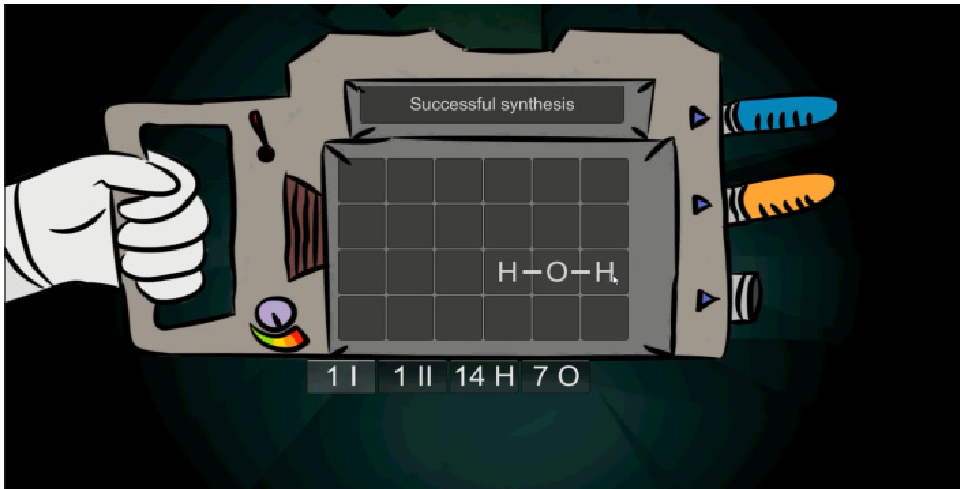 Figure 1: The 3D environment of LewiSpace where learners interact with chemical components.
Insights: Brainwaves Over Blink Rates
The researchers used Scikit-learn to compare Support Vector Machines (SVM) and Logistic Regression. A critical part of their methodology was the "leave-one-participant-out" approach, ensuring the AI could generalize to new users it hadn't seen before.
The results yielded a surprising discovery regarding Feature Importance:
- EEG is King: Removing the Emotiv (EEG) data caused the model’s accuracy to plummet (dropping the Mean Participant Accuracy from ~0.59 to ~0.31).
- Noise in the Face: Surprisingly, facial expression and pupil diameter data did not significantly improve the model. In some cases, adding these features actually introduced noise, suggesting that "internal" neural states are more predictive of chemistry problem-solving than "external" expressions.
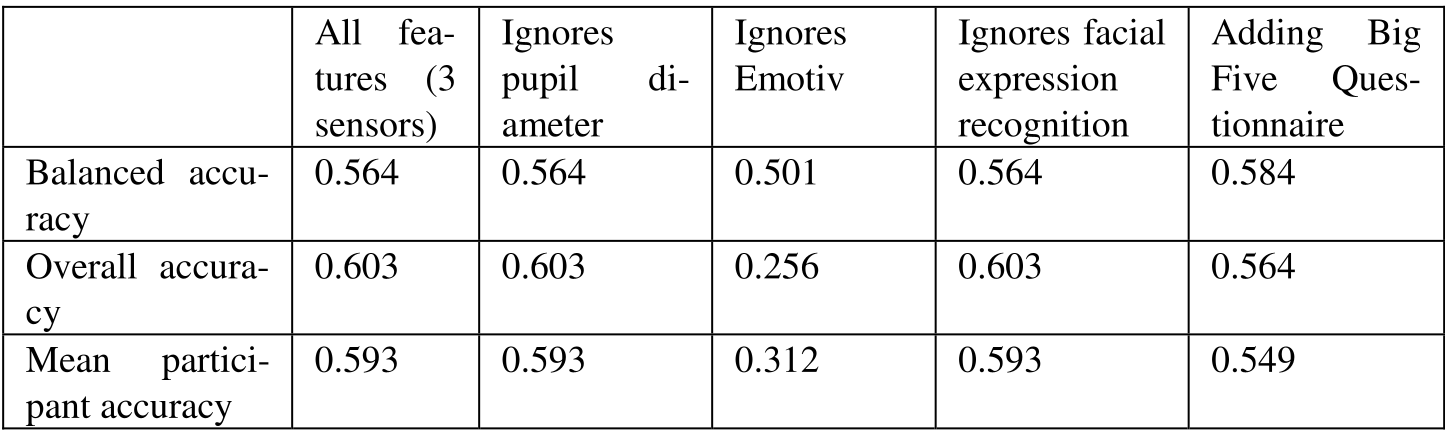 Table 2: Impact of different sensors on prediction accuracy. Removing EEG (Emotiv) shows the most drastic performance loss.
Future Outlook: The Adaptive Tutor
The study concludes that a Logistic Regression model focused on EEG features is the most efficient path forward. While the accuracy (~63%) leaves room for improvement, it represents a foundational step toward Adaptive Serious Games.
Limitations & Future Work
- Individual Differences: The ROC curves (Figure 3 in the paper) showed high variability between participants, indicating that a "one-size-fits-all" model might be less effective than one that calibrates to an individual's unique biological baseline.
- Intrusiveness: Wearing an EEG headset is still a barrier for casual educational use. The next challenge is achieving similar predictive power using less intrusive hardware.
Conclusion
LewiSpace demonstrates that the "Silent Failure"—where a student struggles internally without outward signs—can be detected via machine learning. This research shifts the focus from simply building "fun" games to building "perceptive" environments that understand the learner's mind.
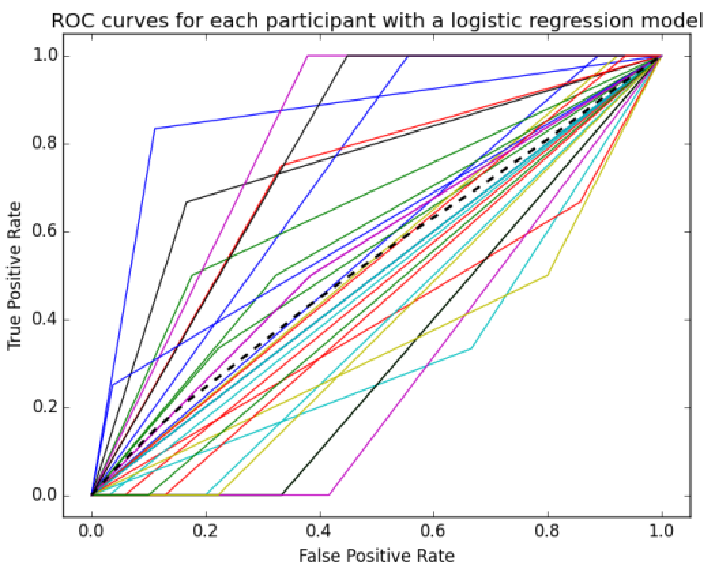 Figure 3: ROC curves showing the model's performance variability across 33 different participants.