
[ArXiv 2025] LeWorldModel: Radical Simplicity in End-to-End World Modeling
LeWorldModel: Stable End-to-End Joint-Embedding Predictive Architecture from Pixels
LeWorldModel (LeWM) is a Joint-Embedding Predictive Architecture (JEPA) designed for stable end-to-end world model learning from raw pixels. It achieves state-of-the-art performance in 2D and 3D control tasks while enabling planning speeds up to 48× faster than foundation-model-based alternatives.
Executive Summary
TL;DR: LeWorldModel (LeWM) sets a new standard for Joint-Embedding Predictive Architectures (JEPA) by stripping away the complexity that has plagued the field. By using just two loss terms and a clever Gaussian regularizer, it learns to predict future states from raw pixels stably and efficiently, outperforming complex 7-loss systems and matching massive pre-trained foundation models in control tasks.
Background: Within the landscape of World Models, we usually choose between Generative Models (which dream in pixels but are slow) and Joint-Embedding models (which dream in latent space but are prone to "collapsing" into a single point). LeWM sits at the SOTA of the latter, providing the first truly stable, end-to-end training pipeline that doesn't rely on pre-trained "crutches" or unstable heuristics.
The Problem: The Fragility of Latent Prediction
The core philosophy of JEPA is to ignore "task-irrelevant" pixels and focus on predicting future latent states. However, the Model is smart: if it maps every image to the vector [0, 0, 0], its prediction error is zero. This is Representation Collapse.
To stop this, prior SOTA like PLDM introduced a "loss-soup" of variance, invariance, and covariance terms—often totaling 6 or 7 hyperparameters. Tuning this is a nightmare. Other methods like DINO-WM simply freeze a pre-trained encoder, but this prevents the model from learning features specific to the unique physics of a new environment.
Methodology: The Power of SIGReg
The breakthrough in LeWM is the application of SIGReg (Sketched-Isotropic-Gaussian Regularizer). Instead of complex covariance matrices, LeWM forces the latent representations to follow a standard Isotropic Gaussian distribution.
How SIGReg Works:
- Random Projections: It projects high-dimensional embeddings onto 1D lines in random directions.
- Normality Testing: It uses the Epps-Pulley test to check if these 1D projections look like a Bell Curve (Gaussian).
- Joint Convergence: Mathematically, if all 1D projections are Gaussian, the whole high-dimensional space is Gaussian.
This "anti-collapse" force keeps the latent space spread out and diverse, allowing the Predictor (a 10M parameter Transformer) to learn the actual dynamics of the world without the "easy way out" of collapse.
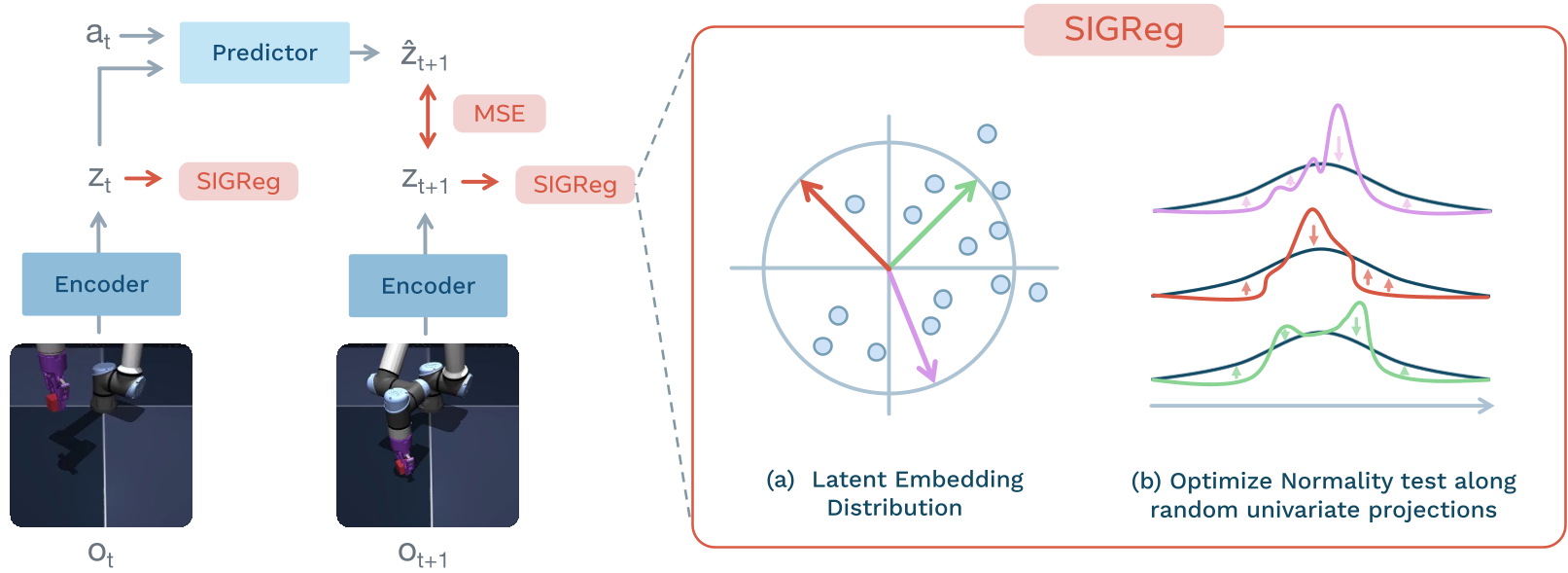 Figure 1: The LeWM Training Pipeline. Simple MSE prediction coupled with the SIGReg "diverse-feature" force.
Experiments: Speed and Physical Intuition
The authors tested LeWM on 2D and 3D tasks like Push-T and OGBench-Cube.
Key Findings:
- Efficiency: LeWM achieves planning times up to 48× faster than DINO-WM because it uses far fewer tokens (compact latents vs. heavy patch features).
- Stability: While PLDM's loss curves looks like a noisy rollercoaster, LeWM's curves are smooth and monotonic.
- Physical Grounding: By training "probes" (simple MLPs) on the latent space, the authors found the model naturally "understands" coordinates and angles of objects, even though it was never told to look for them.
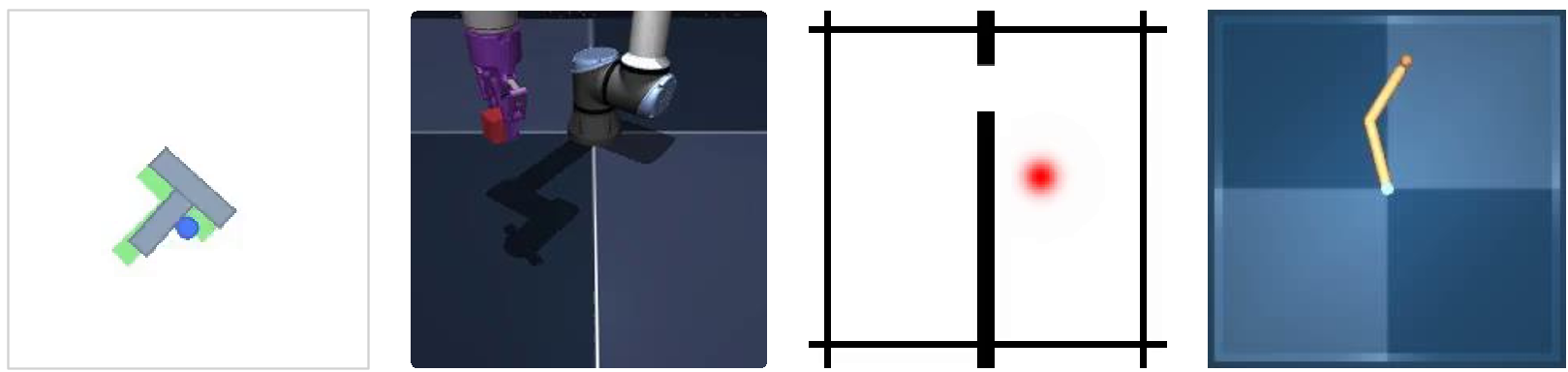 Figure 2: Performance across environments. LeWM beats end-to-end predecessors (PLDM) and matches foundation-model based ones (DINO-WM).
Surprise! Testing the World Model
One of the most impressive parts of the paper is the Violation of Expectation (VoE) test. When the authors "teleported" an object in the simulation (a physical impossibility), the model's Surprise Score (prediction error) spiked immediately. Interestingly, if they just changed the color of the object (a visual but not physical violation), the surprise was much lower. This proves the JEPA is truly focusing on the physics of the world, not just the pixels.
Critical Insights & Conclusion
LeWorldModel proves that less is more. By replacing empirical heuristics with a sound statistical prior (SIGReg), the authors achieved:
- End-to-end training from scratch on a single GPU in hours.
- Robustness across architectures (ViT or ResNet).
- Real-time suitability for robotics via high-speed MPC planning.
Limitations: The model currently struggles in extremely low-diversity environments where forcing a Gaussian distribution might be "overkill" and lead to less structured spaces. Future work should look into hierarchical planning to solve longer-term goals where simple autoregressive prediction might drift.
The Takeaway: For practitioners, LeWM suggests that if you want to build a world model, stop adding more loss terms. Instead, focus on the statistical distribution of your latent space.