[CVPR 2026] LeWorldModel: Stripping JEPA to its Core for Stable, Fast, and Pixel-Direct World Modeling
LeWorldModel: Stable End-to-End Joint-Embedding Predictive Architecture from Pixels
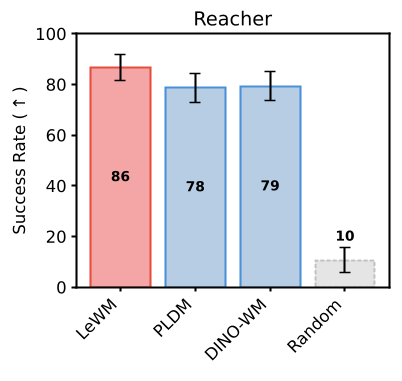
LeWorldModel (LeWM) is a Joint-Embedding Predictive Architecture (JEPA) designed for stable end-to-end world model learning from raw pixels. It achieves state-of-the-art performance on control tasks like Push-T (96% success rate) while enabling planning up to 48x faster than foundation-model-based alternatives.
TL;DR
LeWorldModel (LeWM) sets a new standard for Joint-Embedding Predictive Architectures (JEPA) by proving that "less is more." By replacing complex, multi-term heuristic losses with a single statistically-grounded Gaussian regularizer (SIGReg), LeWM trains stably from raw pixels on a single GPU. It achieves SOTA success rates on robotic manipulation tasks while planning 48x faster than models relying on frozen DINOv2 features.
Background: The Collapse of Complexity
In the quest for "World Models" that can imagine the future, JEPAs are the leading candidates. Unlike generative models (like Dreamer) that reconstruct every pixel—a massive waste of compute—JEPAs only predict in latent space.
However, JEPAs suffer from a fatal flaw: Representation Collapse. If the model predicts that "the future looks like the current state," and the encoder maps every observation to a constant vector , the loss is zero, but the model is useless. Previous attempts to fix this (like VICReg or PLDM) introduced a "hyperparameter soup" of variance, covariance, and temporal smoothness terms that are notoriously hard to balance.
Methodology: Simplicity through SIGReg
The core insight of LeWM is replacing the complexity of the VICReg-style loss (which has ~6-7 terms) with a two-term objective:
- MSE Prediction Loss: Predict the next latent state given and action .
- SIGReg (The Anti-Collapse Guard): Instead of complex covariance matrices, SIGReg projects high-dimensional embeddings onto random directions and ensures they follow a Normal Distribution.
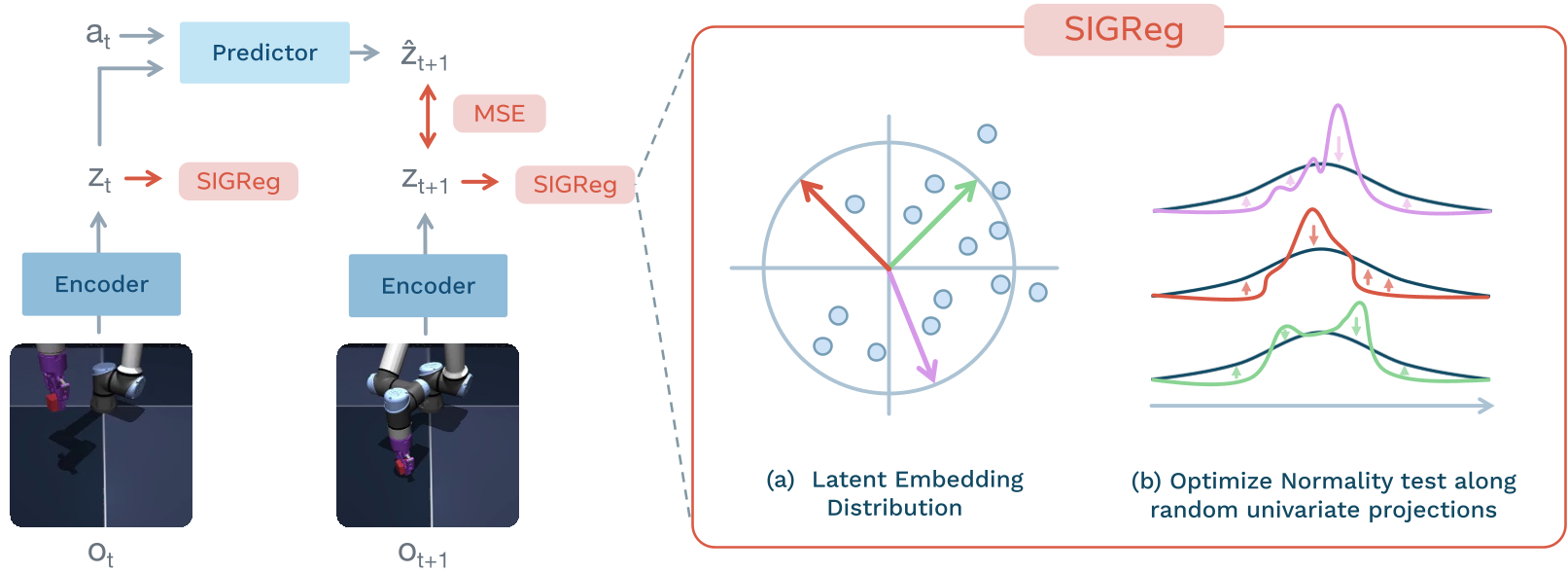
By the Cramér–Wold theorem, if every 1D projection of a distribution is Gaussian, the entire high-dimensional distribution is an Isotropic Gaussian. This "whitens" the latent space, ensuring features stay diverse and informative without needing stop-gradients or teacher-student EMA tricks.
Experimental Results: Speed and Accuracy
The authors tested LeWM across 2D and 3D control environments (Push-T, OGBench, Reacher).
1. Superior Efficiency
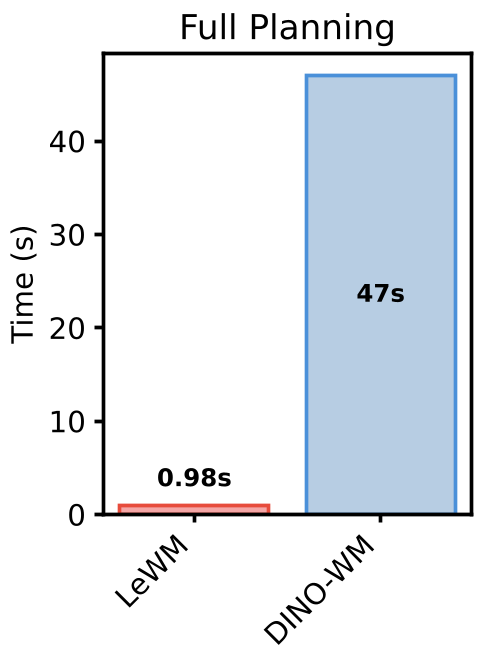
Because LeWM is trained end-to-end, its encoder (a ViT-Tiny) is optimized specifically for the task. This results in a latent space with significantly fewer tokens than DINO-WM (which uses frozen, general-purpose tokens).
- Planning Speed: 48x faster than DINO-WM.
- Latency: Full MPC planning cycles complete in under 1 second on a single GPU.
2. Emerging Physical Intuition
Remarkably, though never trained to reconstruct images or understand physics, LeWM's latent space exhibits "Temporal Straightening." Latent trajectories become smoother and straighter over time, a property observed in biological vision. Probing experiments show that simple linear decoders can extract precise object coordinates and angles from the latent vector, outperforming previous SOTA methods.
Critical Analysis: The Trade-off
LeWM’s primary strength is its logarithmic-time hyperparameter search. Because it essentially only has one parameter to tune , researchers can find the optimal setup in a fraction of the time required for PLDM.
Limitations:
- Environment Complexity: In extremely simple environments (like TwoRoom), the Gaussian prior might be "too strong" for the low-intrinsic dimensionality of the data, leading to slightly worse performance than multi-term losses.
- Horizon: Like all current latent models, it eventually drifts over very long horizons (accumulating error).
Conclusion
LeWorldModel represents a major step toward Autonomous Machine Intelligence. By moving away from "architectural tricks" and toward "statistical principles," it provides a robust, fast, and scalable blueprint for agents that learn to understand the world simply by watching it.