
LEXA: Decoding the Logic of Legal Precedents through Incremental Knowledge Acquisition
LEXA: Towards Automatic Legal Citation Classification
The paper introduces LEXA (Legal tEXt Analyzer), a system for automatic legal citation classification using Single Classification Ripple Down Rules (SCRDR). Evaluated on Australian Federal Court reports, LEXA significantly outperforms Naive Bayes baselines in identifying complex citation relationships like "Distinguished" vs. "Followed."
TL;DR
LEXA is an innovative system designed to classify legal citations (e.g., whether a case is "Followed" or "Distinguished") using a human-in-the-loop approach called Ripple Down Rules (RDR). By building an incremental rule-based knowledge base over just one week, the authors outperformed standard Machine Learning models, particularly in identifying rare but critical legal treatments.
Background: The Chaos of "Legalese"
In common law systems (like Australia, the UK, and the USA), the principle of stare decisis makes past court decisions binding. However, lawyers aren't just looking for if a case was cited, but how. Was the previous ruling applied as a rule, or was it "distinguished"—meaning the court found it irrelevant due to different facts?
Automating this is notoriously difficult because:
- Complexity: Legal sentences are longer and more philosophical than news or scientific papers.
- Ambiguity: Even human experts disagree on citation labels nearly 60% of the time.
- Imbalance: Most citations are neutral ("cited"), while critical "Distinguished" labels are rare.
Methodology: The Ripple Down Rules (RDR) Approach
Instead of relying on a "black box" statistical model, LEXA uses Single Classification Ripple Down Rules (SCRDR).
How it Works:
- The Tree Structure: Knowledge is stored in a binary tree of "if-then" rules.
- Incremental Patching: When the system misclassifies a case, a human expert adds an "except" rule at the specific point of failure.
- Contextual Analysis: Rules are built using JAPE grammars, looking for specific patterns like judge names, party roles (appellant/plaintiff), and specific linguistic cues.
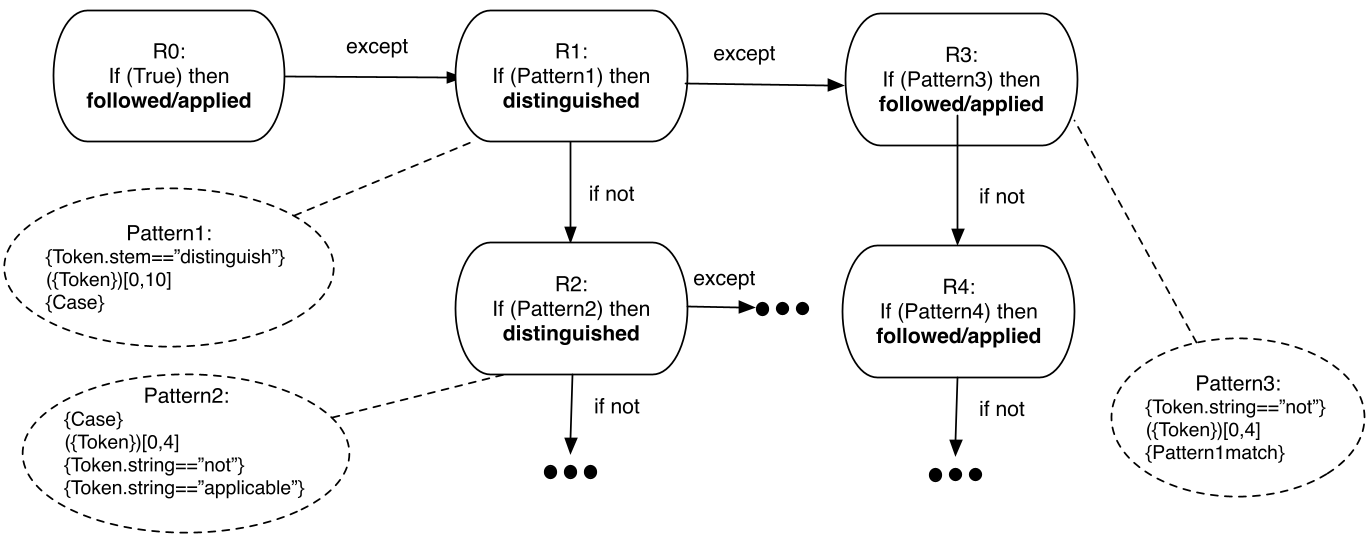 Figure 1: An example of an RDR tree where rules are refined through exceptions to handle "Distinguished" vs "Followed" cases.
Experiments & Results: Human Intuition vs. Naive Bayes
The authors compared LEXA against a Naive Bayes (NB) classifier using a "Bag of Words" model. They focused on the Distinguished (D) class versus the Followed/Applied (FA) class.
Key Findings:
- Superior Generalization: While Naive Bayes showed signs of overfitting (high training performance, low test performance), LEXA remained robust.
- The "Agreement" Boost: When the authors filtered the data to only include cases where two independent legal databases (AustLII and LexisNexis) agreed on the label, LEXA’s performance surged.
 Table 1: Performance comparison showcasing LEXA’s higher F-measure for the minority "Distinguished" class compared to various Naive Bayes configurations.
Critical Insights: Why RDR Wins in Law
The success of LEXA highlights a vital truth in LegalTech: Expertise matters.
- Data Scarcity: In many legal sub-tasks, classified training data is non-existent. RDR allows a system to be built from scratch without a massive pre-labeled corpus.
- Explanation: Unlike ML models, every classification in LEXA can be traced back to a specific rule created by an expert, providing the "why" that is essential in legal contexts.
- Handling Noise: Legal labels are subjective. LEXA’s structure allows it to "ignore" or refine specific noisy cases without ruining the entire statistical distribution of the model.
Conclusion & Future Outlook
LEXA proves that specialized domains don't always need "more data"; sometimes, they need "better logic." As we move into the era of Large Language Models, the RDR approach offers a fascinating blueprint for Human-in-the-loop refinement, where experts can "patch" model behaviors in a structured, verifiable way.
The authors plan to integrate LEXA into a broader summarization framework, moving from recognizing citations to understanding the very fabric of legal arguments.