
Deciphering the Language of UX: A Lexical Approach to Social Media Applications
Using a Lexical Approach to Investigate User Experience of Social Media Applications
This research proposes a methodology to identify core factors influencing the User Experience (UX) of Social Media Applications (SMAs) using a revised lexical approach. By analyzing the natural language (adjectives) used in over 26,000 online reviews across seven independent platforms, the study seeks to map the semantic dimensions of SMA usability.
TL;DR
Researchers are moving beyond structured surveys to understand what makes or breaks a social media app. This study leverages the Lexical Hypothesis—the idea that important human experiences are eventually encoded into language—to analyze 26,000+ online reviews. By distilling thousands of adjectives into core "factors," the authors aim to build a definitive map of the Social Media Application (SMA) user experience.
Background: Why Language Matters
The rapid evolution of SMAs (Facebook, Twitter, etc.) has outpaced our theoretical understanding of why users engage or abandon them. While we know personality traits like Extraversion or Neuroticism affect usage, we often lack a "ground truth" for the application itself.
The authors argue that just as psychologists identified the "Big Five" personality traits by analyzing every descriptive word in the dictionary, UX researchers can identify the "Big Factors" of SMAs by analyzing the adjectives users naturally choose when writing reviews.
The Pain Point: The Gap in UX Standardization
Current UX research often focuses on:
- Interface Design: Shared referents and content visibility.
- User Characteristics: Loneliness, shyness, and the need for cognition.
- Marketing Metrics: Implicit feedback and recommendation accuracy.
However, these views are often siloed. There isn't a unified framework that captures the holistic experience from the user's perspective. Traditional surveys are limited by the researcher's bias (you only get answers to the questions you ask), whereas online reviews are unstructured, honest, and high-volume.
Methodology: Engineering a Lexical Pipeline
The study adopts a four-stage revised lexical approach:
- Data Collection: Using specialized Perl crawlers to scrape 7 major independent review sites, ensuring a diverse mix of expert and casual user opinions.
- Dictionary Building: Using Natural Language Processing (NLP) to isolate adjectives and filter out noise (stop words) while preserving specific tech jargon (e.g., "laggy," "intuitive").
- Rating Extraction: Converting reviews into a binary matrix where each row is a review and each column is a descriptive adjective.
- Factor Analysis: The "magic" step where statistical modeling groups related adjectives (e.g., "fast," "smooth," "responsive") into a single latent factor like "Performance."
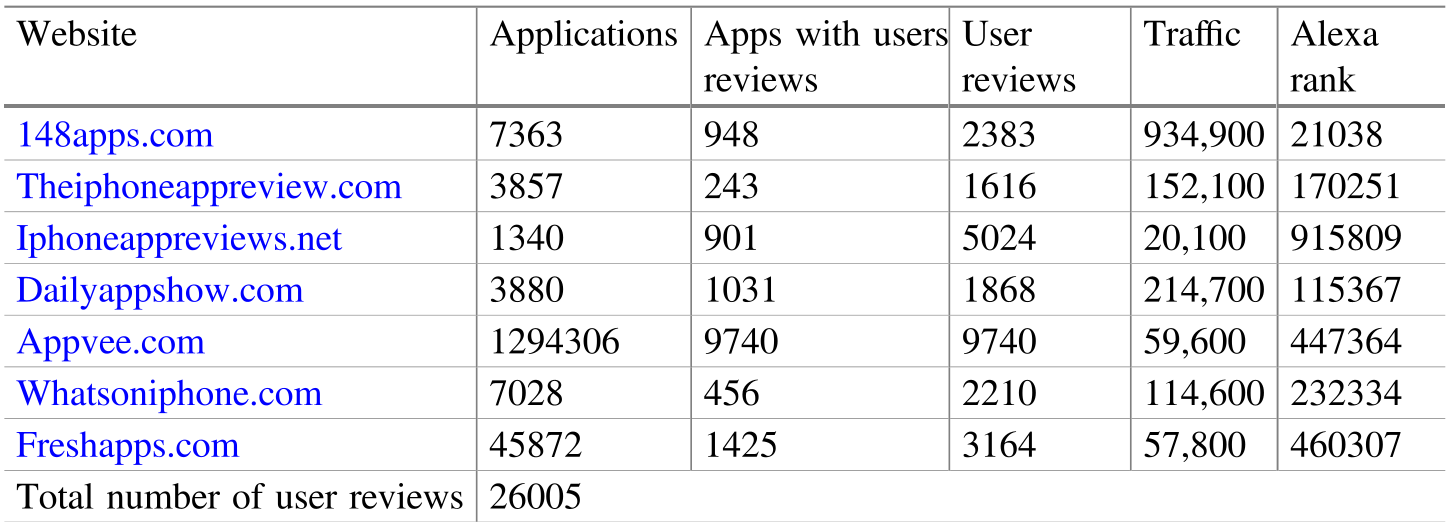 Table 1: The scale of data collection across diverse SMA review platforms.
Early Results & Insights
The researchers successfully crawled a massive dataset, highlighted in the table above. The sheer volume (26,005 reviews) provides a statistically significant foundation for Exploratory Factor Analysis.
One critical insight from the literature review incorporated into this study is the Social Factor. The authors note that user experience in SMAs is uniquely tied to "social capital"—factors like trust, privacy, and "face-to-face" relationship translation—which they expect will emerge as a distinct lexical factor in the final results.
Critical Analysis & Future Outlook
Strengths: This approach is highly scalable. Unlike a lab study with 20 participants, this methodology captures the voices of thousands. It is also "bottom-up," meaning the dimensions of UX are discovered from the data, not imposed by the researcher.
Limitations: The current methodology uses a binary matrix (0 or 1 for word presence). This fails to capture sentiment intensity or negation (e.g., "not fast"). Future iterations could benefit from VADER sentiment analysis or transformer-based embeddings (like BERT) to capture semantic nuance.
Conclusion: This paper serves as a blueprint for "Computational UX." By treating the dictionary as a source of psychological data, the authors are bridging the gap between big data linguistics and human-computer interaction. As social media becomes more integrated into education and work, understanding these latent lexical factors will be crucial for the next generation of application designers.