
IBM's LEXIS Project: Bridging the Gap Between English Simplicity and Norwegian Complexity
Lexicography for IBM Developing Norwegian Linguistic Resources in the 1980s
The paper chronicles the "LEXIS project" (1984–1991), a pioneering collaboration between IBM and the University of Oslo to build comprehensive Norwegian language resources for computing. It details the creation of high-compaction "base dictionaries" for Norwegian Bokmål and Nynorsk, which powered early spelling checkers and automatic hyphenation systems across IBM’s hardware ecosystem.
TL;DR
In the mid-1980s, IBM Norway and the University of Oslo embarked on a massive endeavor to bring "intelligence" to Norwegian word processing. By developing the LEXIS project, they created high-density linguistic modules for Bokmål and Nynorsk that moved beyond simple list-checking into complex morphological analysis. Though birthed in an era of 4.77 MHz processors, this project laid the groundwork for modern Norwegian computational linguistics.
The "English Simplicity" Problem
Most early computing standards were built by English speakers for English speakers. In the realm of NLP, English is deceptively "simple": it has poor morphology (few verb/noun forms) and usually handles compound words with spaces (e.g., "red wine").
Norwegian, however, presents a different beast entirely:
- Inflectional Wealth: A single Norwegian noun can have many more forms than its English counterpart.
- The Compounding Nightmare: Norwegian compounds are written as single complex words (e.g., rødvin). While English can just check "red" and "wine," a Norwegian system needs to understand how constituents fuse—often adding linking letters like —s— or —e—.
Methodology: The Architecture of Compaction
In 1983, the IBM XT had only 256 kB of RAM. Efficiency was not just a goal; it was a physical requirement. To solve this, the LEXIS project employed a tripartite architecture:
- Ultrahigh Frequency List: Constant access to the ~200 most common words.
- High Frequency Dictionary: Covering roughly 85% of text occurrences.
- Main Dictionary: A massive repository of unique word forms.
Breaking Down the Stem
The team moved away from purely "linguistic stems" to "technical stems." A technical stem was a valid word form that could act as a root for other derivations. This was managed via complex "Endings Files" and "Compounding Flags."
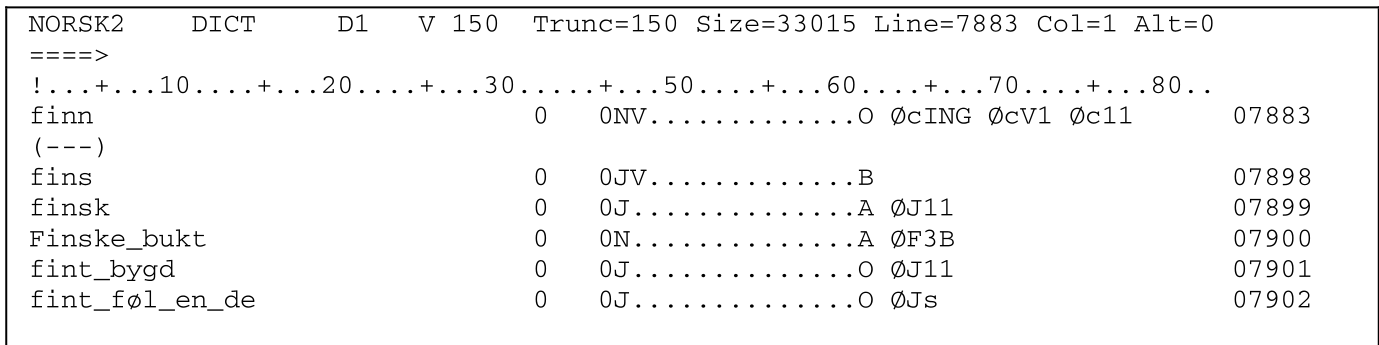 Figure 1: Anatomy of the LEXIS input files, showing technical suffixes and implied ending sets.
The system used logic flags (B, O, F, A) to determine if a word could appear at the front, middle, or back of a compound—a precursor to the finite-state automata used in later years.
Experimental Success: Scaling to Necessity
By 1989, the project had scaled from a "toy system" to a comprehensive national resource. The sheer volume of data generated was staggering for the time:
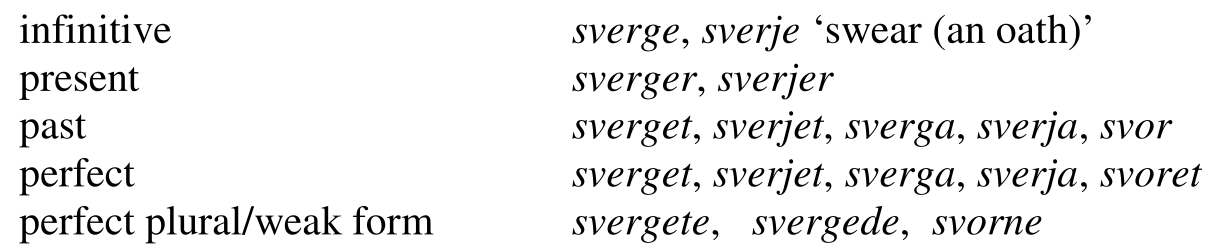 Figure 2: Example of the morphological complexity handled, illustrating the various forms of the verb 'sverge' (to swear).
| Module | Stems (1989/90) | Unique Word Forms |
|---|---|---|
| Bokmål | 51,292 | 487,166 |
| Nynorsk | 92,787 | 360,680 |
The project didn't just stop at spelling. It eventually expanded into synonym dictionaries (25,000 entries for Nynorsk) and early prototypes for grammar and style critiquing.
Critical Insight: The Legacy of a "Failed" Product
Despite its technical brilliance, the project was terminated in the late 1980s due to IBM's corporate financial crisis and the poor sales of their DisplayWrite software.
The Takeaway? Even if a commercial product fails, the underlying linguistic infrastructure can be immortal. When IBM exited the project, the files were transferred to the University of Oslo. Today, the work done in the 80s to define Norwegian digital morphology remains an integral part of the country's academic NLP infrastructure. It serves as a reminder that robust data is the true "base" of any intelligence system—be it an 80-bit dictionary or a modern LLM.
Concluding Remarks
The IBM LEXIS project was a "broad front offensive" against the English-centricity of early technology. It proved that deep linguistic expertise is required to make software truly multilingual. For students of NLP history, it stands as a monument to the transition from simple character sequence recognition to full-scale computational morphology.