
LFOIL: Bridging the Gap Between Symbolic Logic and Natural Language Uncertainty
LFOIL: Linguistic rule induction in the label semantics framework
The paper introduces LFOIL (Linguistic FOIL), a novel rule induction algorithm for classification that integrates Quinlan’s FOIL with the Label Semantics framework. It generates compact, interpretable linguistic rules using random set theory to model the uncertainty of words in data discretization.
TL;DR
LFOIL (Linguistic First-Order Inductive Learning) is a classification algorithm that transforms raw numerical data into a handful of human-readable "linguistic rules." By leveraging Label Semantics, it treats words as random sets, allowing for a mathematically rigorous yet intuitively transparent model that rivals the accuracy of standard decision trees (C4.5) while being vastly more concise.
Context & Positioning: Why Words Matter
In the quest for high performance, modern machine learning often sacrifices transparency. Traditional rule-based systems, while transparent, suffer from "the boundary problem"—a value of 30.1 might be treated fundamentally differently than 30.0 due to arbitrary discretization.
LFOIL positions itself as a successor to both the classic FOIL algorithm and early fuzzy rule induction methods. It resides in the Label Semantics coordinate system, where the goal isn't just to find "fuzzy" boundaries but to model how a population of users would appropriately describe data using a shared vocabulary (e.g., "high," "medium," "low").
Problem & Motivation: The Interpretable Bottleneck
Prior works in fuzzy rule mining often generated hundreds of rules to capture data nuances, effectively becoming "black boxes" themselves. The authors identified a central pain point: How do we maintain robustness (via fuzzy logic) without losing the brevity that makes rules useful to humans?
The insight here is that by using a random set framework, we can quantify the "appropriateness" of a linguistic description. This allows the model to "speak" in a way that aligns with human cognition while using information theory to prune away redundant complexity.
Methodology: The Core Mechanism
LFOIL’s architecture is built on three pillars:
- Linguistic Translation (LT): Converting numerical points into mass assignments. This isn't just a membership function; it’s a distribution over sets of labels.
- -Function and -Function: These provide the bidirectional mapping between logical expressions (e.g.,
Attribute IS NOT Large) and their underlying random set representations. - Modified Information Gain: Unlike standard FOIL, LFOIL calculates gain using the sum of appropriateness degrees across the dataset, allowing for partial coverage.
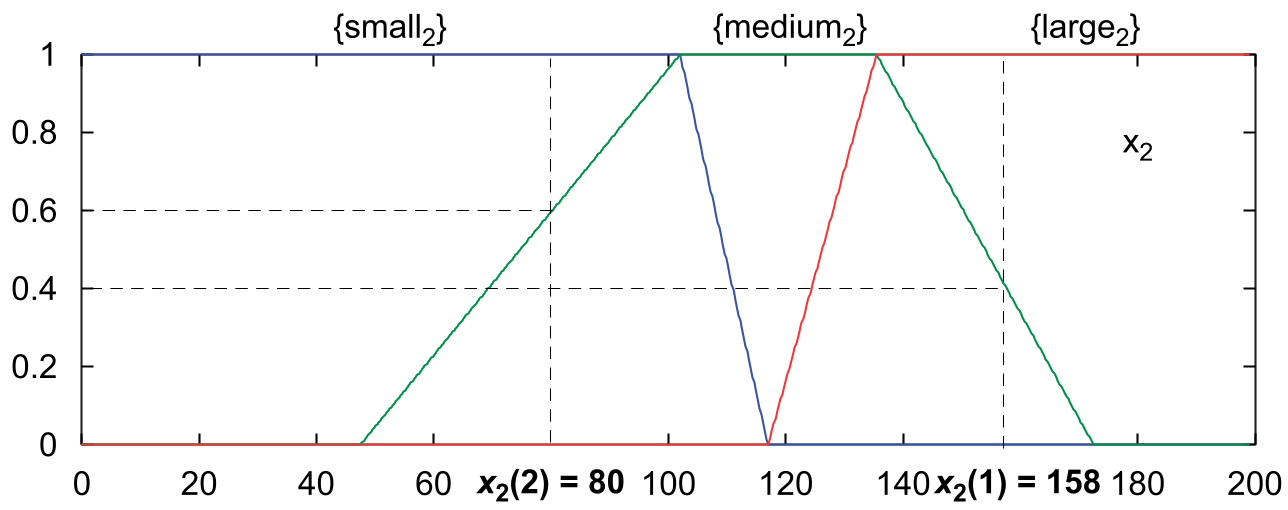 Figure 1: Numerical domains are covered by overlapping fuzzy labels, ensuring smooth transitions and a linguistic basis for rule induction.
The Rule Induction Loop
LFOIL starts with an empty rule and greedily adds the literal that maximizes the info-gain . It stops adding literals once the rule’s "purity" (probability of the class given the rule) exceeds a threshold . This prevents the model from over-specifying rules that only capture noise.
Experiments: SOTA Comparison
The authors tested LFOIL against C4.5 and other linguistic models (LID3, FNB). While LFOIL's accuracy was occasionally "marginally worse" than the most complex fuzzy models, its rule count was the real winner.
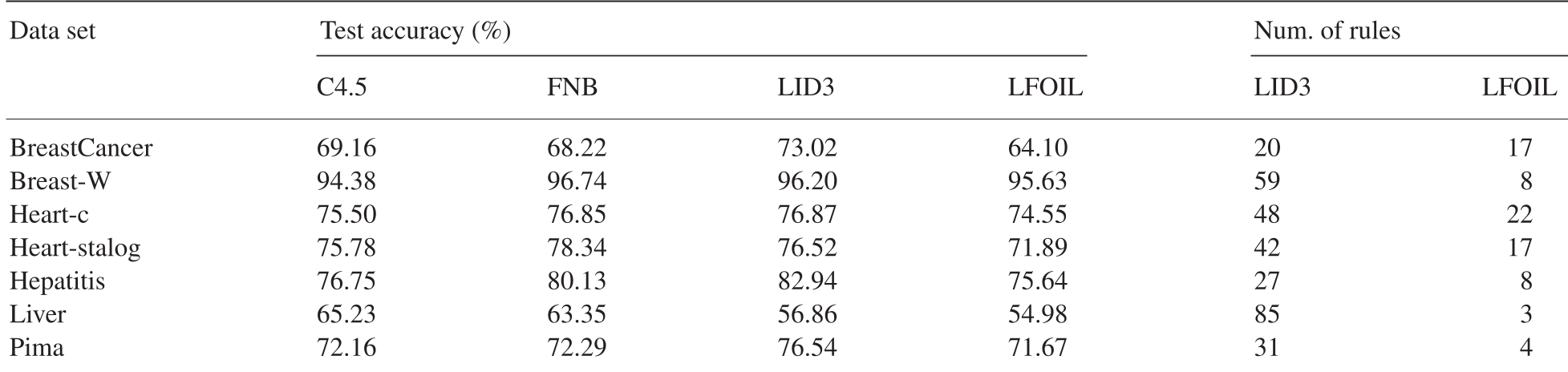 Table 1: Note the 'Num. of rules' column. For the 'Breast-W' dataset, LFOIL achieves 95.6% accuracy with just 8 rules, while LID3 requires 59.
In the Pima Indian diabetes study, LFOIL distilled a complex medical dataset into just four rules, such as:
- If Plasma Concentration is medium AND Age is NOT low Diabetic.
This level of compression is invaluable for practitioners who need to validate the model's logic against clinical domain knowledge.
Critical Analysis & Conclusion
Takeaway
LFOIL proves that we don't need hundreds of rules to solve real-world problems. By grounding rule induction in Label Semantics, we can obtain "compact linguistic essences" of datasets.
Limitations & Future Work
The primary drawback is the reliance on manual parameter tuning (, , ). The current selection via trial-and-error suggests that more automated "parameter-free" versions of LFOIL are needed. Additionally, while it handles numerical data well, its performance on high-dimensional relational data remains an open question.
Ultimately, LFOIL is a powerful reminder that transparency is a feature, not a compromise.