
LGIM: Balancing the Scales of Efficiency and Accuracy in Social Influence Maximization
LGIM: A Global Selection Algorithm Based on Local Influence for Influence Maximization in Social Networks
The paper introduces LGIM (Local-Global Influence Maximization), a heuristic algorithm that bridges the gap between efficiency and accuracy in social network influence maximization. It utilizes a two-stage filtering strategy and a novel objective function, EIOS, to select optimal seed nodes without relying on time-consuming Monte-Carlo simulations.
TL;DR
Influence Maximization (IM) is the task of finding nodes in a social network that trigger the widest information spread. For years, researchers have struggled with the "Efficiency-Accuracy Paradox." LGIM (Global Selection Based on Local Influence) breaks this deadlock by replacing expensive simulations with a localized filtering strategy and a smart objective function (EIOS), achieving SOTA results on six massive real-world datasets.
Academic Positioning: This work is a strategic "theoretical bridge," merging the speed of heuristic local-search with the rigorous mathematical properties (submodularity) of greedy global algorithms.
The Problem: The High Cost of Greed
The "hill-climbing" greedy algorithm proposed by Kempe et al. is the gold standard for accuracy, but its reliance on Monte-Carlo (MC) simulations makes it a nightmare for large-scale graphs. While heuristics like Degree Discount are fast, they are "blind" to the complex paths of influence beyond immediate neighbors.
The authors identify a critical gap: Why select seed nodes from the entire graph when only a fraction of nodes truly drive the global narrative?
Methodology: The Local-to-Global Insight
The core intuition of LGIM is twofold:
- If you can influence a person who is already influential, you are globally powerful.
- Influential nodes tend to cluster; a representative "Source Node" can act as a proxy for its locality.
1. Two-Stage Filtering Strategy
Instead of calculating the marginal gain for every node in the graph, LGIM narrows the search space:
- Stage 1 (Source Node Selection): Identify nodes with high Local Influence Value (LFV) within a two-hop radius.
- Stage 2 (Candidate Pruning): Find the "ancestors" (potential sources) of these LFV nodes. This reduces the search space from to a much smaller set .
2. The EIOS Objective Function
The authors define Expected Influence on Source Nodes (EIOS). This function estimates how likely a set of candidate nodes is to activate the pre-selected source nodes. Crucially, they prove that EIOS is submodular, allowing them to use the "Lazy Forward" strategy to pick seeds with mathematical growth guarantees.
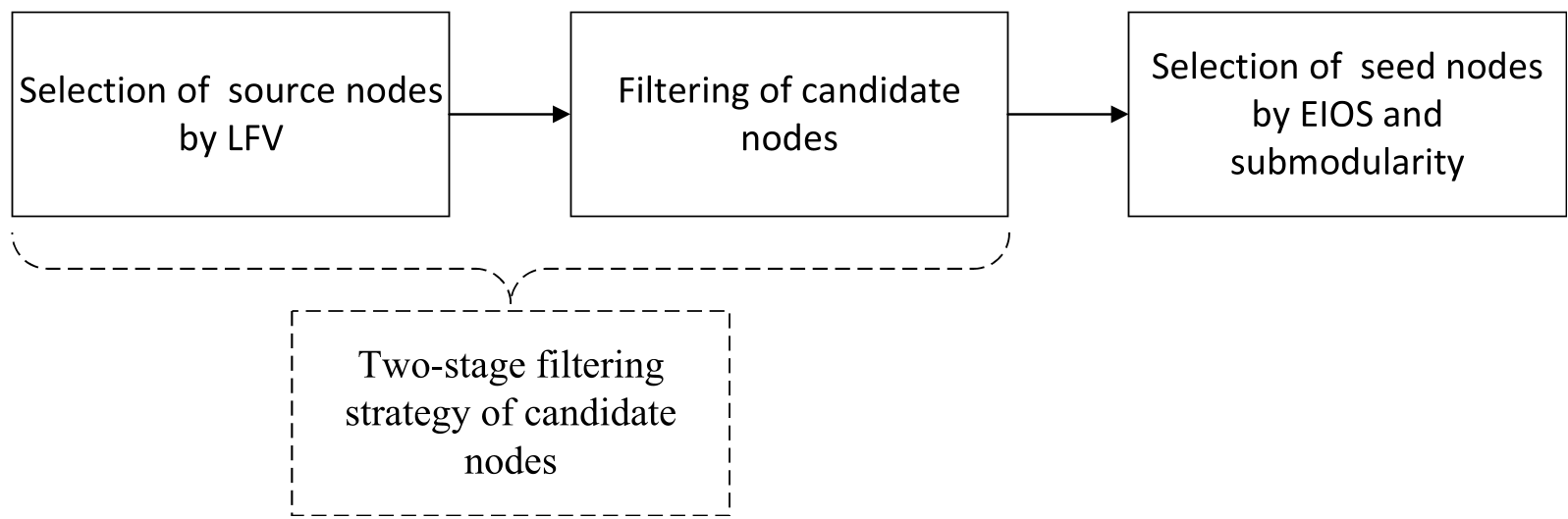 Figure 1: The three-step framework of LGIM involving Source Selection, Candidate Filtering, and Seed Selection.
Experiments: Breaking the SOTA
The researchers tested LGIM against heavyweights like IMM (Martingale-based) and PMIA (Arborescence-based) on datasets ranging from Wikipedia votes to Epinions trust networks.
Performance Highlights:
- Accuracy (Influence Spread): LGIM outperformed all competitors on 5 out of 6 datasets. In the Wiki-Vote network, it delivered 31.85% better spread than PMIA.
- Efficiency (Running Time): While slightly slower than the basic Degree Discount (which is expected given the higher complexity), LGIM was orders of magnitude faster than IMM and DDSE. On the CA-GrQc network, it saved over 90% of the computation time compared to IMM.
 Figure 2: Influence spread comparison across different seed set sizes (k). LGIM consistently stays at the top of the curve.
Critical Analysis & Takeaways
The brilliance of LGIM lies in its Search Space Pruning. By acknowledging that 90% of nodes in a social network are "followers" and focus on the ancestors of "local leaders," the algorithm avoids the computational trap of global optimization.
Limitations:
- The performance is somewhat dependent on the
thresholdandpop(source node set size) parameters. - In extremely sparse networks with low average degrees, the gap between LGIM and simpler heuristics narrows.
Future Work: The authors suggest that parallelizing the filtering process could make LGIM viable for real-time influence tracking in billion-node graphs like X (Twitter) or Facebook.
Conclusion: LGIM proves that you don't need to simulate the whole world to influence it—you just need to know who influences the influencers.