
Beyond Linear Models: Uncovering Hidden Health Risks via Association Rule Mining
Analysis Between Lifestyle, Family Medical History and Medical Abnormalities Using Data Mining Method – Association Rule Analysis
This study utilizes association rule analysis, a data mining technique, to explore the complex relationships between 6 lifestyle factors, 5 family medical histories, and 6 medical abnormalities using a 7-year longitudinal dataset of 5,350 male employees. The researchers successfully demonstrated that data mining uncovers more significant and potent risk factor combinations than traditional logistic regression.
TL;DR
While independent risk factors like smoking or obesity are well-known, their combined impact is often greater than the sum of their parts. This study moves beyond traditional logistic regression to employ Association Rule Analysis (Data Mining) on a 7-year dataset of 5,350 individuals. The results show that data mining identifies significantly more risk combinations and provides higher predictive "confidence" than conventional statistical modeling.
The "Adult Disease" Blind Spot
Modern medicine has shifted from "early treatment" to "primary prevention" of lifestyle diseases (hypertension, diabetes, etc.). However, health guidance in corporate and local settings remains largely uniform.
The core problem is combinatorial explosion. With 11 primary risk factors (6 lifestyle + 5 family history), there are possible combinations. Traditional logistic regression struggles to evaluate these interactions effectively, often leading to a "one-size-fits-all" approach that misses high-risk individuals with specific profiles.
Methodology: Rules of Engagement
The researchers redefined the problem as a search for association rules: (where is a set of lifestyle/genetic factors and is a medical abnormality).
Key Technical Metrics:
- Confidence: The conditional probability that abnormality occurs given the presence of risk factors .
- Support: The frequency of the combination in the total dataset.
- Adjusted Odds Ratio: A metric designed to remove confounding factors, allowing for a fair comparison with logistic regression.
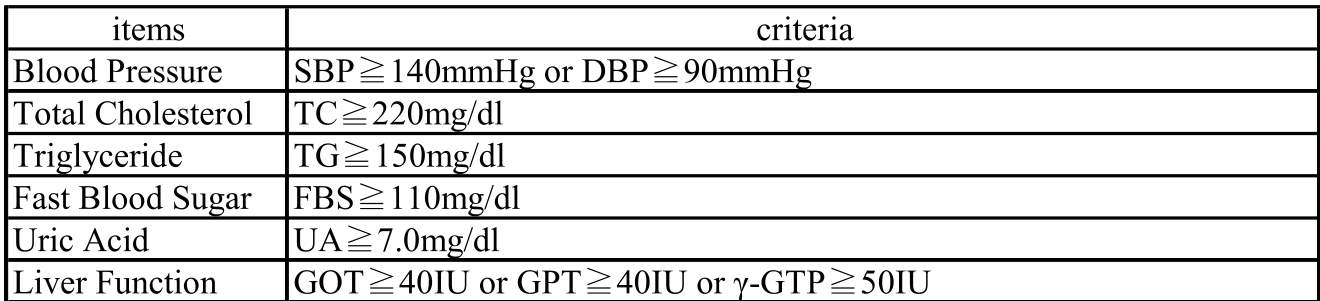
The study specifically focuses on two "classes" of patients: Class 1 (initially healthy) and Class 2 (higher initial values but still within "normal" range). This stratification allows the model to see how lifestyle impacts different baseline health states over seven years.
Experimental Results: The Power of Combinations
The study extracted 4,371 rules, of which 489 were statistically significant.
The Discovery of "Hyper-Risks"
The association rule mining found specific "antecedents" that logistic regression simply could not highlight. For example:
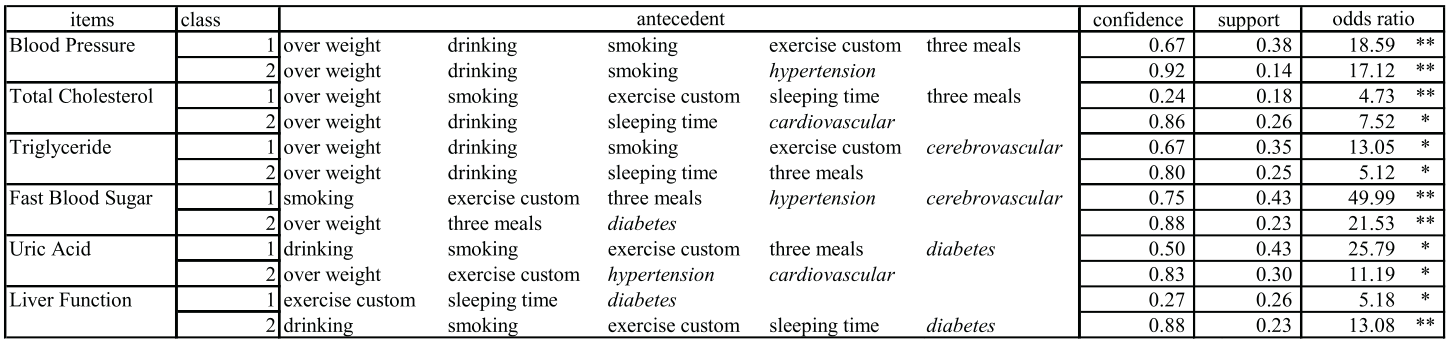
- Fast Blood Sugar Abnormality: A combination of smoking, lack of exercise, irregular meals, and a family history of hypertension/cerebrovascular disease resulted in an odds ratio of 49.99.
- Synergy: For almost every category, the odds ratios derived from association rules were significantly higher than those from logistic regression (see Table 9).
Critical Insight: Data Mining vs. Conventional Modeling
The superiority of the association rule method lies in its ability to treat risk factors as a interdependent cluster.
- Granularity: Logistic regression failed to find significant combinations for Total Cholesterol and Liver Dysfunction in Class 1 subjects, whereas data mining succeeded.
- Insight on Obesity: While obesity and alcohol were common denominators in many rules, the degree to which they amplified other factors (like family history) was only quantifiable through the mining approach.
Conclusion & Future Outlook
This research proves that the "Association Rule Method" is a more powerful tool for identifying effective combinations of risk factors than traditional linear models.
Limitations: The study is limited to a male-only cohort (5,350 employees), and the "support" (frequency) of some high-impact rules is low (under 2%), meaning they apply to specific sub-populations.
Future Work: Integrating these "rules" into automated health checkups could enable AI-driven, individualized health coaching—telling a patient not just that "smoking is bad," but exactly how much their specific family history and BMI amplify that risk.