
Light-Induced Quantum Friction: When Excitons Put the Brakes on Nanotubes
Light-induced quantum friction of carbon nanotubes in water
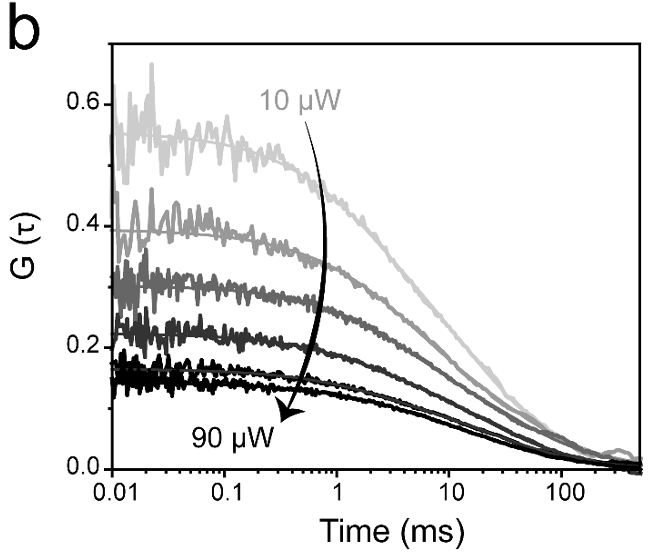
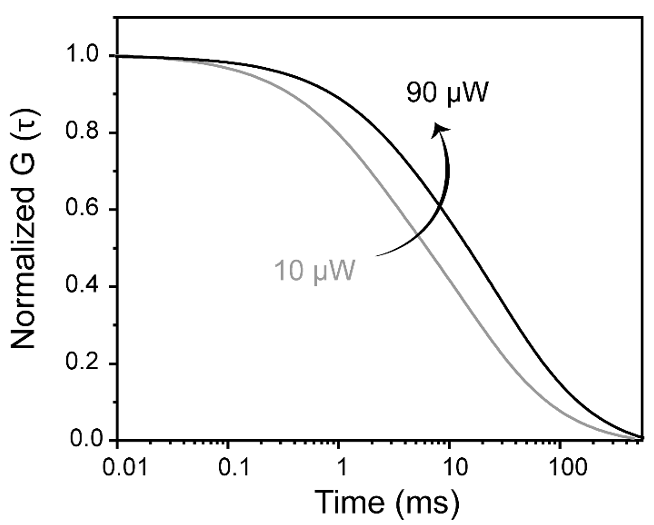
This study identifies and characterizes "light-induced quantum friction" in single-walled carbon nanotubes (SWCNTs) within aqueous environments. Using NIR fluorescence correlation spectroscopy and MD simulations, the authors demonstrate that electronic excitons couple with water's translational modes, reducing SWCNT diffusion constants by up to 50% as excitation power increases.
Executive Summary
TL;DR: In a groundbreaking study published by researchers at Ruhr-University Bochum, it has been discovered that light doesn't just make carbon nanotubes (SWCNTs) glow—it actually slows them down. This phenomenon, termed quantum friction, occurs because the electronic excited states (excitons) in the nanotubes "rub" against the surrounding water molecules, transferring momentum and increasing drag.
Context: This work moves beyond traditional Brownian motion frameworks, positioning the exciton as a tunable handle for nanofluidic friction. It provides a rare experimental bridge between quantum electrodynamics and macroscopic fluid dynamics.
Problem & Motivation: Beyond "Slippery" Carbon
Carbon nanotubes are often celebrated for their "superlubricity"—their smooth atomic walls allow water to flow through or around them with minimal resistance. However, theorists have long suspected that this classical picture is incomplete.
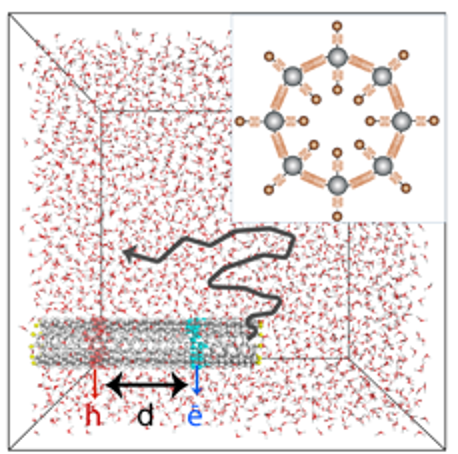
The authors identified a major gap: What happens when the nanotube is electronically excited? In semiconducting SWCNTs, light creates excitons—bound electron-hole pairs. The authors hypothesized that these excitons create fluctuating dipoles that couple with the Terahertz (THz) libration modes of water, creating a "quantum" drag force that shouldn't exist in the dark.
Methodology: Tuning Friction with Light and Chemistry
The team used Fluorescence Correlation Spectroscopy (FCS) to track the diffusion of SWCNTs. Their approach was two-pronged:
- Physical Control: Increasing laser power to generate more excitons.
- Chemical Control: Using analytes (Ascorbic Acid and Riboflavin) to "quench" or "boost" the fluorescence (exciton density) without changing the light intensity.
The Smoking Gun: Quantum Defects
To prove the friction was caused by moving excitons, they introduced sp3 quantum defects. These defects act as traps, pinning excitons to a single spot. Interestingly, nanotubes with these defects showed zero power-dependent change in diffusion, confirming that the mobility of the exciton along the tube is critical for generating friction.
Deep Dive: The Terahertz Connection
Why water? Using Optical Pump Terahertz Probe (OPTP) spectroscopy, the authors observed transient absorption features at 37 cm⁻¹ and above 80 cm⁻¹. These frequencies correspond exactly to the translational modes of water's hydrogen-bond network. This is the "friction" in action: the electronic energy from the nanotube is being leaked directly into the collective "sloshing" of the water molecules.
Results: A Macroscopic Impact
The results were startling:
- Diffusion Drop: Standard SWCNT diffusion constants decreased linearly by ~50% as excitation power increased.
- Molecular Scaling: Chemical "boosters" of excitons (ascorbic acid) slowed the tubes down, while quenchers speeded them up.
- Viscosity Shift: The friction is so potent that it affects nearby objects. 5 µm polystyrene beads placed in a "bright" SWCNT solution exhibited significantly slower movement (subdiffusion), effectively sensing an increased macroscopic viscosity.
Critical Insight & Conclusion
This work fundamentally changes our understanding of the solid-liquid interface. Friction is usually viewed as a surface-area or roughness problem. Here, it is shown to be an electronic density problem.
Takeaways for the Future:
- Nanofluidics: We can now imagine DNA-wrapped nanotubes acting as light-controlled valves or sensors where "brightness" directly translates to "mechanical resistance."
- Biological Imaging: Since SWCNTs are used for deep-tissue imaging, researchers must now account for the fact that their excitation light might be altering the local rheology of the cellular environment.
Limitations: The study primarily focuses on (6,5) chiralities in water. How this effect scales in non-polar solvents or with different nanotube diameters remains an open question for future "quantum tribology."