
LQOAS: Efficient Real-Time Data Pruning for Social Sensing in the Cloud
A Light-Weight and Quality-Aware Online Adaptive Sampling Approach for Streaming Social Sensing in Cloud Computing
The paper introduces LQOAS (Light-weight and Quality-aware Online Adaptive Sampling), a novel framework for streaming social sensing data in cloud computing. By utilizing a submodular maximization approach combined with information-theoretic quality estimation, it enables real-time selection of a representative subset of unstructured data (e.g., tweets) while achieving up to 18% improvement in sensing quality over state-of-the-art baselines.
TL;DR
Social sensing transforms humans into sensors, but the resulting flood of unstructured data (like tweets during a disaster) can overwhelm cloud resources and network bandwidth. LQOAS (Light-weight and Quality-aware Online Adaptive Sampling) solves this by using a submodular maximization approach to "live-filter" only the most informative data points. It achieves an 18% quality boost over standard methods while processing each data point in under 10 milliseconds.
Background: The Cost of Global Awareness
In the aftermath of events like Hurricane Sandy, millions of tweets are generated per minute. For emergency response systems, this "Big Data" is a double-edged sword: the information is vital, but the sheer volume creates a bottleneck for cloud processing and network transmission. Traditional sampling (like picking every 100th tweet) often discards high-value, "long-tail" information. The challenge lies in identifying which piece of unstructured text is "representative" without looking at the whole dataset at once.
The Core Innovation: Quality as a Mathematical Objective
The authors identify two fatal flaws in existing work: the inability to quantify quality for unstructured text and the lack of real-time adaptability. To fix this, they reframe sampling as a Streaming Submodular Maximization problem.
1. Quantifying the "Unquantifiable"
The DSQE (Dynamic Sampling Quality Estimation) component uses an information-theoretic approach. It doesn't just look for keywords; it measures:
- Coverage: How well the sample subset represents the overall feature distribution of the stream.
- Redundancy: Whether the new sample adds unique information or just repeats what we already know.
By using Enhanced Relative Entropy, the system turns raw text into feature vectors (via N-gram models) and calculates the "divergence" between the stream and the sample set.
2. The RQAS Mechanism: The Greedy Guardian
Instead of waiting for a batch of data, the RQAS (Real-time Quality-aware Adaptive Sampling) makes a split-second decision for every incoming tweet:
- Should we keep this?
- If yes, which old tweet should we discard to stay within our resource budget?
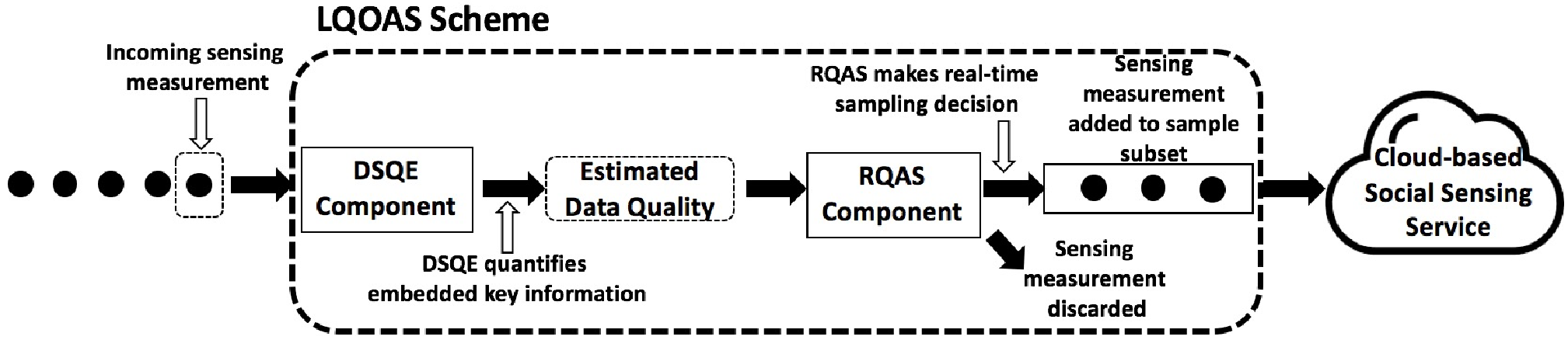
As shown in the architecture above, the system maintains a "Sliding Sampling Window" that constantly refreshes, ensuring the cloud only ever deals with a small, high-quality "Representative Set."
Experimental Proof: Better Quality, Lower Latency
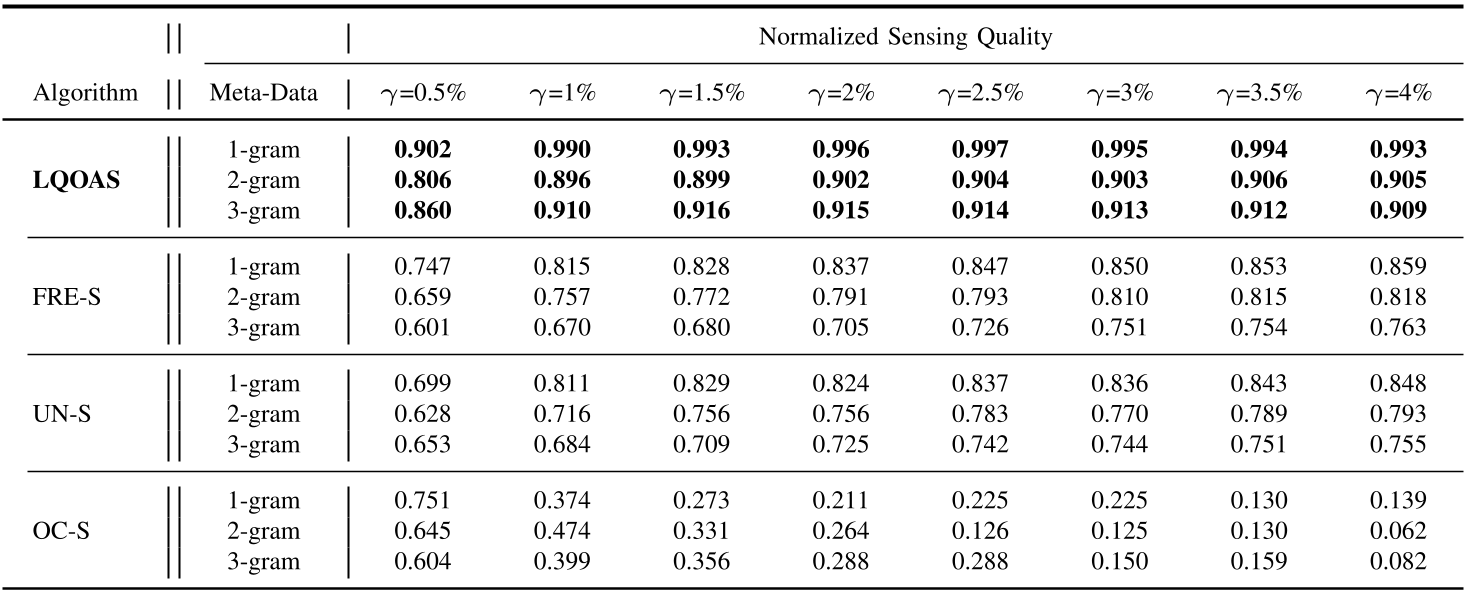
The researchers tested LQOAS against three major baselines: Uniform Sampling (UN-S), Frequency Sampling (FRE-S), and Online Clustering (OC-S).
- Performance: LQOAS consistently maintained a higher Normalized Sensing Quality (NSQ) across varying sampling rates (from 0.5% up to 4%).
- The 18% Gain: Compared to the best-performing baseline, LQOAS increased the richness of captured information by nearly 18%.
Perhaps most impressively, the computational cost is negligible. With an execution time of 3-9ms per measurement, the system can handle hundreds of tweets per second on standard hardware—far exceeding the peak arrival rate of even the largest global disasters.
Critical Insights & Takeaways
The brilliance of LQOAS lies in its Inductive Bias: it assumes that in a massive stream of human reports, information is redundant, and quality can be estimated by looking at the divergence of semantic features.
Limitations:
- The current version relies heavily on N-gram and TF-IDF models. In a modern context, replacing these with lightweight embedding models (like SBERT or DistilBERT) could potentially enhance semantic understanding, though at a higher computational cost.
- The system assumes a "Sliding Window" perspective; identifying very long-term trends that span across multiple windows remains an open challenge.
Future Outlook: This work paves the way for "Intelligence at the Edge." By implementing LQOAS on edge gateways/routers, we can drop 96% of irrelevant data before it ever hits the expensive cloud network, making real-time disaster response more affordable and faster.