
Efficient Sentiment Analysis for Mobile Tourism: Solving the "Greeklish" Review Overload
A lightweight algorithm for the emotional classification of crowdsourced venue reviews
The paper introduces a lightweight sentiment classification algorithm designed for crowdsourced venue reviews on Foursquare. It employs a bag-of-words approach with specialized lexicons to categorize multilingual (Greek and English) reviews by emotion and intensity, achieving high performance comparable to human evaluators.
TL;DR
Researchers from the University of Patras have developed a lightweight algorithm to tackle the "information overload" problem in mobile venue reviews. By combining specialized Greek/English lexicons with a system that translates "Greeklish" (Greek written in Latin characters), the tool categorizes the emotional polarity of venue tips with human-like accuracy. The core insight? Users need a curated mix of roughly 10 balanced reviews to make decisions, rather than a raw feed of thousands.
Context: Why "Star Ratings" Aren't Enough
When browsing venues on Foursquare or TripAdvisor, we often rely on a 5-star aggregate. However, as the authors point out, an 8/10 rating for a hotel might hide a specific complaint about noise that is a dealbreaker for a light sleeper.
The problem is twofold:
- Volume: Popular venues have thousands of tips. Users typically only read the first 5–10 but feel they should read more to be informed.
- Language Complexity: In regions like Greece, reviews are a mess of formal Greek, English, and "Greeklish"—a colloquial transliteration that baffles standard NLP models.
The Lightweight Methodology
Instead of a heavy, resource-intensive Neural Network, the team opted for a Bag-of-Words (BoW) approach optimized for speed and multilingual handling.
The Architecture
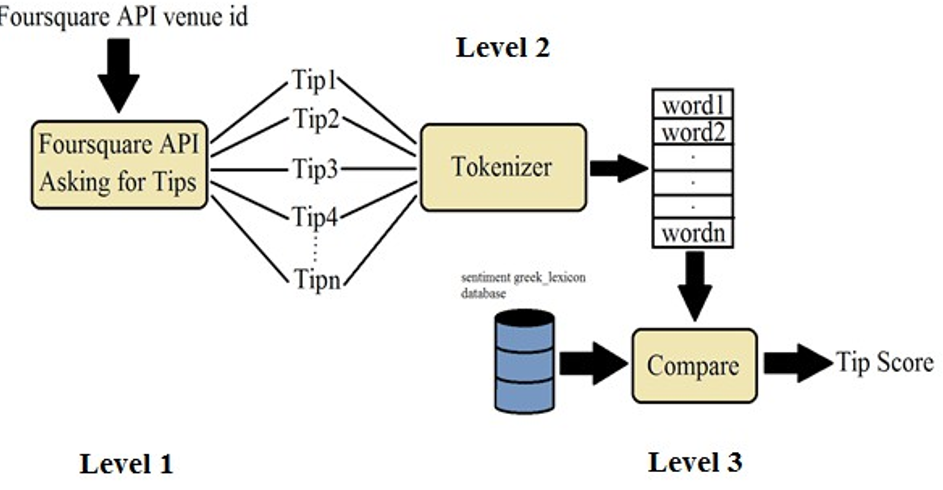
The system operates on three distinct levels:
- Level 1 (Data): Real-time retrieval via Foursquare API.
- Level 2 (Tokenization): Splitting sentences into individual words.
- Level 3 (Classification): This is the "brain," using the Greek Sentiment Lexicon (3,000+ words) and the Twinword API for English.
Handling the "Greeklish" & Informal Style
The algorithm includes a custom "Greeklish-to-Greek" converter to normalize text. It also uses Levenshtein Distance (string similarity) to correct typos and maps emoticons (e.g., :D) to descriptive keywords like "laugh" to ensure their emotional weight isn't lost during analysis.
Human vs. Machine: Experimental Results
The researchers tested their algorithm against 95 human participants. A fascinating takeaway from the study was the "6-Second Threshold": participants took roughly 6 seconds to judge a review's sentiment, regardless of whether the review was short or long. This suggests humans "scan" for keywords—a behavior the BoW algorithm successfully mimics.
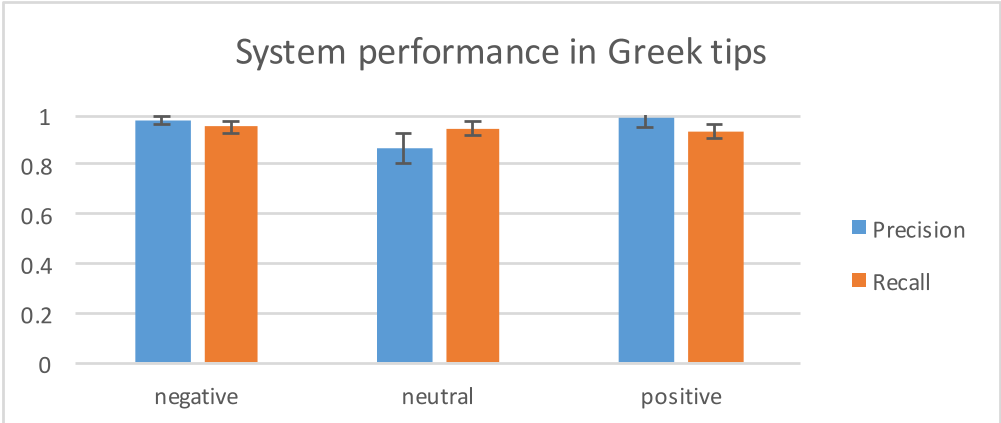
The results showed that the lightweight algorithm achieved high precision and recall, successfully categorizing positive, negative, and neutral tips in a way that aligns with human intuition.
Deep Insight: Why This Matters for Product Design
This paper offers more than just an algorithm; it provides a blueprint for mobile UX. The survey data included in the paper reveals that 84.2% of users believe only a mixture of positive and negative comments helps them form a reliable opinion.
Critical Takeaways for Developers:
- The Power of 10: Don't show users 100 reviews. Show them 10 highly relevant ones using sentiment analysis to ensure a balanced view.
- Keyword Visibility: Since users spend the same time on long and short reviews scanning for "emotional triggers," highlighting sentiment-rich keywords as tags could drastically reduce cognitive load.
- Local Nuance: Global models often fail on local dialects and scripts (like Greeklish). A lightweight, lexicon-based "preprocessing" layer is a cost-effective way to fix this without retraining massive models.
Conclusion
By focusing on the specific linguistic habits of social media users and the physical constraints of mobile browsing, Kolokythas et al. demonstrate that "lightweight" doesn't mean "weak." In the world of real-time mobile applications, specialized efficiency often beats generalized complexity.
Reference: P. Kolokythas, A. Komninos, L. Marini and J. Garofalakis. 2017. A lightweight algorithm for the emotional classification of crowdsourced venue reviews. PCI 2017.