
Uninterrupted Care: Secure Agent Data Transmission for M-Healthcare
Lightweight and privacy-preserving agent data transmission for mobile Healthcare
The paper proposes a lightweight, privacy-preserving agent data transmission scheme for mobile healthcare (m-healthcare) in opportunistic social networks. It leverages an identity-based handshake and a "hidden parameter" mechanism to allow a user's Wireless Body Sensor Network (WBSN) to securely forward health data via a nearby third-party smartphone (agent) when the user's own device is unavailable.
TL;DR
Mobile healthcare (m-healthcare) often fails when a user's smartphone is MIA. This paper introduces a privacy-preserving agent protocol that allows a user’s body sensors to "borrow" a nearby stranger's smartphone to transmit vital health data to a hospital, without compromising the patient's identity or the sensitivity of their medical records.
Background: The Smartphone Bottleneck
In standard m-healthcare, the smartphone is the critical bridge between Wireless Body Sensor Networks (WBSNs) and the Healthcare Center (HCC). But what happens during a heart attack if your phone is dead or sitting on the kitchen counter while you're at the park?
Most current research assumes the bridge is always there. This paper tackles the "unavailable smartphone" problem using Opportunistic Social Networks, turning nearby peers into temporary medical relays.
The Core Insight: Balancing Security and Battery
The primary challenge is a trade-off: Security vs. Resource Constraints.
- WBSN nodes (like the MICA2DOT) have negligible processing power and strictly limited battery.
- Privacy is paramount; a patient shouldn't have to reveal their identity or illness to a stranger’s phone just to send a data packet.
The authors solve this with a Two-Tier Handshake:
- Identity-Based Signatures: Used for the initial
AGENT-REQUESTto ensure the requester is a legitimate registered patient. - Hidden Parameter (gp): A shared secret known only to registered HCC users and the healthcare app. By using
gpin a hash function, the sensor node can verify that the "agent" (stranger's phone) is a trusted member of the system without performing heavy asymmetric cryptography.
Methodology: The Agent Handshake
The process is broken down into four phases:
- System Initialization: The HCC sets up bilinear parameters and master keys.
- Registration: Users receive pseudonyms (PIDs) to ensure anonymity.
- Agent Discovery: When the sensor node NA detects no local phone, it broadcasts a request.
- Data Transmission: PHI is encrypted end-to-end. The agent phone only sees encrypted blobs and adds its own signature to prove it handled the data for incentive rewards.
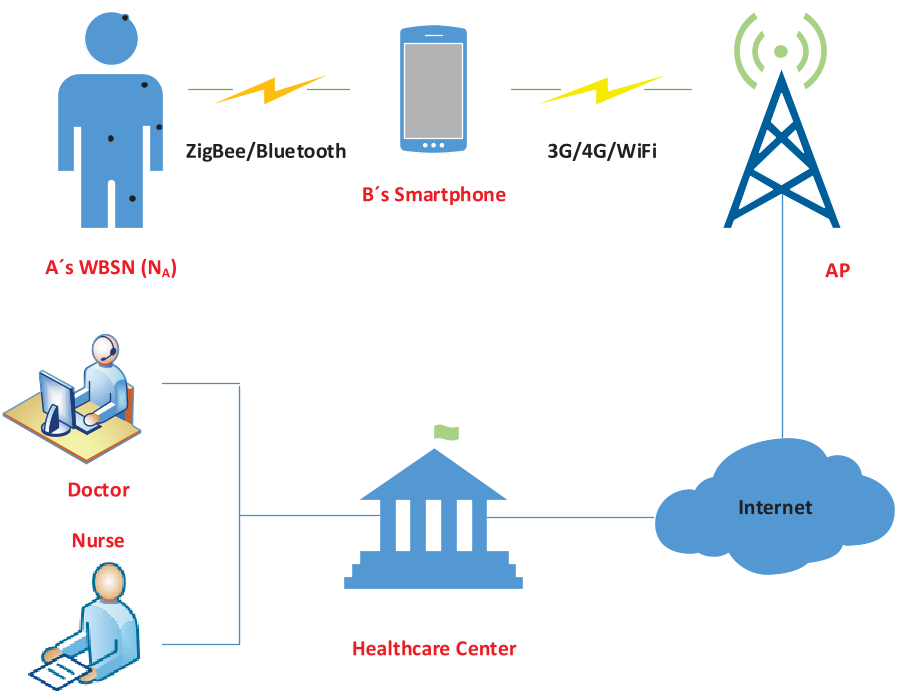 Fig 1: The framework where WBSN, Agent Smartphones, and the HCC interact.
Experimental Results & Performance
The authors validated the scheme based on the energy profile of MICA2DOT nodes.
1. Energy Efficiency
Transmitting a byte costs roughly 59.2µJ, whereas complex signature verification on the sensor side would cost over 1200 mJ—an impossible feat for tiny sensors. By offloading verification to the HCC and using the hidden parameter hash, the discovery phase cost is slashed to just 60.272 mJ.
2. Communication Overhead
The message sizes are kept tiny to minimize radio airtime:
AGENT-REQUEST: 52 bytesAGENT-RESPOND: 30 bytesDATA-TRANS: 70 bytes
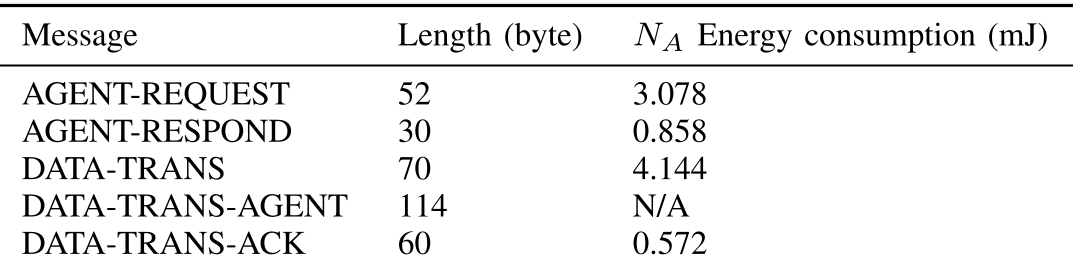 Table 1: Message lengths and corresponding energy consumption.
Critical Analysis: Why This Matters
The brilliance of this paper lies in its adversarial model. It assumes users are "honest-but-curious." The stranger helping you might want to know who you are or what your heart rate is. By combining Pseudonymity (using pidi) and End-to-End Encryption (pairwise keys with HCC), the paper ensures the agent is merely a "dumb pipe."
Limitations
- Incentive Complexity: While the paper mentions "Incentive Payments (IP)," the actual economic model of how "tokens" are converted to value isn't fully explored.
- Signal Interference: In a crowded opportunistic network, the "Agent Discovery" could lead to packet collisions if multiple WBSNs seek help simultaneously.
Conclusion
This research provides a vital "plan B" for mobile health. By treating the social environment as a resource, it ensures that even when our personal tech fails, the social fabric—supported by lightweight cryptography—can literally be a lifesaver.