
PZE Approach: Agile Social Computing for Rapid Emergency Policy-Making
A Lightweight Social Computing Approach to Emergency Management Policy Selection
This paper introduces the PZE approach, a lightweight social computing framework for emergency management policy selection, evaluation, and adjustment. It integrates a standardized artificial society model named "zombie-city" to facilitate rapid policy testing through both quantitative simulations and qualitative formal reasoning.
TL;DR
The PZE approach (Policy-Zombie-Evaluation) is a lightweight alternative to heavy-duty social computing frameworks like ACP. By modeling societies as "zombie-cities" and treating policy selection like agile software development, it allows experts to quantitatively simulate and qualitatively reason through emergency scenarios (like pandemics) to find the most cost-effective interventions.
Backgound: The Crisis of Unconventional Emergencies
When unconventional emergencies—such as the SARS outbreak or sudden disasters—occur, traditional mathematical "prediction-response" models often collapse due to the non-linear complexity of human interactions. While the ACP approach (Artificial society, Computational experiments, Parallel execution) offers a solution, its appetite for supercomputing power and lack of standardized models make it a "heavy" tool for rapid response.
The authors argue that a lightweight, iterative method is needed to bridge the gap between individual micro-behaviors and the macro-emergence of social crises.
Methodology: The PZE Framework
The core of the paper is the PZE Approach, which views policy adjustment as a feedback loop.
1. The "Zombie-City" Meta-Model (Z)
Instead of building a new simulation from scratch for every emergency, the authors propose a formal 5-tuple model: zombie-city ::= <AG, SN, EN, RO, RU>.
- Agents (AG): Autonomous individual entities.
- Social Network (SN): The links between agents.
- Environment (EN): The spatial grid where agents interact.
- Roles (RO): Dynamic behaviors (e.g., Susceptible vs. Infected).
- Rules (RU): The logic governing interactions.
2. Scenario-Response Mode
Through formal reasoning, the authors define a "Scenario" as a runtime situation of a system. By comparing the ImplementationSystem to the SpecificationEmergence, decision-makers can detect exactly when a crisis (like a viral outbreak) crosses a critical threshold.
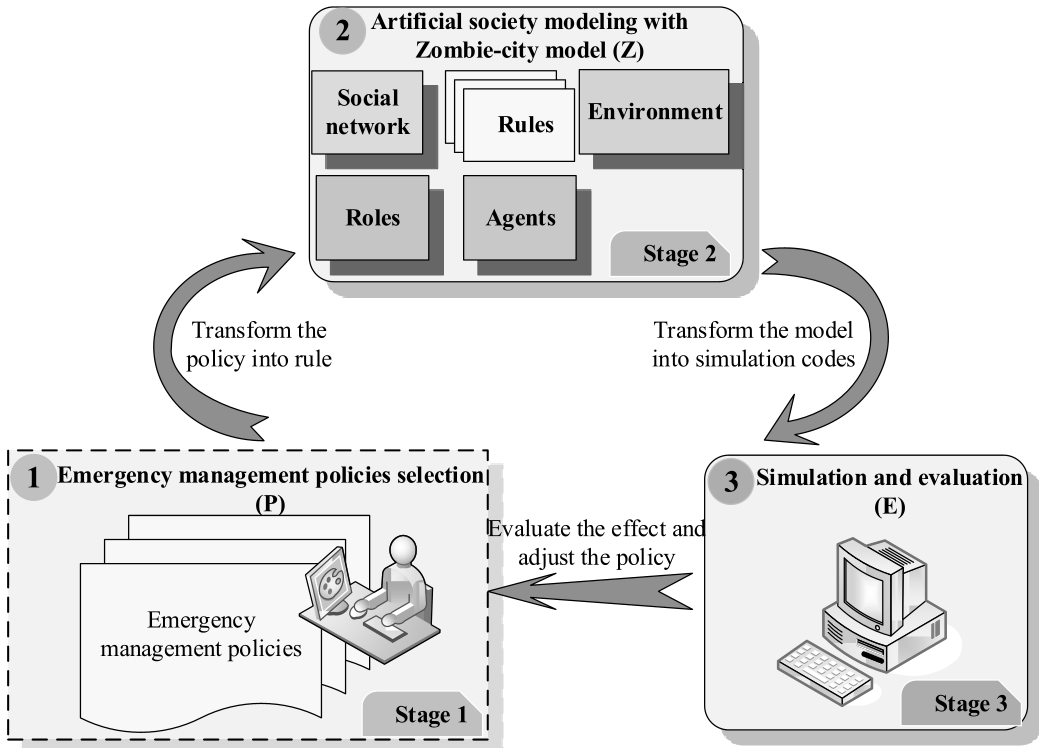 Above: The feedback loop of the PZE approach, illustrating the transition from policy selection to artificial society modeling.
Case Study: H1N1 Transmission
The researchers tested four policies in a Netlogo-based artificial society of 1,000 agents:
- P1 (Isolate Infected): Only those showing symptoms are isolated.
- P2 (Isolate Infected & Contacts): Strict but expensive quarantine.
- P3 (Medical Measures): Disinfection and drugs only.
- P4 (Comprehensive): Combining isolation of infected with medical measures.
Quantitative Evidence
The effectiveness () was calculated based on the accumulated percentage of infected people () and the duration of the outbreak ().
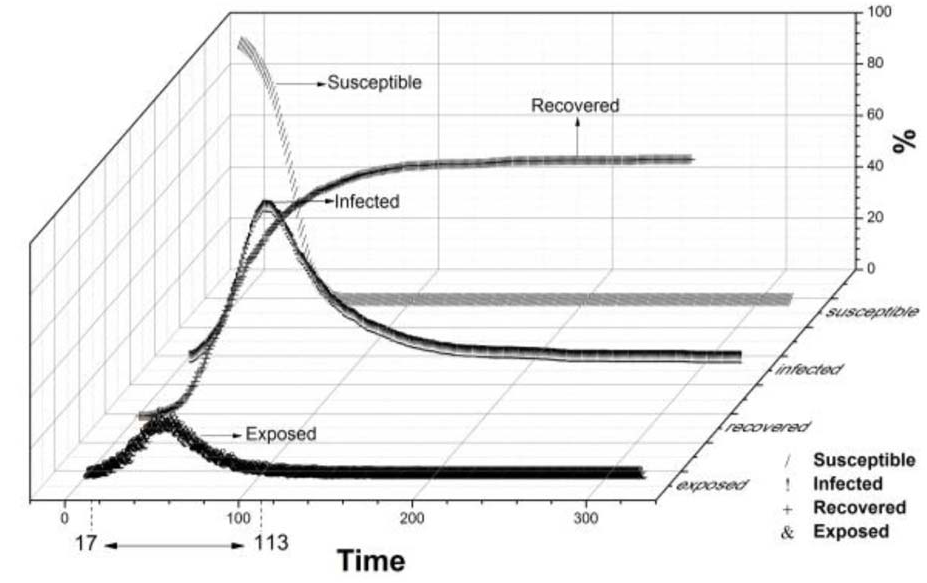 Above: Baseline spread of H1N1 without any policy intervention.
The results were striking: Policy 4 (Comprehensive) achieved an effectiveness of 1.798, while Policy 1—the most common intuitive response—only hit 0.088. The simulation revealed that P1 failed because "Exposed" agents (who were carrying the virus but not yet "Infected") continued to drive the outbreak intermittently.
Qualitative Insight: Beyond the Numbers
One of the paper's strongest contributions is the use of Formal Reasoning. By using lemmas and scenario specifications, the authors proved logically why P1 behaves sporadically. If a policy doesn't account for the transition probability between "Exposed" and "Infected" roles, the "Emergence" (the outbreak) will inevitably resurface.
| Policy | Effectiveness () | Cost | Result |
|---|---|---|---|
| P1 (Contact Isolation) | 0.088 | Moderate | Intermittent Outbreaks |
| P2 (Strict Quarantine) | 0.766 | Very High | Effective but Expensive |
| P3 (Medical Only) | 0.011 | Low | Ineffective |
| P4 (Comprehensive) | 1.798 | High | Most Effective |
Critical Analysis & Conclusion
The PZE approach represents a significant shift toward Agile Social Computing. By defining a standardized "Zombie-City" model, researchers can move faster from theory to simulation.
Limitations: The current model assumes relatively simple agent logic. Real-world human behavior—driven by fear, misinformation, or economic necessity—is far more chaotic than the rules currently embedded in the model.
Future Outlook: The authors suggest integrating more social roles (doctors, police) and developing automated human-machine interfaces. As social data becomes more available through IoT and mobile sensing, lightweight models like PZE could eventually run in near real-time, providing mayors and health officials with a "digital twin" to test emergency decrees before they are signed into law.