
Limitations of Trace Norm Minimization: Is the Low-Rank Assumption a Trap?
Limitations of matrix completion via trace norm minimization
This paper investigates the limitations of matrix completion via trace norm minimization, a widely used convex relaxation for rank minimization. By evaluating state-of-the-art algorithms like SVT and MultiRegression on collaborative filtering and image recovery tasks, the authors demonstrate that the low-rank assumption often fails in real-world scenarios, leading to poor reconstruction or unstable solutions.
Executive Summary
In the world of Compressive Sensing and Collaborative Filtering, Trace Norm Minimization is often hailed as the standard convex surrogate for the NP-hard rank minimization problem. However, this paper by Shi and Yu serves as a sobering reality check. Through rigorous empirical analysis, the authors reveal that the method frequently fails in practice because real-world data often lacks a definitive low-rank structure, and the optimization process can stumble into "unstable" solutions that satisfy the rank constraint but fail to recover the truth.
Problem & Motivation: The Mirage of Sparsity
The core intuition behind matrix completion is that a sparse matrix (like the Netflix prize matrix) can be reconstructed because user preferences are driven by only a few latent factors. Mathematically, we seek:
Since this is computationally intractable, researchers swap rank(X) for the Trace Norm (the sum of singular values).
The author's highlight a critical blind spot:
- The Validity of the Assumption: Is a observed matrix necessarily low-rank? In practice, this is an unverified leap of faith.
- Solution Multiplicity: The optimization landscape may contain multiple matrices with the same minimal rank, leading to arbitrary and often incorrect recoveries.
Methodology: Testing the Limits
The authors deconstructed the performance of two prominent algorithms: Singular Value Thresholding (SVT) and MultiRegression. They focused on the "how" and "why" of failure cases across synthetic data, CF benchmarks (Jester dataset), and 3D tensors (Image recovery).
The Unstable Solution Problem
Consider an incomplete matrix where a missing value could be completed as a "2" or a "4" to maintain the same rank. Trace norm minimization lacks the "common sense" to pick the most likely value (e.g., the majority value in a column), leading to the following counter-example:
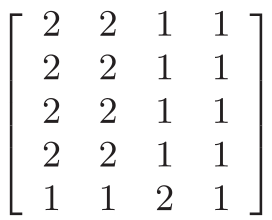 In Eq 5, 6, and 7 of the paper, the authors show that SVT successfully achieves the target rank but produces a matrix where not a single missing entry matches the ground truth.
Experiments & Results: A Surprising Performance Drop
The most striking evidence comes from the Jester Recommendation Dataset. One would expect that forcing a lower rank would filter "noise" and improve prediction. The experimental data shows the exact opposite.
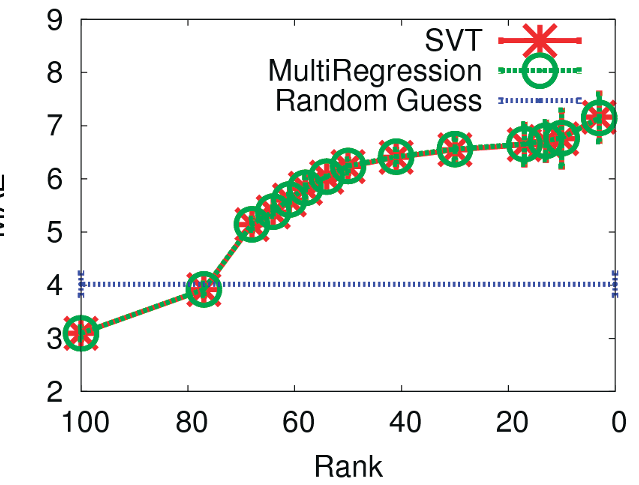 The MAE (Mean Absolute Error) for Jester datasets increases as the rank constraint is tightened. In many cases, the "best" recovery occurred at full rank—negating the very purpose of rank minimization.
In image recovery (visualized as tensors), the results were equally disappointing. Even after 2,000 iterations where the objective function converged (indicating the math "worked"), the recovered images (Fig 2c, 3c) were nonsensical compared to the originals.
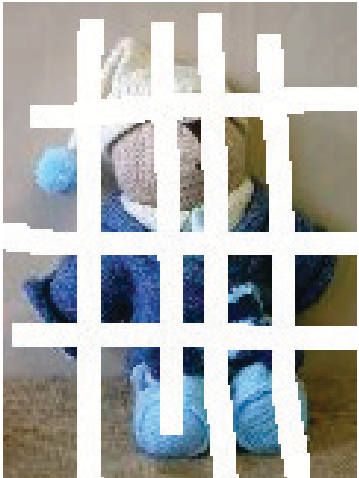 Despite reaching a mathematical optimum, the visual reconstruction of the flag pattern fails significantly due to the existence of multiple low-rank solutions.
Critical Insight & Conclusion
The fundamental takeaway is that mathematical convergence does not equal factual accuracy. Trace norm minimization works in a vacuum where the data is perfectly low-rank and the sampling satisfies strict theoretical conditions (like RIP).
Key Lessons for Practitioners:
- Don't Assume Rank: Verify if your dataset actually benefits from low-rank approximation. If error increases as rank decreases, your data is likely high-rank or noisy.
- Stability is Key: If a problem has multiple low-rank solutions, the algorithm will pick one arbitrarily.
- Hybrid Constraints: To fix this, future models should combine trace norm with other inductive biases, such as local smoothness or "majority-value" priors, to narrow down the solution space to the one that actually reflects reality.