
Behind the Low-Rank Illusion: Limitations of Trace Norm Minimization
8822_Limitations of matrix completion via trace norm minimization.
This paper investigates the fundamental limitations of Matrix Completion via Trace Norm Minimization. It argues that while this convex relaxation is a popular surrogate for rank minimization in fields like Collaborative Filtering (CF) and Image Recovery, it frequently fails in practical scenarios due to invalid low-rank assumptions and the existence of multiple unstable solutions.
TL;DR
Trace Norm Minimization is the industry standard for Matrix Completion, yet this paper reveals a sobering reality: it often fails in practice. The authors demonstrate that the "low-rank assumption" is frequently violated in real-world data and that the algorithm can "successfully" find low-rank solutions that are mathematically optimal but factually wrong due to solution instability.
Executive Summary
In the era of Big Data, we often deal with incomplete matrices—think of Netflix ratings or blurred images. The common fix is Trace Norm Minimization, a convex relaxation of the NP-hard rank minimization problem. While theoretical work suggests exact recovery is possible, this paper by Shi and Yu serves as a critical "reality check." It positions itself as a cautionary critique, proving that in applications like Collaborative Filtering and Tensor Completion, the method is far from a universal solution.
The Problem: Blind Faith in Sparsity
The core of Compressive Sensing relies on the idea that if a dataset is sparse, it must be "simple" (low-rank).
- The Hidden Rank: With only 10% of data observed, how can we prove the ground truth is low-rank? We often assume it is, but if the underlying matrix is high-rank, trace norm minimization forces it into a low-rank "straitjacket," destroying the data's integrity.
- The Ambiguity Trap: The paper highlights that rank minimization can lead to multiple solutions. If two different ways of filling a matrix result in the same rank, the algorithm might pick the wrong one.
Methodology: Why it Fails
The authors analyze the standard optimization objective: Where (the trace norm) is the sum of singular values.
The Instability Logic
Consider a simple matrix with a missing value ?. If filling it with 2 or 4 both result in a Rank-2 matrix, the optimization has no reason to prefer the correct one. In large, sparse matrices, this "solution space" becomes massive, making the results highly unstable.
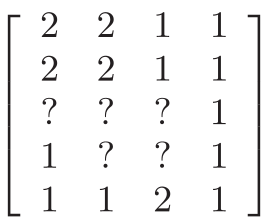 Figure: A synthetic matrix where the recovered version (bottom) achieves the low-rank goal but fails to match the original values.
Experiments: Real-World Disappointment
1. Collaborative Filtering (The Jester Benchmark)
The authors tested two SOTA algorithms, Singular Value Thresholding (SVT) and Multi-task Regression, on the Jester joke rating dataset.
- The Shocking Result: As the rank constraint was tightened (lowering the rank), the Mean Absolute Error (MAE) increased.
- Worse than Random: At ranks lower than 80, the sophisticated algorithms actually performed worse than assigning random values to the missing entries.
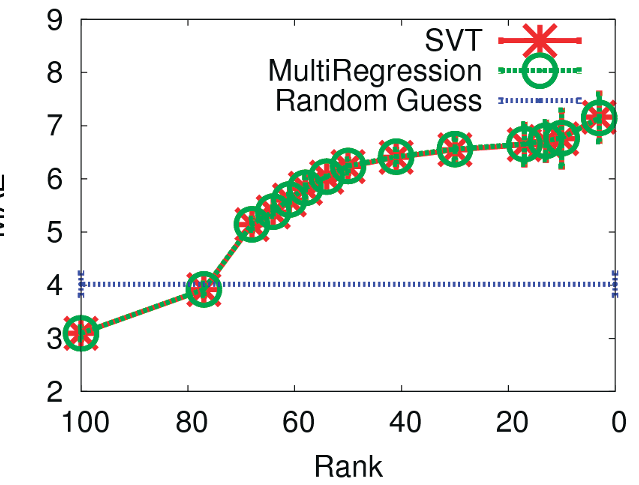 Figure: Error rates grow as the rank decreases, contradicting the assumption that low-rank recovery should improve performance.
2. Image and Tensor Recovery
When extended to 3D tensors (images), the algorithm reached mathematical convergence (the objective function stopped decreasing), but the visual result remained a blurred mess. This confirms that the algorithm was finding a low-rank solution, just not the correct one.
 Figure: Despite 2000 iterations, the recovered image (c) fails to reconstruct the patterns of the original (a).
Critical Analysis & Future Outlook
The key takeaway is that Trace Norm Minimization is not a black box you can throw at any sparse dataset.
Advice for Practitioners:
- Verify the Assumption: Check if your data actually exhibits low-rank characteristics before applying these methods.
- Structural Priors: As the authors suggest, we need more constraints. For example, adding a "majority-value" constraint or specific local spatial constraints in images could help disambiguate between multiple low-rank solutions.
Limitations: While the paper exposes failures, it doesn't provide a new "universal" algorithm. However, it successfully shifts the research focus from "how to solve the optimization faster" to "is this even the right optimization to solve?"
Conclusion: This work is a vital contribution to the field of data mining, reminding us that mathematical elegance (convex relaxation) does not always translate to physical truth.