
LSE: Controlling Epidemic Outbreaks under Time Constraints in Social Networks
Limiting the Spread of Epidemics within Time Constraint on Online Social Networks
The paper introduces the Limiting the Spread of Epidemics (LSE) problem under a novel Time-Constraint Deterministic Linear Threshold (T-DLT) model. It aims to identify at most k nodes for removal to maximize the number of "saved" nodes before a specific time deadline (d hops).
TL;DR
Epidemics on social networks—ranging from viral infections to fake news—spread with high velocity but often lose steam after a few hops. This paper introduces a new framework, LSE (Limiting the Spread of Epidemics), which focuses on saving the maximum number of users within a fixed time deadline (d hops). By moving from complex probabilistic models to a deterministic one (T-DLT), the authors provide a heuristic algorithm, FLE, that is thousands of times faster than traditional greedy approaches while maintaining near-optimal performance.
Problem & Motivation: The Race Against Time
While older research focuses on the potential total reach of an epidemic, real-world data shows that social influence is often localized and transient. Research indicates that typical propagation chains are shorter than four to five hops.
Current state-of-the-art methods face two major hurdles:
- Computational Complexity: Most models rely on Independent Cascade (IC) or Stochastic Linear Threshold (LT) models. Calculating influence in these is #P-hard, making them unsuitable for real-time response on massive networks.
- Lack of Deadlines: Prior methods don't account for the "golden hour." If a rumor isn't stopped within the first few hours (or hops), the damage is done.
The authors argue for a Deterministic Linear Threshold (DLT) approach with an added time dimension: the T-DLT model.
Methodology: The T-DLT Model and FLE Algorithm
The core of the paper is the transition to a deterministic model where propagation stops at hop .
1. The LSE Problem Definition
Given an initial set of infected nodes , we want to find a set (size ) to remove from the graph to maximize: Where is the set of infected nodes at hop . The authors prove this problem is NP-hard and even hard to approximate within a ratio of .
2. Fast and Effective Limiting Epidemics (FLE)
To solve this efficiently, the authors designed the FLE algorithm. Unlike the brute-force Greedy approach (which checks every possible node in every iteration), FLE uses two specific metrics:
- : The number of immediate neighbors saved if is removed.
- : The weighted influence node exerts on its neighbors further down the line.
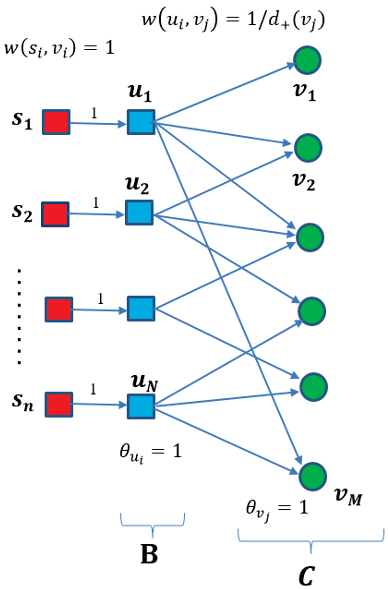 Figure 1: Illustration of the theoretical reduction used to prove NP-hardness.
Experiments & Results
The authors tested their methods on four datasets, ranging from the small Gnutella network to the million-link Google Web graph.
- Superior Efficiency: On the Wiki-Vote dataset, while a standard Greedy algorithm took 20 minutes, FLE finished in milliseconds—a speedup of over 14,000x.
- Scalability: For the Google Web dataset (5M+ edges), the Greedy algorithm failed to finish within 12 hours. FLE completed the task in 7.8 seconds.
- High Impact: The number of saved nodes using FLE and Greedy was up to 48.5 times higher than common strategies like "Max Degree" (removing the most connected nodes).
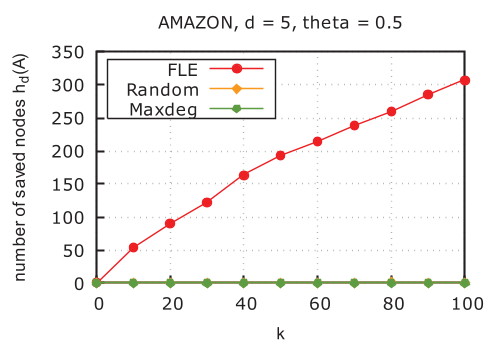 Figure 2: Performance on Gnutella (top) and Wiki-Vote (bottom), showing FLE (green) and Greedy (red) significantly outperforming baselines.
Critical Analysis & Conclusion
Takeaways
The research confirms a vital intuition in network science: Speed is more important than precision. By simplifying the diffusion model from probabilistic to deterministic, the authors unlocked the ability to process massive graphs in seconds without losing much accuracy.
Limitations
- Threshold Knowledge: The model assumes we can determine a user's infection threshold through surveys or data mining. In high-stakes, real-time scenarios (like a sudden cyberattack), these values might be unknown.
- Node Removal Cost: The model assumes all node removals have equal cost. In reality, removing a "High-Value" account (like a news outlet) has social costs not captured by the "saved nodes" metric.
Future Work
The authors suggest that future iterations of FLE could be improved to reach even closer to the theoretical optimal solution and potentially incorporate dynamic weight changes during the propagation process.