
Limiting the Influence to Vulnerable Users: A Ratio-Based Approach to Socially Responsible Marketing
Limiting the Influence to Vulnerable Users in Social Networks: A Ratio Perspective
The paper introduces a socially responsible influence maximization problem that seeks to maximize information spread to non-vulnerable users while strictly limiting exposure to vulnerable groups (e.g., preventing junk food marketing to overweight individuals). The authors propose the Additive Smoothing Ratio (ASR) measure and a novel approximation algorithm, ISS (Iterative Subsample with Spread bounds), to optimize this non-submodular objective.
TL;DR
Standard Influence Maximization (IM) is "blind" to the harm it might cause. This paper introduces a new framework to maximize spread among general users while minimizing it for vulnerable populations. By introducing a smoothed ratio objective (ASR) and a specialized approximation algorithm (ISS), the authors provide a way to conduct viral marketing that is both effective and ethically conscious.
Background: Beyond Raw Reach
In the world of social network analysis, Influence Maximization has historically been a game of numbers: find users who trigger the largest possible cascade. However, the authors argue that this "utility-only" view is ethically flawed. If a company promotes alcoholic beverages or junk food, influencing a massive crowd that happens to include minors or individuals with health risks is a liability, not a success.
The challenge lies in the trade-off. You can't just pick users who never touch vulnerable groups, or your reach will be near zero. You need a strategy that understands the "Ratio Perspective."
The Problem with Current Metrics
Why not just use the Difference ()?
- Fraction Blindness: A difference of 100 could mean 100 vs 0 (great!) or 1000 vs 900 (terrible protection).
- Optimization Hardness: The difference of submodular functions is notoriously difficult to approximate.
Why not a simple Ratio?
- If the denominator (vulnerable spread) is zero, the ratio is undefined. This makes it impossible for greedy algorithms to distinguish between a seed set that hits 10 people vs. 10,000 people if both hit 0 vulnerable users.
The Solution: ASR and ISS
1. Additive Smoothing Ratio (ASR)
The authors propose: The constant acts as a "smoothing" factor. It prevents division by zero and allows the organization to tune how much they care about the "protection" of vulnerable users versus "utility" for others.
2. The ISS Algorithm
Optimizing ASR is hard because it's neither submodular nor monotone. The core insight of the ISS (Iterative Subsample with Spread bounds) algorithm is to "sandwich" the ASR function between two submodular modular-ratio bounds:
- ASR-L: A submodular lower bound.
- ASR-U: A submodular upper bound.
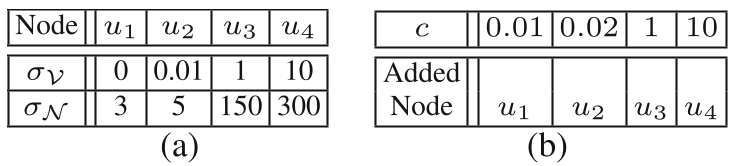
By iteratively maximizing these surrogate functions using a subsampling greedy strategy, ISS finds high-quality seed sets that the standard Greedy approach would miss.
Experimental Battleground
The researchers tested their methods on platforms like Twitter and PolBlogs. The results were clear:
- Effectiveness: ISS consistently achieved the highest ASR scores, proving that its bounding strategy successfully navigates the complex search space.
- Protection vs. Utility: As shown in the "Protection-Utility Map" (Fig 4), ISS dominates the popular TIM heuristic, providing better safety for vulnerable users without sacrificing too much reach.
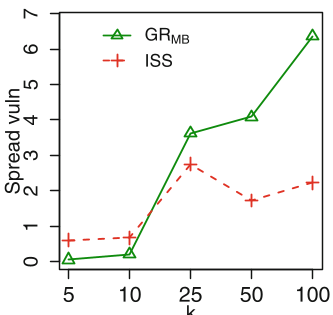 Fig: Utility and Protection map showing ISS (star) outperforming baseline heuristics.
- Efficiency: Despite the mathematical complexity, ISS is remarkably fast. Because it uses subsampling (only looking at a fraction of the network in each step), it is often orders of magnitude faster than TIM, which struggles as the network grows.
Critical Insight & Conclusion
The real value of this paper isn't just the algorithm; it's the tunability. By adjusting the parameter, a marketer can move from a "maximum caution" stance to a "maximum reach" stance within the same mathematical framework.
Takeaway: In an era of increasing scrutiny over algorithmic ethics, "socially responsible" influence maximization is no longer a niche—it's a requirement. This paper provides the first robust toolkit to ensure that viral marketing doesn't become viral harm.