
Genie: Thwarting Sybil Crawlers by Turning Social Links into Currency
Limiting large-scale crawls of social networking sites
The paper proposes Genie, a novel defense system designed to limit large-scale crawling of Online Social Networks (OSNs). By modeling the social graph as a credit network, Genie ties a user's ability to browse profiles to their social connectivity, effectively neutralizing Sybil attacks that bypass traditional rate-limiting.
Executive Summary
TL;DR: Genie is a defense framework that transforms an Online Social Network (OSN) into a credit network to stop automated crawlers. Instead of just tracking how many pages an IP visits, Genie checks how well-connected the visitor is in the social graph, effectively capping the "data harvest" of any user (or bot) based on their actual social trust.
Positioning: This work is a seminal architectural shift in OSN security, moving from reactive rate-limiting (which fails against Sybil attacks) to a proactive graph-theoretical defense based on the scarcity of human social capital.
The Problem: The Fragility of Rate-Limiting
Most OSNs today attempt to stop scrapers by capping requests per minute or per IP. However, attackers have professionalized their "harvesting" techniques through Sybil Attacks:
- Identity Inflation: Creating thousands of fake accounts to bypass per-account limits.
- IP Rotators: Using botnets or residential proxies to bypass IP-based blocks.
The fundamental issue is that traditional defenses treat every account as an independent entity. In reality, accounts in a social network are connected, and it is the structure of these connections that reveals the account's legitimacy.
Methodology: The Social Graph as a Credit Network
The genius of Genie lies in its core insight: It is hard for an attacker to make real friends. While a bot can create 10,000 accounts, it cannot easily trick 10,000 real users into accepting friend requests.
How it Works
Genie maps the social network onto a Credit Network.
- Links = Credits: Every friendship edge is assigned a "credit" value.
- Transaction = Profile View: When User A wants to view User B's profile, the system finds a path between them.
- Flow Constraint: One unit of credit is "spent" along the path to unlock the view.
- Limit: Once the credits on the links connecting a crawler to the "real" world are exhausted, the crawler is blocked, no matter how many Sybil sub-accounts it has created.
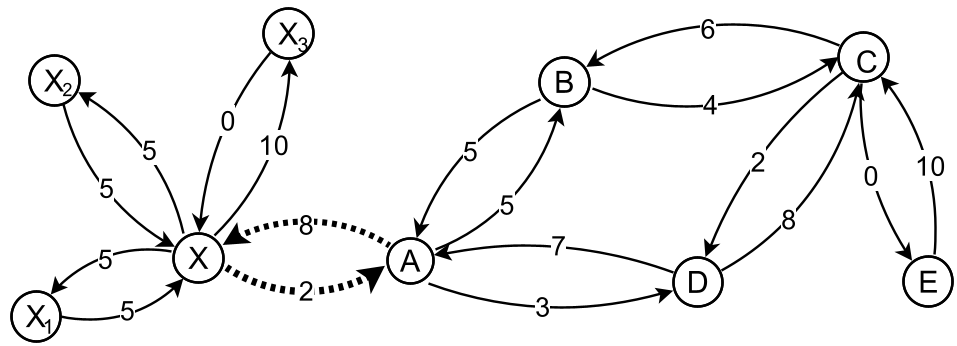 Figure 1: Even if Crawler X creates multiple identities (), its total crawl capacity is strictly limited by the narrow "bottleneck" (dotted lines) connecting it to the legitimate social graph.
Addressing Practical Concerns
Any graph-based defense raises three critical questions:
- Does it break the "Public" nature of profiles? Genie argues that "accessible to all" shouldn't mean "scrapable by all." For celebrities, they naturally have thousands of links, providing high liquidity for fans to view their profiles.
- What about Denial of Service (DoS)? Can a group of users "drain" the credits to a profile to make it invisible? Genie suggests a Whitelist mechanism: users can always allow their direct friends to bypass the credit check.
- Liquidity Management: The OSN must balance credit refresh rates. Too much credit lets crawlers through; too little prevents normal users from exploring.
Experiments & Results
The authors highlight a mathematical property: The Max-Flow Min-Cut Theorem. In Genie, the maximum number of profiles a crawler can view is bounded by the capacity of the cut separating the Sybil cluster from the rest of the network.
Since a botnet usually has very few "attack edges" (links to real people) compared to its internal fake links, its global visibility is effectively neutered. This is a massive improvement over traditional systems where one bot could visit the entire network given enough time and IP addresses.
Critical Analysis & Conclusion
Takeaway
Genie represents a shift towards Proof-of-Relationship. In an era where AI can generate infinite fake identities, the only scarce resource is the verified link between two humans.
Limitations
- Computational Overhead: Finding paths in a million-node graph for every profile view is computationally expensive.
- Bootstrap Problem: New users with zero friends would be unable to see any profiles, potentially hurting platform growth.
- Privacy Paradox: To calculate the path, the system needs global knowledge of the graph, which itself is sensitive data.
Future Outlook
As we move toward a "Scraping-as-a-Service" economy, systems like Genie that leverage Network Topology will be essential. Future research could focus on decentralized implementations of credit networks to prevent centralized OSN operators from having total control over "social liquidity."