
Subgraph-Wise Perturbation: Revolutionizing Privacy in Social Network Analysis
Limiting link disclosure in social network analysis through subgraph-wise perturbation
This paper introduces a "subgraph-wise perturbation" method for directed social networks to limit link disclosure. By partitioning graphs into localized subgraphs and randomizing destinations within these clusters, the authors achieve SOTA architectural preservation for metrics like clustering coefficient and graph diameter while maintaining formal privacy guarantees.
TL;DR
Social networks are goldmines for researchers but nightmares for privacy. This paper presents a breakthrough in Link Disclosure prevention by moving away from global randomization. By partitioning graphs into subgraphs and perturbing links locally, the authors maintain high Utility (up to 83% link retention) while strictly bounding an adversary's ability to infer sensitive connections.
The Core Challenge: The Cost of Noise
Traditionally, if you wanted to hide a friendship (a link) in a network, you would delete random edges and add fake ones across the whole graph. This is like trying to hide a single person in a crowd by moving everyone in the city to different houses. The result? The "city" (the graph structure) becomes unrecognizable.
The authors identify three fatal flaws in prior work:
- Undirected Bias: Most models ignore the directed nature of modern social media (Followers vs. Following).
- Structural Blindness: Randomly adding links between distant nodes destroys shortest-path properties.
- Popularity Blindness: High-degree nodes (celebrities) have such a high "prior" probability of being linked that traditional noise doesn't actually hide anything.
Methodology: The Power of Localization
The authors propose a two-step solution that leverages the inherent community structure of social networks.
1. Directed Perturbation and -Privacy
Instead of randomizing both ends of a link, they keep the source intact and only perturb the destination. They adopt the -privacy model: if an adversary's prior belief about a link is below , their posterior belief (after seeing the data) must stay below .
2. Subgraph-Wise Partitioning
This is the "secret sauce." Since the retention probability is inversely related to the size of the randomization domain , partitioning the graph into subgraphs reduces drastically.
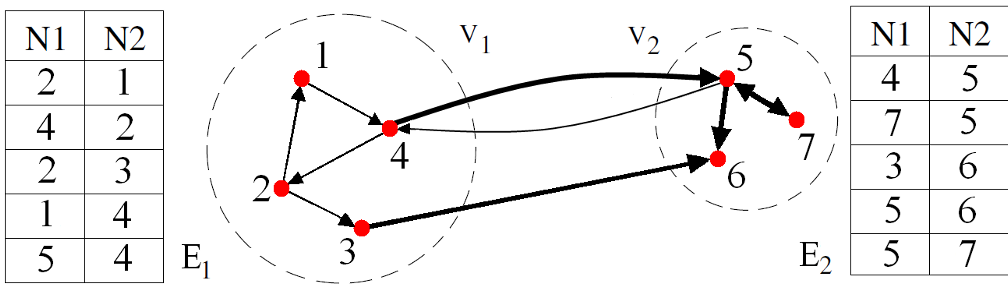
In the figure above, links are partitioned so that randomization stays within "clutches" of nodes, preserving the local "flavor" of the network.
Algorithms for Balancing Utility and Privacy
To ensure the partitioning doesn't accidentally reveal information, the authors introduce:
- Degree Balancing: Moving links between subgraphs to prevent nodes from becoming "exposed" (where their local prior exceeds ).
- -Sparsity: Ensuring each source node has at least possible destinations to prevent deterministic inference of "singular links" (self-loops or duplicates created during perturbation).
Experimental Proof: Better Data, Better Privacy
Testing on the URV Email network and Newman’s Co-authorship network, the results were definitive.
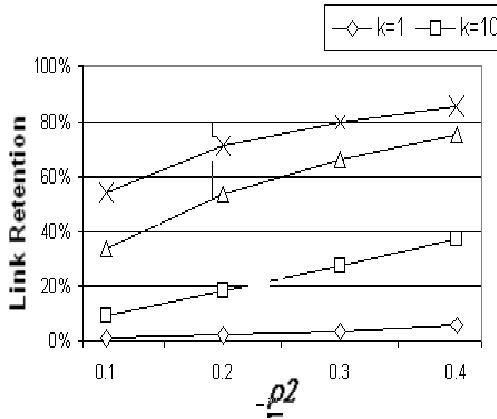
The data shows that as the number of partitions (k) increases, the Link Retention Probability (Pii) sky-rockets compared to global (k=1) methods.
Visual Evidence: Social Network Analysis (SNA) Stability
When measuring Closeness, Betweenness, and Clustering Coefficients, the Subgraph-wise approach (blue bars) consistently stayed closer to the original values than Random Add/Del or Global Perturbation.
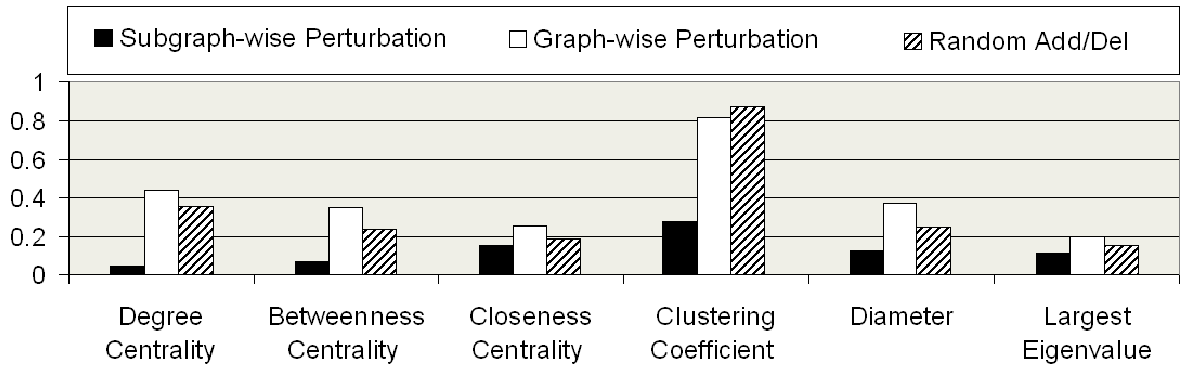
Critical Insight & Conclusion
This paper proves that locality is the key to graph privacy. By keeping the "lies" (perturbed links) local, the "truth" (global metrics like diameter and eigenvalues) remains remarkably accurate.
Limitations: The method relies on an initial good partitioning (like METIS), and for extremely dense graphs, the utility gains might diminish. However, for the sparse "long-tail" distributions typical of human social networks, this approach is a game-changer for privacy-preserving data publishing.