
Linear Computation for Independent Social Influence: Disentangling Seed Contributions
Linear Computation for Independent Social Influence
This paper introduces a linear social influence model to efficiently measure the "independent influence" of individual seed nodes within a set. By formulating influence as a linear system solvable via Gauss-Seidel iteration, the authors achieve high-fidelity approximations of traditional models like the Weighted Cascade (WC) model while significantly reducing computational overhead.
TL;DR
Quantifying the true value of an individual in a social network is difficult when their influence overlaps with others. This paper presents a Linear Social Influence Model that breaks down the aggregate influence of a group into the sum of its parts. By treating influence propagation as a linear system, the authors provide a method that is both mathematically rigorous and computationally efficient enough for million-node graphs.
Problem & Motivation: The "Mutual Enrichment" Trap
In viral marketing, we often identify a set of "seeds" to start a campaign. However, if two seeds are close friends, their influence spheres overlap. Standard metrics often double-count this shared reach or fail to show how much new reach a specific seed adds.
Current state-of-the-art models like the Independent Cascade (IC) model are #P-hard to compute exactly, requiring thousands of slow Monte-Carlo simulations. The motivation here is two-fold:
- Efficiency: We need a model that scales linearly with the number of edges.
- Independence: We need to isolate a seed's "Independent Influence"—the reach it provides if all other seeds were "turned off" as transmitters.
Methodology: The Linear Framework
The core innovation is the definition of influence as a steady-state linear combination. For a node , its influence from initiator is: where is a damping factor and is the transmission probability.
1. The Global Influence Vector
By representing the entire network as a transmission matrix , the influence vector can be solved as:
u_i$$ This is effectively a linear system. Unlike PageRank, which focuses on random walks, this model ensures that the seed's own influence is normalized to 1 ($f_{i \rightarrow i} = 1$). ### 2. Independent Influence Properties The authors prove two groundbreaking properties: * **Additivity**: The total influence of a set $S$ is exactly the sum of the independent influences of its members. * **Upper Bound**: A node's independent influence is always less than or equal to its original (isolated) influence, which in turn is bounded by its column sum in the inverse matrix $(I - dT')^{-1}$.  *Note: The linear system allows using the Gauss-Seidel method for O(|A|) efficiency.* ## Experiments: Performance and Real-World Impact The researchers tested their model on datasets including DBLP (collaboration network) and Amazon (co-purchase network). ### Key Findings: * **Accuracy**: The rankings produced by the Linear model closely match the "Ground Truth" (20,000 Monte-Carlo simulations of the WC model), significantly outperforming Degree-based heuristics. * **Efficiency**: As shown in the benchmarking figures, while Monte-Carlo takes thousands of seconds on large graphs, the Linear model finishes in seconds—comparable to the speed of PageRank. * **Pruning Power**: By using the theoretical upper bounds, the authors developed **Algorithm 2**, which can identify Top-K influential seeds without calculating the influence for every seed in the set, further boosting speed. 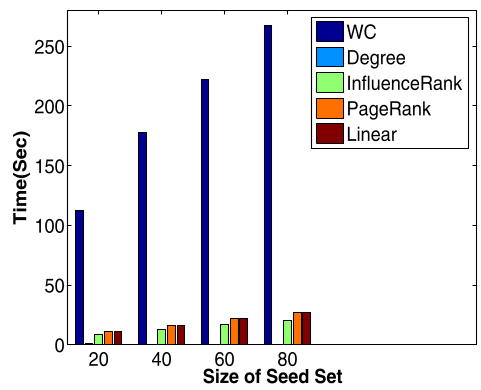 *Figure: The Linear model (red line) consistently maintains the highest Spearman correlation with the ground truth compared to other heuristics.* ## Critical Analysis & Conclusion ### Takeaway This paper successfully bridges the gap between high-complexity stochastic models and over-simplified degree heuristics. The **Independent Social Influence** measure acts as a "fairness metric"—allowing marketers to pay influencers based on the unique audience they reach, rather than the total audience they share with others. ### Limitations * **Linear Assumption**: The model assumes influence is a linear combination. In reality, some social effects might be sub-modular or exhibit "diminishing returns" that are non-linear (e.g., seeing a message 10 times is not 10x more effective than once). * **Parameter Sensitivity**: The damping factor $d$ significantly affects results, and while $0.85$ is a standard default, optimal values may vary by network type. ### Future Work The authors suggest extending this to **Topic-Sensitive Influence**, acknowledging that a person might be an influencer in "Data Mining" but have zero influence in "Cooking." Integrating content dynamics into this linear framework is the next frontier.