
Bridging Logic and Probability: Solving Bayesian Networks via Integer Linear Programming
A linear constraint satisfaction approach to Bayesian networks
This paper presents a methodology for solving the Most Probable Explanation (MPE) problem in Bayesian Networks by transforming it into an Integer Linear Programming (ILP) formulation. By mapping network states and conditional probabilities to binary variables and linear constraints, the author enables the use of mature optimization techniques like the Simplex method and Branch and Bound.
TL;DR
The "Most Probable Explanation" (MPE) problem in Bayesian Networks is a notoriously difficult NP-hard challenge. This paper demonstrates a powerful transformation that reformulates these probabilistic graphs into Integer Linear Programming (ILP) models. By leveraging the Simplex method and Branch-and-Bound algorithms, the author provides a rigorous framework to find exact solutions for uncertain reasoning tasks.
The Motivation: Moving Beyond Heuristics
Bayesian Networks are the gold standard for reasoning under uncertainty, but as their connectivity grows, they become computational nightmares. Traditional exact algorithms work for simple "singly-connected" trees, but for "multiply-connected" (loopy) graphs, the community often resorts to stochastic heuristics like Simulated Annealing or Genetic Algorithms.
The author’s insight is profound yet practical: Why reinvent the wheel? The Operations Research community has spent decades optimizing ILP solvers. If we can map a Bayesian Network's joint probability distribution into a set of linear constraints, we can harness these high-performance engines to solve MPE problems with mathematical guarantees.
Methodology: The ILP Transformation
The transformation treats the probability of a full assignment as an optimization objective. To linearize this (since products are non-linear), the method maps each entry in a node’s Conditional Probability Table (CPT) to a unique binary ILP variable.
- Variable Assignment: For every node and every possible state of its parents (conditioning cases), a 0-1 variable is created.
- Structural Constraints: Linear equations are used to ensure that if a node is "True," exactly one of its corresponding parent-state variables must be active.
- Objective Function: The goal is to maximize the probability (or more commonly, minimize the cost/negative log-probability) across the network.
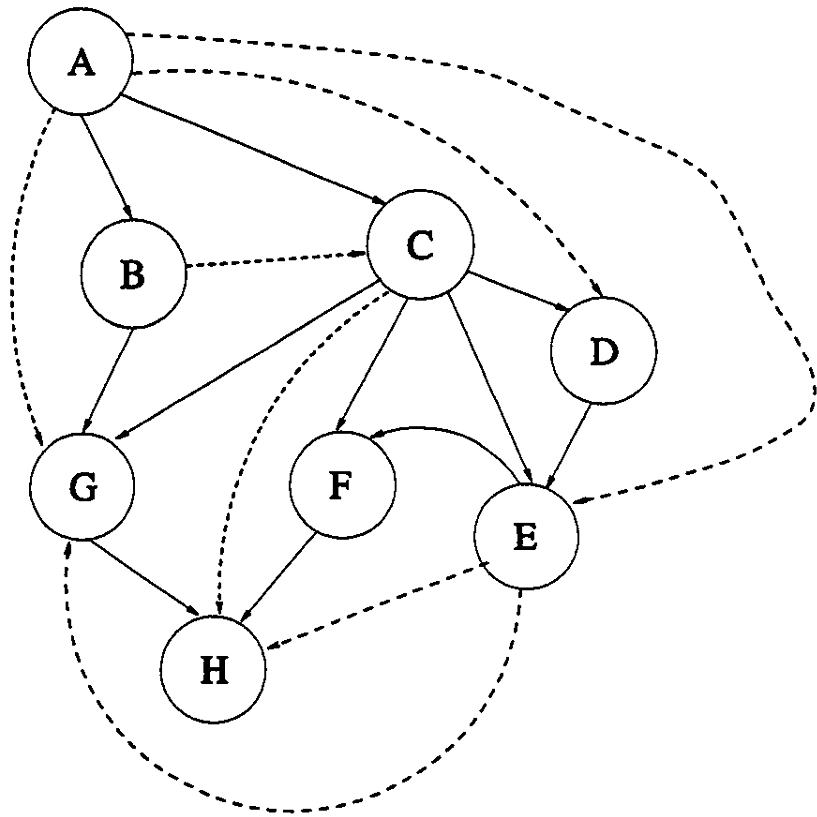 Figure: The two network topologies tested, showing different levels of connectivity.
Experiments: Connectivity vs. Complexity
The author tested the approach on two topologies (A and B) across various probability ranges ().
| Metric | Topology A (Sparse) | Topology B (Dense) |
|---|---|---|
| Max In-degree | 2 | 4 |
| ILP Variables | 292 | 764 |
| ILP Constraints | 131 | 259 |
The results (summarized in the table below) indicate that connectivity is the primary driver of difficulty. Topology B, with more edges, required significantly more "Simplex Pivots" and resulted in deeper Branch-and-Bound trees compared to the simpler Topology A.
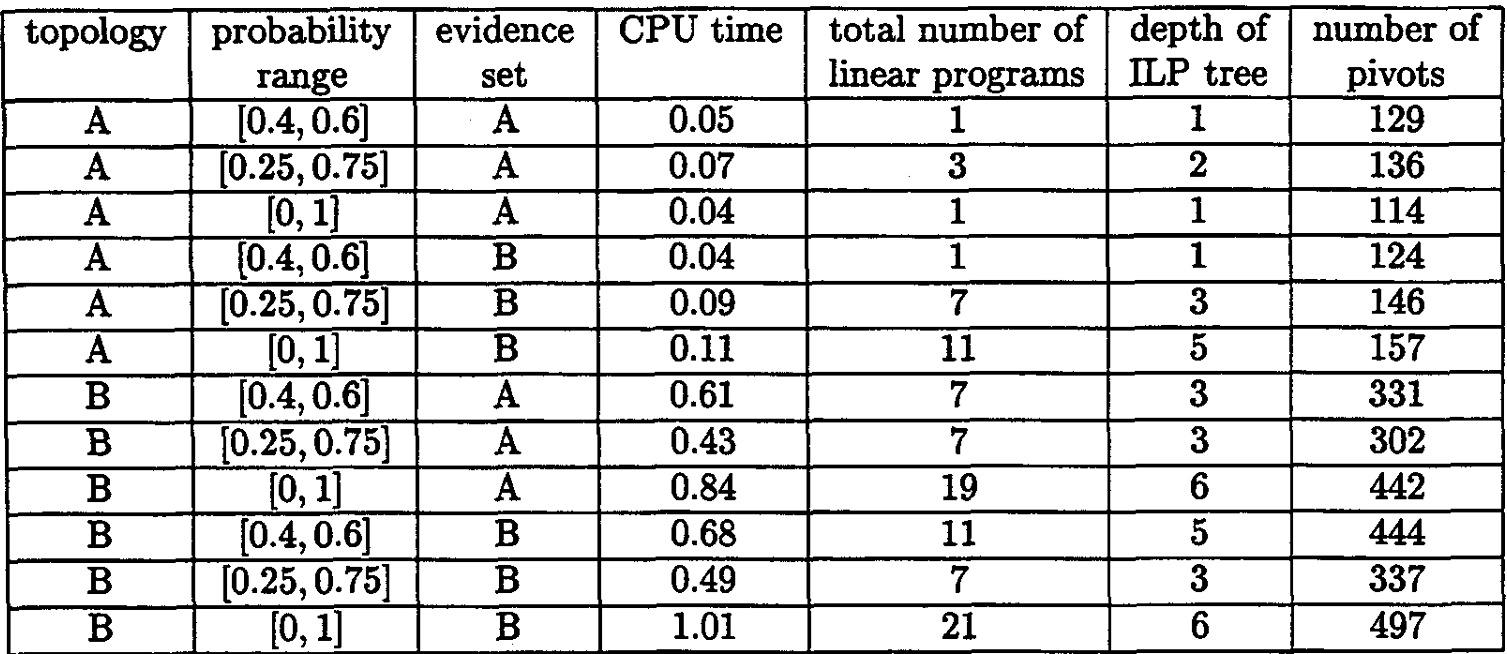 Table: Summary of performance across different probability ranges and evidence sets.
Interestingly, the range of probability values also impacted the solver. Networks with restricted ranges (e.g., ) often yielded integral solutions directly after the first linear programming pass, suggesting that "flatter" probability distributions might be easier for ILP solvers to resolve.
Conclusion and Deep Insight
This paper justifies the use of Constraint Satisfaction as a viable alternative to pure probabilistic inference. By viewing a Bayesian Network through the lens of ILP, researchers gain access to:
- Optimal Guarantees: Unlike Genetic Algorithms, we know when we have the the most probable explanation.
- Pruning Power: The Branch-and-Bound method effectively prunes huge swaths of the search space that heuristics might still explore.
Limitations: While powerful, the number of ILP variables scales with the size of the Conditional Probability Tables, which grows exponentially with the number of parents per node (the "in-degree"). For massive, hyper-connected networks, this approach still faces the "Curse of Dimensionality." However, for many structured AI tasks, this ILP bridge remains a highly efficient path to truth.