
Decoding Satire: How Brazilian Social Media Users React to "Fake" News
Linguistic Analysis Model for Monitoring User Reaction on Satirical News for Brazilian Portuguese
This paper presents a linguistic analysis of user reactions to Brazilian Portuguese satirical news from the "Sensacionalista" Twitter account. It identifies five distinct categories of user intent and utilizes the LIWC dictionary alongside the Unitex tool to characterize the linguistic markers of satire (mis)interpretation.
TL;DR
This study investigates the linguistic patterns of Brazilian Portuguese speakers when interacting with satirical news on Twitter. By categorizing over 1,500 comments, the researchers discovered that while many enjoy the humor, a significant portion uses the platform to voice toxic opinions or completely misses the joke, potentially fueling the accidental spread of misinformation.
Contextual Positioning
In the landscape of "Information Disorder," satire sits in a gray area. It is not "fake news" in the sense of malicious fabrication, but its dependency on irony makes it a potent source of accidental disinformation. This paper acts as a foundational linguistic study, moving beyond content detection to user reaction monitoring.
Problem & Motivation: The Danger of the Unseen Joke
The core issue is world knowledge. Satirical news (like the Brazilian Sensacionalista) relies on the reader sharing a common context with the author. When that link breaks, the satire is "de-ironized" and shared as fact. The authors argue that by analyzing the comments left by users, we can identify linguistic "red flags" that indicate whether a population is successfully decoding humor or falling prey to misinformation.
Methodology: Categorizing Intent
The researchers extracted 36,000 tweets and focused on the "Comments and Replies" subset. They settled on five structural categories for user reactions:
- C1 (General Opinion): Discussing the subject matter generally.
- C2 (Satire Understood): Direct recognition of the joke (e.g., "LOL, so funny").
- C3 (Toxic): Negative/hateful comments directed at people/entities in the news.
- C4 (Positive): Affirmative comments about the subject.
- C5 (Doubtful): Ambiguous comments where it is unclear if the user knows it's a joke.
The Analytical Pipeline
The team used Unitex for corpus processing and a semi-automated algorithm utilizing the LIWC (Linguistic Inquiry and Word Count) dictionary for Portuguese to assign polarity to adjectives.
 Algorithm 1: The logic used to determine if a comment's adjectives were positive, negative, or neutral.
Experiments & Results: What Do the Markers Tell Us?
The results highlight a startling reality of social media: toxicity is rampant even in satire. Category 3 (Toxic) and Category 1 (General Opinion) were heavily marked by negative adjectives.
| Category | Positive % | Negative % | Neutral % |
|---|---|---|---|
| C2 (Satire Understood) | 55.00% | 27.50% | 17.50% |
| C3 (Toxic) | 23.75% | 56.25% | 20.00% |
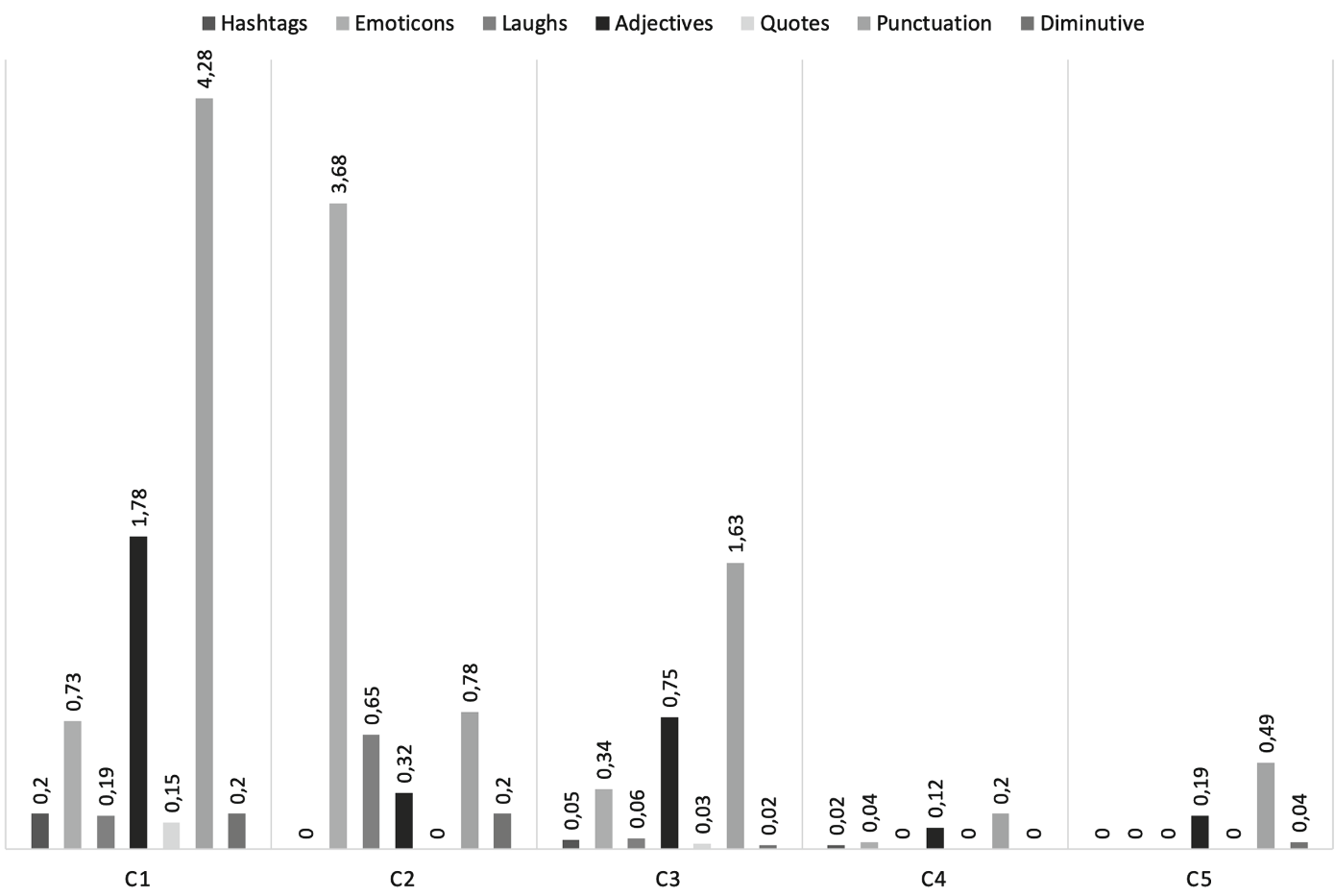
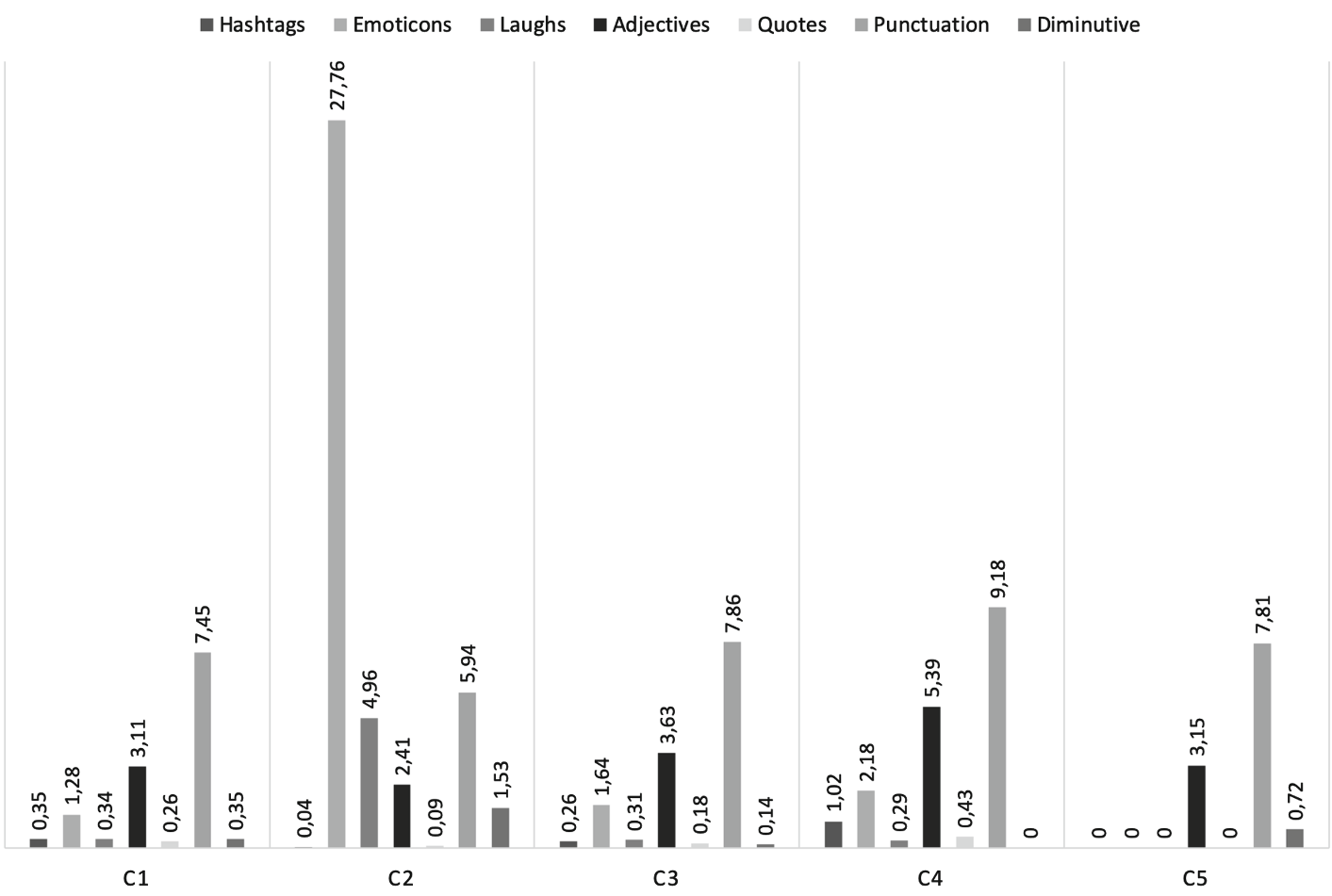 Figure 1: Comparison of linguistic markers (hashtags, laughter, punctuation) across different user reaction categories.
Key Findings:
- Laughter as a Filter: Laughter and emoticons are (unsurprisingly) highest in C2, making it the most "linguistically marked" category for positive interaction.
- The "Doubtful" Void: Category 5 (Doubtful) is the hardest to detect because it lacks high frequencies of specific markers. This "neutrality" is dangerous because it looks like a standard reaction to real news.
- Negativity Dominates: Overall, negative adjectives (43.53%) far outweigh positive ones (26.91%) in satirical discussions.
Critical Analysis & Conclusion
The study concludes that manual analysis of user intent is an "exhausting and time-consuming task" due to the high subjectivity of irony. However, the data confirms that satire often acts as a lightning rod for political venting (C1) and toxicity (C3) rather than just being a source of entertainment.
Limitations: The research is limited to a specific two-month window in 2019 and a single satirical source. Furthermore, the reliance on a dictionary-based approach (LIWC) may miss slang or evolving internet jargon.
Future Outlook: For developers of AI moderators, this research suggests that looking at how people reply—specifically the absence of laughter and the presence of high-polarity negative adjectives—might be the key to flagging when a satirical post is being misinterpreted as a harmful piece of misinformation.