
Beyond Crisp Numbers: Bridging Fuzzy Logic and Natural Language
On Linguistic Approximation in the Frame of Fuzzy Logic Deduction
This paper introduces a specialized linguistic approximation algorithm designed for Fuzzy Logic Deduction (FLD) and its integration into Linguistic Fuzzy Logic Controllers (LFLC). It moves beyond standard defuzzification by assigning natural language expressions to fuzzy sets using a piecewise decomposition approach and similarity relations.
TL;DR
In the world of Fuzzy Logic, we often end up turning rich, nuanced fuzzy sets into boring "crisp" numbers through defuzzification. This paper by A. Dvořák proposes a way back to language. By introducing a sophisticated Linguistic Approximation algorithm, the author demonstrates how to translate complex fuzzy deduction results into human-readable expressions like "roughly medium or big," making fuzzy expert systems significantly more intuitive.
The "Defuzzification" Bottleneck
In standard fuzzy control, we need a single number to act on—for instance, deciding exactly how many volts to send to a motor. However, in Expert Systems or Decision Support, a single number is often a lossy abstraction.
If an AI tells a doctor "The risk is 0.72," it carries less intuitive weight than saying "The risk is very high." The challenge lies in the fact that the output of a mathematical fuzzy deduction doesn't always perfectly match a predefined word. Previous methods often struggled with distorted, noisy, or "subnormal" fuzzy sets that didn't reach a membership degree of 1.
Methodology: The Decomposition Strategy
The core innovation here is the Piecewise Decomposition of the membership function. Instead of trying to match a complex curve to a single word, the algorithm breaks the curve down into segments.
1. Segmentation and Identification
The algorithm identifies "boundary points" where the slope of the membership function changes direction. These segments are then classified:
- Horizontal Segments: Discarded as they bear no semantic info.
- Peaks: Segments containing the global maximum (these are normalized if the peak is lower than 1).
- Sections: The transitional slopes of the fuzzy set.
2. Similarity Matching
The paper employs a rigorous similarity relation to compare these segments against a linguistic scale consisting of atomic terms (small, medium, big) and modifiers (hedges like very, extremely, more or less).
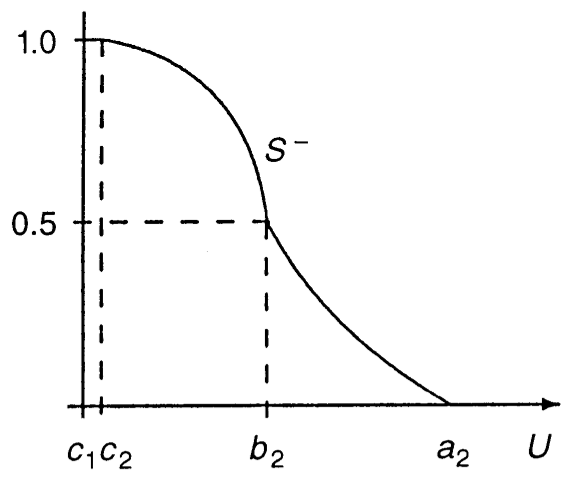 Fig 1: The standard quadratic membership functions for "small," "medium," and "big" used as the baseline for matching.
Mathematical Intuition
The similarity between a calculated fuzzy set and a linguistic term is calculated using a specialized formula:
If multiple terms yield the same similarity score, the algorithm becomes "more sensitive" by increasing the power of the difference function (moving from linear to quadratic or quartic ), effectively zooming in on the nuances of the curve's shape.
Experimental Results
The author demonstrates the algorithm on two complex fuzzy sets. In one example, a multi-modal fuzzy set is successfully decomposed and re-composed using the "OR" connective.
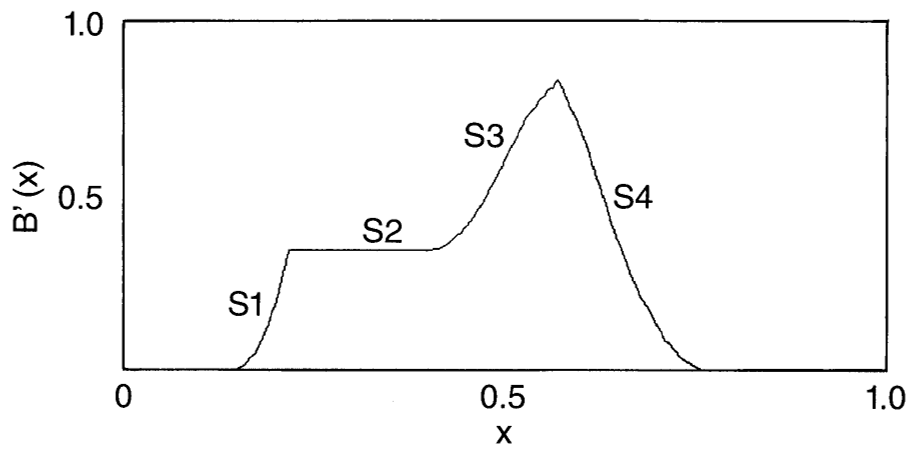 Fig 2: A complex membership function. The algorithm correctly identifies multiple regions to produce the result: "more or less medium OR roughly big."
In the second example, even with "flat-topped" peaks, the algorithm remains robust, yielding expressions that accurately reflect the uncertainty of the data.
Critical Insight & Future Outlook
This work sits at the intersection of Linguistics and Control Theory. While many modern AI researchers focus on deep learning, the "Linguistic Fuzzy Logic" approach offers a level of transparency that neural networks often lack.
Limitations: The method relies on a predefined term set. If the underlying "vocabulary" of the system is too small, the approximation might feel forced or inaccurate.
Future Work: Integrating this with neural networks (as hinted in the references) could allow the "term set" to be learned from data while maintaining the human-readable output that makes fuzzy logic so powerful for expert systems.