
Beyond "Like" or "Dislike": Decoding Consumer Satisfaction through Affective Computing
Linguistic-based emotion analysis and recognition for measuring consumer satisfaction: an application of affective computing
This paper introduces a linguistic-based emotion analysis framework specifically designed for measuring consumer satisfaction in enterprise systems (ES). Utilizing the Ren-CECps Chinese emotion corpus, the authors developed a system capable of recognizing eight basic blended emotions using machine learning, achieving significantly more nuanced feedback than traditional binary sentiment analysis.
TL;DR
In the hyper-competitive world of e-commerce, knowing that a customer is "unhappy" isn't enough. This paper presents a sophisticated linguistic framework that moves beyond binary sentiment analysis to detect eight distinct emotions in Chinese consumer reviews. By leveraging the Ren-CECps corpus and machine learning, the research provides a roadmap for enterprises to gain "rich feedback" and personalize their response strategies based on the specific emotional state of the buyer.
The Problem with the Five-Point Scale
Most businesses measure satisfaction via surveys or the American Customer Satisfaction Index (ACSI). However, these methods are notoriously sluggish. By the time a survey is processed, a frustrated customer has already switched to a competitor. Furthermore, "Sentiment Analysis" typically buckets feedback into Positive/Negative/Neutral. This lack of granularity hides the why—is the customer angry about a delay, or anxious about product quality?
The Core Insight: Linguistic Fingerprints
The authors argue that language is the most direct window into the consumer's mind. They identify several "Linguistic Features" that serve as emotional signals:
- Emotion Words: The primary carriers of affect.
- Negation Words: Critical for flipping sentiment (e.g., "not happy").
- Degree Words: Modifiers that scale intensity (e.g., "extremely" vs. "slightly").
- Punctuation & Face Marks: Visual cues like "!" or "?" that signify emotional peaks.
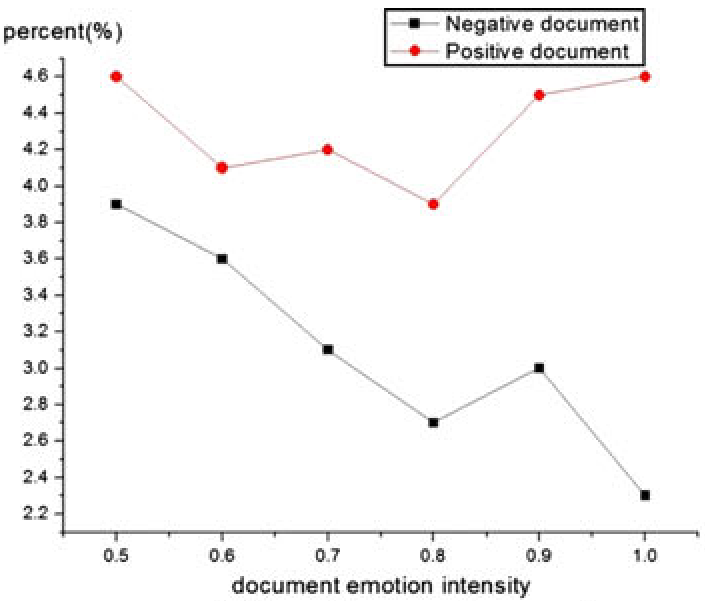 Analysis shows that positive/negative words and punctuation are the most reliable discriminators for attitude polarity.
Methodology: The Power of Blended Emotions
The paper utilizes Ren-CECps, a fine-grained corpus where emotions are represented as vectors:
This allows the system to recognize Blended Emotions—the reality that a customer can feel both "joy" and "surprise" or "sorrow" and "anxiety" simultaneously.
The Recognition Pipeline
- Pre-processing: Detecting emotion words using a MaxEnt model.
- Feature Extraction: Combining word emotions with Negation Word Features (NWF) and Conjunction Features (CF).
- Classification: Comparing Multinomial Naive Bayes, Voting Feature Intervals, and RandomForest.
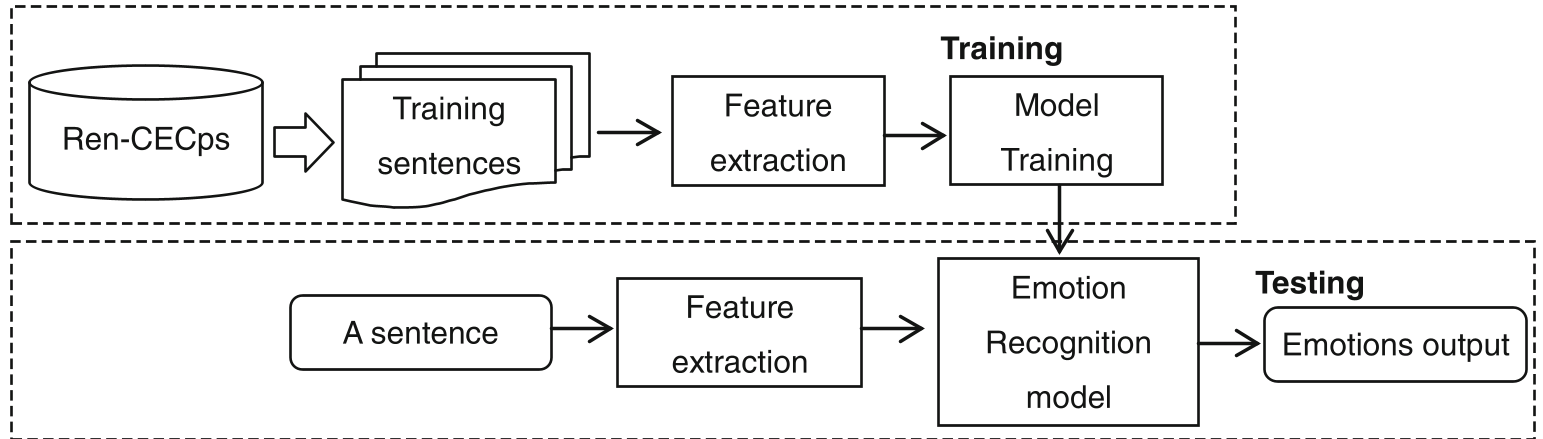 The architecture focuses on how word-level emotions propagate to the sentence level through linguistic rules.
Experimental Results: Why Naive Bayes Still Wins
While complex models are popular, the authors found that Multinomial Naive Bayes achieved the best performance for this specific linguistic task, reaching an F-value of 90.2.
| Feature Set | Detection F-value | Recognition F-value |
|---|---|---|
| Word Emotion (WEF) | 90.2 | 77.3 |
| WEF + Negation + Conjunction | 91.8 | 77.9 |
The study reveals a crucial finding: Word emotions play a dominant role. While degree words and punctuation help, they can occasionally introduce noise, whereas negation and conjunctions are essential for correctly interpreting the logic of an emotional sentence.
Strategic Implications for CRM
The relationship between negative emotions is particularly telling. The authors noted that Anger and Hate are often precursors to Sorrow and Anxiety. For a Customer Relationship Management (CRM) system, identifying "High Intensity Anger" early allows for immediate intervention (like a discount or a phone call) before the customer completely disengages.
Critical Analysis & Future Outlook
While this work is a milestone for Chinese linguistic affective computing, it was published in 2012. Since then, Large Language Models (LLMs) have superseded Naive Bayes in context understanding.
Limitations: The reliance on manual lexicons for degree words and negate words is heavy. Modern approaches might use self-attention to capture these relationships more dynamically.
Legacy: This paper's true value lies in its fine-grained vector representation of emotion. It shifts the industry focus from "how much do they like us?" to "how are they feeling during the interaction?"—a question that remains central to the future of AI-driven customer experience.