
Linguistic Fingerprints: Decoding Gender and Race through Twitter Discourse
Linguistic Diversities of Demographic Groups in Twitter
This study presents a large-scale characterization of linguistic styles and interests across gender (male/female) and race (Asian/Black/White) on Twitter. Using the Face++ deep learning framework to infer demographics from 1.6 million U.S. users, the authors employ the LIWC lexicon to identify distinct psycholinguistic patterns and topical preferences.
TL;DR
By analyzing 1.6 million U.S. Twitter users through deep learning-based image recognition and psycholinguistic text analysis, this study reveals that our digital "voice" is heavily influenced by our demographic background. From the frequency of "anxiety" words to a preference for "technology" versus "lifestyle" topics, the research provides a data-driven roadmap of how gender and race shape online expression.
Background & Motivation
While Twitter is a goldmine for social research, it is notoriously "demographically blind"—users rarely list their race or gender in their bios. Past research has tried to bridge this gap using name-matching, but this paper takes a more physiological approach: using profile pictures as a proxy for identity via the Face++ recognition platform. The goal is to move beyond "what" people are saying to "why" and "how" different groups utilize language to express cognition, affect, and social concerns.
Methodology: The Face-to-Text Pipeline
The researchers built a robust pipeline to transform raw tweets into demographic insights:
- Filtering: Identified 6 million active U.S. users via timezone and location data.
- Visual Inference: Used Face++ to detect gender and race (categorized as Asian, Black, and White).
- Linguistic Extraction: Applied LIWC (Linguistic Inquiry and Word Count) to categorize tweets into six dimensions: Affective, Cognitive, Lexical Density, Temporal References, Social/Personal Concerns, and Interpersonal Focus.
- Interest Mapping: Analyzed the "following" lists of users to extract 20 top-tier interests.
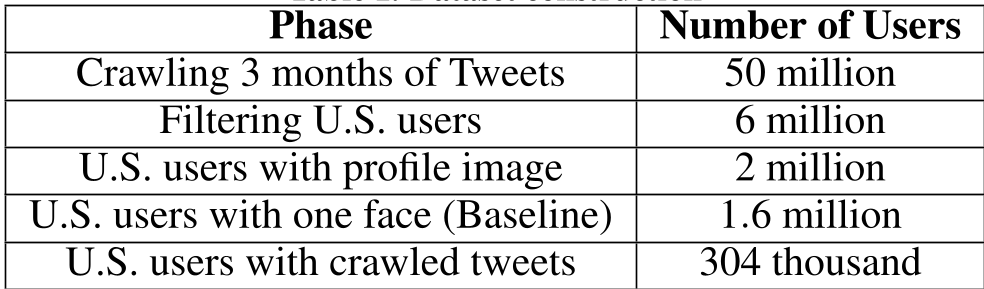 Table 1: The data refinement process from 50 million initial users to the final linguistic baseline.
Key Findings: The Language of Groups
The study’s most striking results lie in the Wilcoxon rank-sum tests, which highlight extreme statistical significance (z-scores) in linguistic choices:
1. The Gender Gap in Emotion
- Females: Show a significantly higher tendency to use words related to anxiety, sadness, and feelings. They also utilize first-person singular ("I") much more frequently.
- Males: Tend to use more anger-related terms and focus on achievement. In terms of grammar, men use more articles (a, an, the) and prepositions, indicating a more "object-oriented" or informational style of writing.
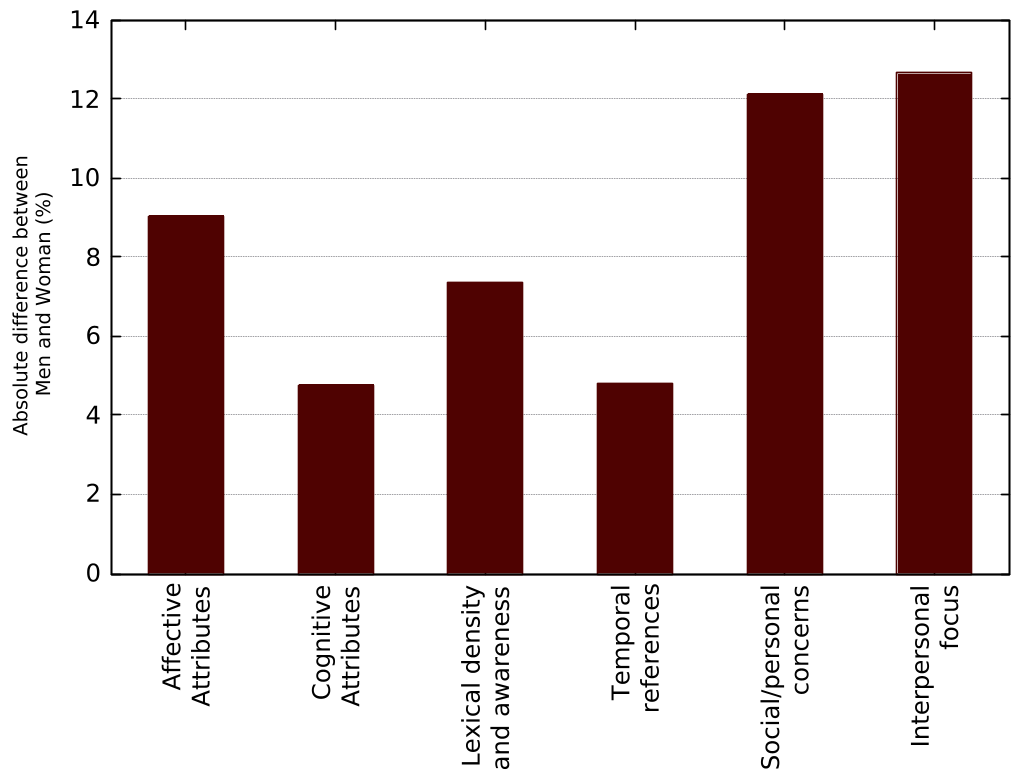 Figure 1: Mean absolute differences between male and female users show high variance in interpersonal focus and affective attributes.
2. Racial Nuances in Expression
- Black Users: Exhibit the highest frequency of affective attributes, including anger and swear words, compared to White and Asian groups. They also lead in social-personal concerns like "family," "religion," and "social" interactions.
- White Users: Show a unique preference for first-person plural ("we"), suggesting a different collective or group-based writing focus.
- Asian Users: Present differences in lexical density and temporal references, indicating cultural specificities in how time and auxiliary verbs are structured in their tweets.
3. Divergent Interests
The study proves that "we are who we follow."
- Males dominate topics like Sports, Organizations, and Technology.
- Females show a marked preference for Life, Actors, and Movies.
- Racial Interests: White users are significantly more engaged in Politics than Asians or Blacks, whereas Black users show a stronger engagement with Music and Artists.
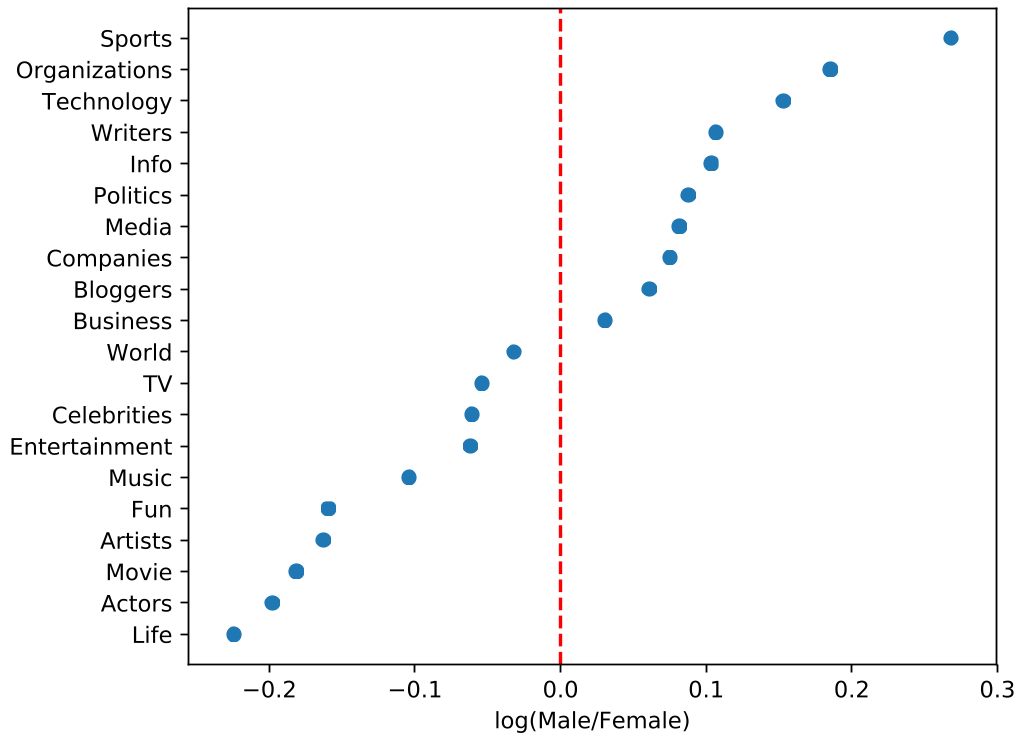 Figure 5: Log-ratio of male to female interest across top topics.
Critical Insight & Conclusion
This work highlights that "Standard English" on social media is a myth; instead, there are several "Demographic Englishes."
Takeaways for the Industry:
- Ad-Tech: Targeting should move beyond simple keywords to recognize the style of a demographic group.
- Sociology: This provides a scalable methodology for tracking social shifts without relying on self-reported surveys.
Limitations: The study relies on Face++, which has a reported confidence of ~86% for race—leaving room for misclassification. Furthermore, the binary gender classification and limited racial categories (Asian/Black/White) do not capture the full spectrum of human identity. Future work should look at the speed of information propagation within these specific clusters to see how demographics influence virality.