
Decoding the Silence: Using Topic Modeling to Predict Suicide Risk on Microblogs
Using Linguistic Features to Estimate Suicide Probability of Chinese Microblog Users
This study presents a machine learning framework to estimate suicide probability among Sina Weibo users by analyzing linguistic features. Leveraging a dataset of 697 users, the authors compare the Chinese Linguistic Inquiry and Word Count (LIWC) lexicon with Latent Dirichlet Allocation (LDA) topic modeling, achieving a State-of-the-Art RMSE of 11.68 in predicting Suicide Probability Scale (SPS) scores.
TL;DR
Researchers have developed a method to proactively identify at-risk individuals on Sina Weibo by analyzing their linguistic patterns. By moving beyond simple keyword counting (LIWC) to advanced topic modeling (LDA), they achieved a significant improvement in predicting suicide probability scores, suggesting that what people talk about in context is more telling than the specific words they use.
Context: The Shift to Proactive Mental Health
Suicide prevention has historically been reactive—waiting for a person to call a hotline or visit a clinic. However, the "digital footprint" left on platforms like Sina Weibo offers a window into the subconscious. This study treats social media not just as a communication tool, but as a continuous, real-time psychological assessment.
The Problem: The Poverty of Keywords
Traditional psychological linguistics relies on tools like LIWC (Linguistic Inquiry and Word Count). While useful, LIWC is a "closed-vocabulary" approach; it only knows what is in its pre-defined dictionary. If a user expresses despair through metaphors or niche topics not in the lexicon, LIWC fails. Furthermore, suicidal ideation is a "rare event" in general data, making it hard for standard models to find the signal in the noise.
Methodology: Beyond Frequency to Semantics
The researchers compared two distinct paths for feature extraction:
- LIWC (Simplified Chinese Version): Categorizing words into 88 psychological dimensions.
- LDA (Latent Dirichlet Allocation): An unsupervised method that groups words into "topics" based on co-occurrence.
The "Inferred Topics" Insight
A critical contribution of this paper is the Training vs. Inference strategy. Recognizing that suicidal ideation is rare, the authors pre-trained an LDA model specifically on a "High-Risk Corpus" (users with high SPS scores + confirmed suicide cases). They then used this specialized model to "infer" topics in the broader participant pool. This essentially "tuned" the model's ears to hear the specific frequencies of distress.
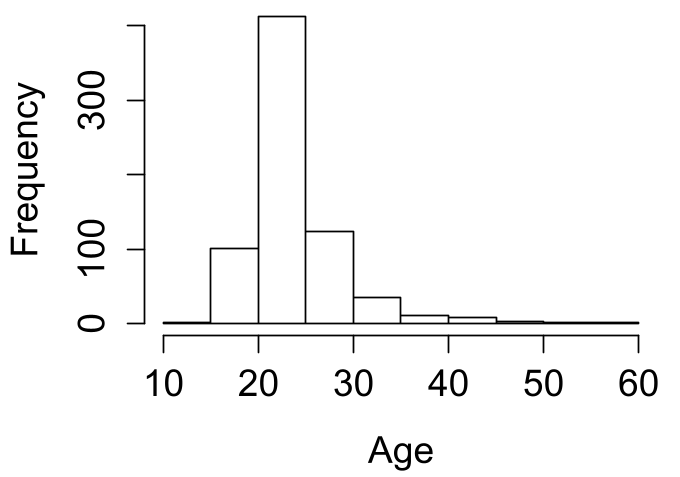 Fig 1: The study utilized a diverse age and gender distribution to ensure the model's broad applicability.
Experiments and Results: Topic Superiority
The results were conclusive: Topics outshine Lexicons.
- LIWC Baseline: Achieved an RMSE of 15.43.
- LDA (Trained): Improved RMSE to 11.68 (at 70 topics).
- LDA (Inferred): Provided the most stable results, especially when the number of topics became large, proving that pre-training on high-risk data prevents the model from getting lost in irrelevant "noise" topics.
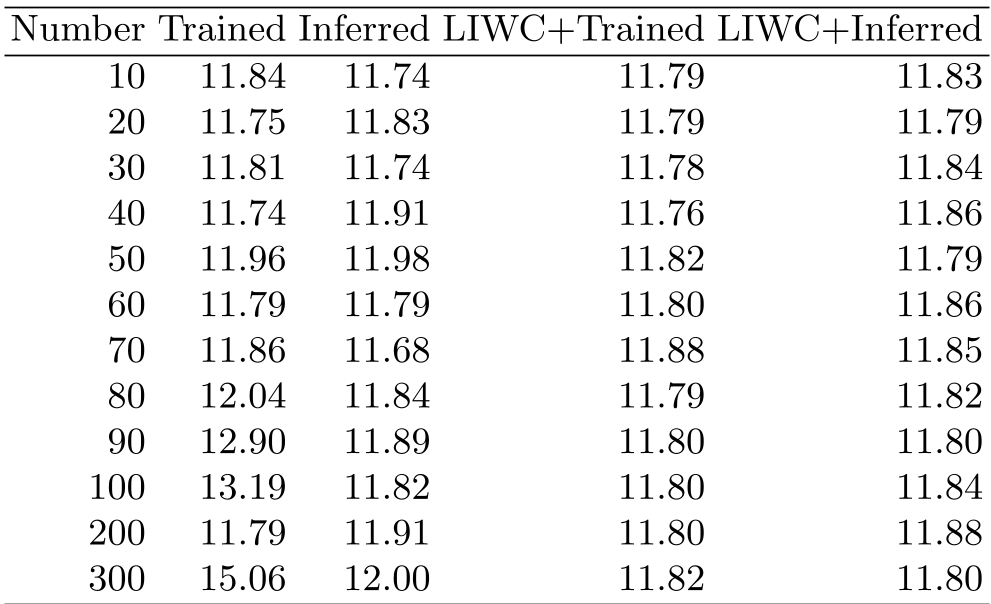 Table 2: Comparison of RMSE across different feature sets. Note how "Inferred" topics maintain low error rates even with high topic counts.
One striking finding from the correlation analysis was that "Inhibition" words (e.g., block, constrain, stop) and "Cognitive Processes" (e.g., cause, know) were the strongest LIWC predictors, reflecting the psychological state of feeling trapped or over-analyzing one's situation.
Critical Insight: The "Small Grain" Trap
The study found that when the number of topics (granularity) exceeds 70 in standard models, the error rate spikes. This suggests that as we look too closely at the data, we lose the "big picture" of the user's mental state. However, the specialized "Inferred" model resisted this degradation, highlighting the importance of domain-specific pre-training in sensitive NLP tasks.
Conclusion & Future Outlook
This work validates that suicide probability is not just a clinical metric but a detectable linguistic pattern.
- Takeaway: For high-stakes social sensing, unsupervised topic models provide deeper context than static dictionaries.
- Limitation: While the RMSE of 11 is a breakthrough, it is not yet a replacement for clinical diagnosis.
- Future Work: The next frontier lies in Active Intervention—not just detecting the risk, but determining the optimal, ethical way to reach out to a user in real-time.
Moving forward, we expect to see these LDA-based features replaced by Large Language Models (LLMs), yet the "Inferred" strategy (specialized pre-training) remains a gold standard for detecting rare, high-consequence signals.