
Decoding Disinformation: A Linguistic and Neural Approach to Fake News Detection
An Approach Utilizing Linguistic Features for Fake News Detection
The paper proposes a style-based Machine Learning approach for fake news detection, utilizing manually extracted linguistic features and Named Entity Recognition (NER). It evaluates several classifiers on the TrueFact KDD 2020 dataset, ultimately achieving a peak accuracy of 79.2% using a Convolutional Neural Network (CNN).
TL;DR
This research tackles the "infodemic" by analyzing the DNA of fake news. By combining traditional linguistic features (like POS tagging) with deep learning (CNNs), the authors achieved a 79.2% accuracy in distinguishing fake from real stories. A key finding: while fake news successfully mimics the "entities" of real news (names, dates, places), it leaves subtle psychological footprints in its grammar and verb usage.
Problem & Motivation: The Sophistication of Deception
In the era of rapid information propagation, manual fact-checking is too slow. The authors note that fake news often targets the "peripheral route" of persuasion—focusing on sensational titles and emotional triggers rather than logical arguments.
The primary challenge is that deceptive writers have become experts at mimicking journalistic styles. The authors ask: Can we find a "stylometric fingerprint" that persists even when the content appears legitimate?
Methodology: Bridging Linguistics and AI
The study employs a three-pronged approach to dissect the news:
- Linguistic Feature Engineering: The authors extracted 84 features encompassing lexical, syntactic, and psycholinguistic signals. Using Gini Impurity, they narrowed this down to the 23 most "telling" features.
- Vector Representations: They compared various word embeddings (Google News Word2vec vs. spacy's GloVe) and used PCA (Principal Component Analysis) to reduce noise, finding that 180-dimensional vectors provided the best balance for SVM classifiers.
- Neural Architecture: Moving beyond traditional ML (like Random Forest and SVM), they designed a shallow CNN and LSTM to capture local and sequential dependencies in the text.
 Fig 1: The inherent difficulty of disinformation—Fake news often spreads faster due to hyperpartisan and emotional framing.
Experiments & Results: What the Machines Learned
The results confirm a trend in NLP: Artificial Neural Networks (ANNs) dominate.
- CNN Performance: Reached 79.2% accuracy with a combination of ReLU/Sigmoid activations and the Adam optimizer.
- The "Linguistic Clues":
- Modal Verbs: Fake news uses more words like "could," "might," or "would," reflecting the author's underlying uncertainty about the lies they are telling.
- Pronouns: Real news features higher levels of "First Person Singular" (direct reporting), while fake news leans on "Third Person" to distance the author from the claims.
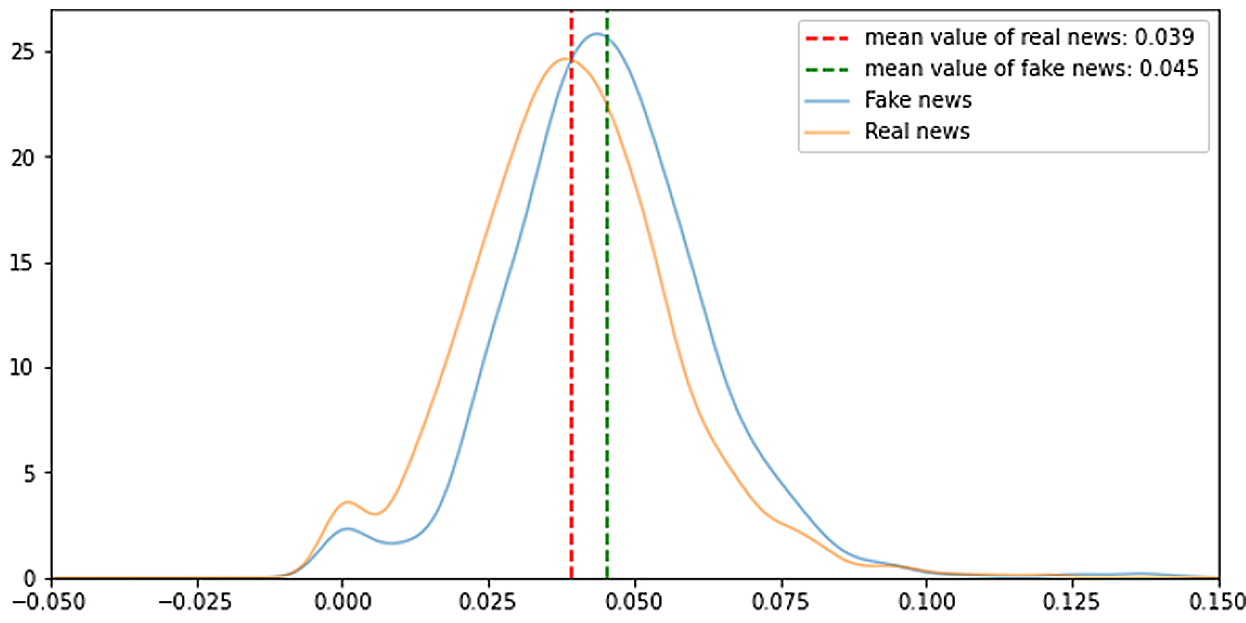 Fig 2: Probability distribution of modal verbs—note the significant overlap, highlighting why simple rule-based detection fails.
The Entity Overlap
Perhaps the most intriguing result came from Association Rule (AR) Mining using the FP-Growth algorithm. The authors found that real and fake news use almost the exact same types of Named Entities (Person, Date, Org, GPE). This confirms that fake news is "environmentally" accurate—it talks about the same people and places as real news, making it harder to catch using "Topic" analysis alone.
Critical Analysis & Conclusion
Takeaway
The study proves that while content is easily faked, style is a harder trait to mask. The combination of deep learning for pattern recognition and linguistic features for explainability offers a robust path forward for social media platforms.
Limitations & Future Work
- Static Nature: The "psychological" cues used here were originally derived from real-time speech studies (Undeutsch hypothesis); their transferability to carefully edited text remains a point of debate.
- Dataset Specificity: The authors noted that "Work of Art" entities were unique to real news in their specific dataset, which might not hold true globally.
- Next Steps: The authors suggest moving toward Deep ANNs and testing these style-based methods across diverse, multi-domain datasets to ensure the models aren't just memorizing the "flavor" of one specific news cycle.
By focusing on the how (style) rather than just the what (content), this research provides a vital layer of defense against the digital disinformation age.