
Deciphering Deception: Key Linguistic Signatures of Fake Online Reviews
Linguistic Features for Detecting Fake Reviews
This paper introduces a specialized dataset, "Restaurant Dataset," and evaluates 15 linguistic features for detecting fake reviews using various machine learning classifiers. The study identifies that a compact set of features—specifically Adjective Count, Redundancy, and Pausality—can effectively distinguish deceptive content with high precision, achieving a peak accuracy of 79.09% using a Multilayer Perceptron (MLP).
TL;DR
Detection of fake reviews is often a cat-and-mouse game between spammers and platforms. This paper demonstrates that we don't need massive models to catch liars; instead, by focusing on just four core linguistic features—Adjectives, Redundancy, Pausality, and Lexical Diversity—we can identify fake reviews with nearly 80% accuracy. The research highlights that deceptive writing tends to be more redundant and structurally "paused" than authentic feedback.
Problem & Motivation: Why is Catching Liars So Hard?
Online reviews are the lifeblood of modern commerce, but they are easily manipulated. Previous research has shown that humans are essentially flipping a coin when trying to spot a fake review. While automated systems exist, they often rely on:
- N-gram Analysis: Which is vocabulary-dependent and easily defeated by clever synonyms.
- Metadata: Such as IP tracking, which can be masked by VPNs.
The authors' insight was to pivot back to Forensic Linguistics. In a courtroom, experts look at how someone speaks (sentence structure, hesitation, expressiveness) rather than just what they say. This paper applies that logic to the "Restaurant Dataset," exploring whether these same subconscious patterns appear when a student or a spammer sits down to write a fake 5-star review.
Methodology: Finding the "Signal" in the Noise
The researchers didn't just throw features at a wall; they used a rigorous statistical pipeline to find the most discriminative cues.
The Feature Selection Pipeline
They analyzed 15 features across categories like Quantity, Complexity, and Diversity. To identify which ones actually mattered, they employed:
- Recursive Feature Elimination (RFE): Systematically removing the least useful features.
- Boruta Algorithm: A "shadow feature" technique that compares the importance of real variables against random permutations.
- Overlapping Coefficients (OVL): Using Kernel Density Estimation to visualize how much a feature's distribution differs between "Real" and "Fake" categories.
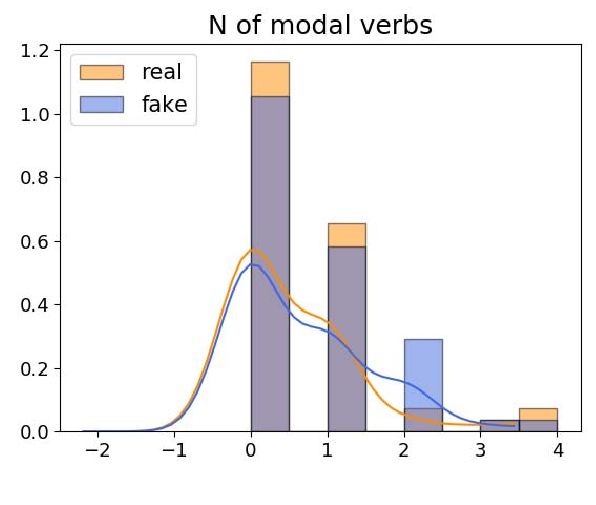 Above: Histograms showing the overlap of features. Notice how features like Pausality have distinct peaks, making them excellent discriminators.
Experiments & Results: Efficiency Over Complexity
The team tested seven classifiers, including SVM, Random Forest, and Multilayer Perceptrons (MLP).
Key Findings:
- MLP Wins: The Multilayer Perceptron achieved 79.09% accuracy.
- The "Core Four": The highest performance wasn't achieved by using all 15 features, but by using a subset of only four: Adjectives, Pausality (use of punctuation/pauses), Redundancy (percentage of function words), and Lexical Diversity.
- Superiority over Doc2Vec: Interestingly, these simple linguistic cues outperformed complex word embeddings like Doc2Vec, which only managed ~68% accuracy.
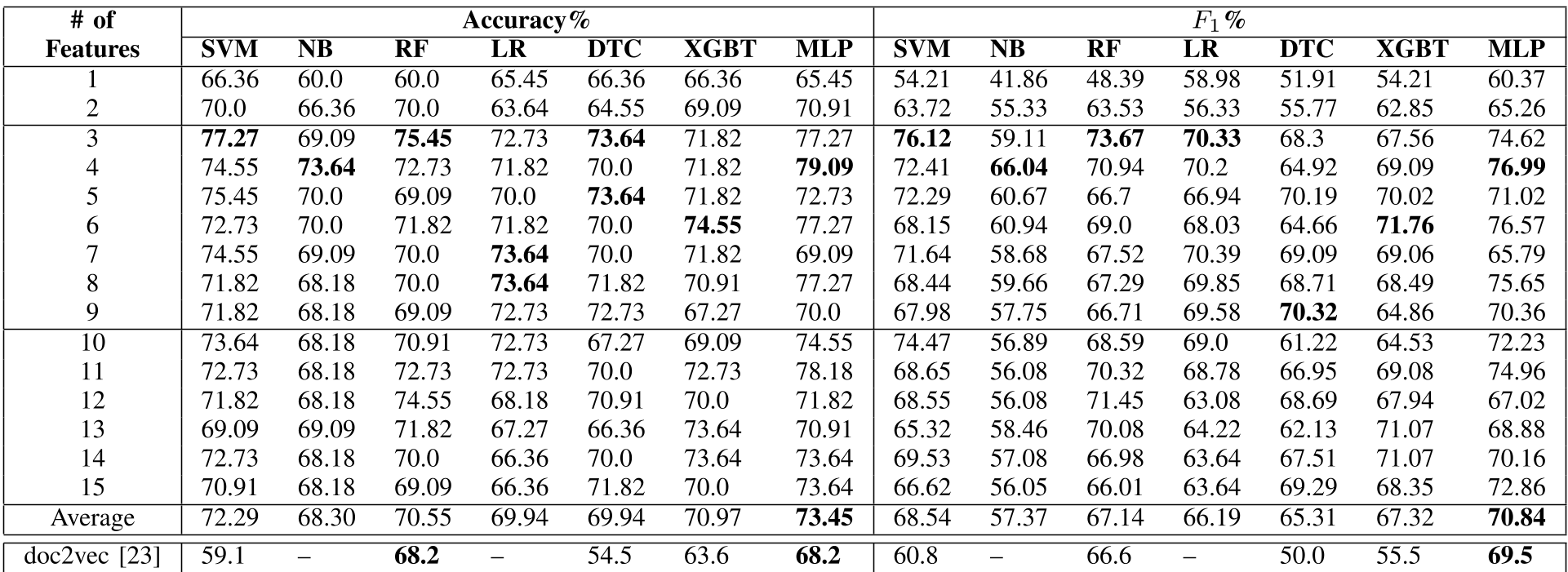 The table demonstrates that the sweet spot for accuracy is reached remarkably quickly, often with just 3 or 4 features.
Critical Insight: The "Anatomy" of a Fake Review
Why do these specific features work?
- Redundancy: Liars often over-explain. They use more function words and repetitive structures to make their story seem "fuller."
- Adjectives: Fake reviews tend to be more descriptive—over-compensating for a lack of a real experience by using "flowery" language.
- Pausality: Deceptive writers often have different rhythmic patterns in their writing, potentially reflecting the cognitive load of "building" a lie versus "recalling" a memory.
Conclusion & Future Outlook
This study proves that linguistically-driven models are not only viable but highly efficient. By reducing the feature set from dozens to just four, we can build detection systems that are lightweight enough to run in real-time on edge devices or within browser extensions.
Future Work: The authors suggest applying these "deception signatures" to other cybersecurity threats, such as Phishing attacks and Social Engineering, where the goal is similarly to distinguish between a trusted source and a malicious actor through text alone.